Personal Statement No Work Experience: What to Write
By Michael Thompson · Education Specialist; 10 years teaching the IB at Bromsgrove School · Published 4 September 2026
Writing a personal statement with no work experience feels like a problem - but for most university courses, it isn't one. The UCAS personal statement now asks three separate questions, and only one of them is about what you've done outside the classroom. Admissions tutors are far more interested in whether you can reflect on your experiences than in whether those experiences look impressive on paper. This guide explains what counts as evidence, what to do if you're applying to courses that do expect experience, and how to build something worth writing about if you're starting from scratch.
Key Takeaways
- Work experience is not compulsory: For the majority of university courses, UCAS Question 3 accepts a wide range of evidence - volunteering, hobbies, online courses, competitions, and personal responsibilities all qualify.
- Reflection beats a list: A strong answer names one activity, explains what it taught you, and links that quality to the course - rather than listing five activities with no analysis.
- Transferable skills from any job count: Per UCAS guidance on marketing and computer science statements, most job or work experience, even in an unrelated industry, provides transferable skills relevant to an application.
- Some courses do expect experience: Medicine, nursing, veterinary science, and teaching genuinely expect evidence of people-facing or clinical exposure - virtual experience programmes are an accepted alternative.
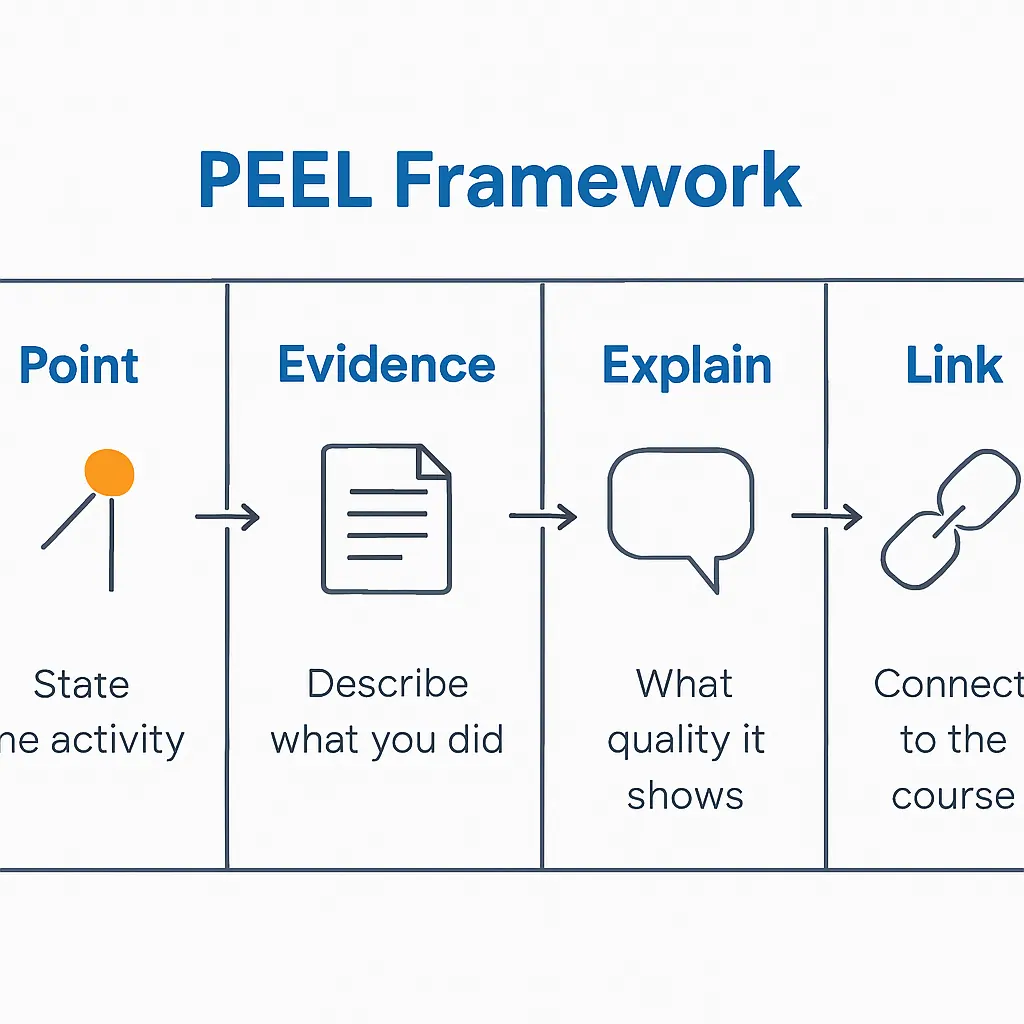
- The PEEL framework helps structure each answer: UCAS recommends Point, Evidence, Explain, Link as a method for turning extracurricular activities into coherent evidence of a quality.
- Four weeks is enough time to gain something: Online tasters, subject reading, and virtual work experience can all be completed quickly and legitimately referenced in your statement.
In This Article
- What admissions tutors are actually asking
- What counts instead of work experience
- Skills for your personal statement: how to describe what you did
- Weak vs strong: two worked examples for personal statement Q3
- Courses where experience is expected - and what to do if you have none
- What to do if you have nothing to write about yet: a four-week plan
- What to do next
1. What admissions tutors are actually asking
If you're worried about writing a personal statement no work experience on your record, the first thing to understand is that the UCAS form isn't asking you to prove you've had a job. It's asking three distinct questions, and only one of them touches on what you've done outside education.
UCAS structures the personal statement around exactly these three prompts:
- Q1: Why do you want to study this course or subject?
- Q2: How have your qualifications and studies helped you to prepare for this course or subject?
- Q3: What else have you done to prepare outside of education, and why are these experiences useful?
Work experience sits in Q3 only, and even there it is one option among many. UCAS explicitly lists sports, community work, summer schools, club leadership roles, music competitions, caring responsibilities, and virtual work experience through platforms such as Springpod as valid alternatives. Paid employment is not mentioned as a requirement.
The counter-intuitive detail many applicants miss: Q2 discourages you from repeating your grades, because universities already see those elsewhere on the application. That means Q2 is about how you studied, not what you scored. An EPQ, a UKMT competition, or a tutoring role you took on all belong there.
Universities do not require proof of paid work for most courses. The question is what you have done and what it shows about you.
2. What counts instead of work experience
The counterintuitive truth here: UCAS defines evidence using the Collins Dictionary standard, which includes "anything you see, experience, read, or are told that makes you believe something is true." That is a deliberately broad net, and it means the personal statement no work experience problem is largely a framing problem, not an evidence gap.
UCAS recognises the following as valid alternatives to formal work experience:
- Super-curricular reading and media - textbooks beyond the syllabus, academic journals, or industry podcasts. UCAS explicitly names pop-culture entry points as legitimate: a TED talk by a marketing expert such as Rory Sutherland, or a documentary that prompted further reading, can open a discussion of genuine subject interest.
- Online courses and tasters - platforms such as Springpod offer Subject Spotlights and virtual work experience, both named by UCAS as accepted alternatives to in-person placements.
- Competitions - UKMT maths challenges, coding hackathons, STEM fairs, arts competitions, and sustainability days are all cited by UCAS as evidence of subject engagement.
- Volunteering and community work - counts directly under UCAS Question 3.
- Summer schools and club leadership - listed alongside sports and music competitions as extracurricular evidence.
- Part-time jobs in any sector - UCAS states clearly that most work experience, even in a different industry, provides transferable skills relevant to an application. A Saturday shift in a cafe demonstrates time management and communication; the industry is beside the point.
- Personal responsibilities - caring for a family member is explicitly accepted by UCAS as evidence of qualities such as resilience and empathy.
The critical step is framing. Listing activities as a task inventory wastes word count. UCAS recommends the PEEL framework: state your Point (the quality or skill), give the Evidence (the specific activity), Explain what you learned or did, then Link it back to why it prepares you for the course. A hackathon becomes evidence of working under pressure and iterating on feedback, not just "I did a coding competition." That shift is what separates a strong response to UCAS Question 3 from a weak one.
3. Skills for your personal statement: how to describe what you did
The most common mistake in Question 3 is listing activities without explaining what they show. "I play football for a local team" tells a tutor nothing useful. "Playing for a local team required me to adapt my role mid-season when we lost our striker, which taught me how to problem-solve under pressure" gives them something to assess.
That shift from naming to analysing is exactly what UCAS source material signals tutors are looking for. The skills that come through extracurricular activities carry the same evidential weight as a formal placement, provided you reflect on them properly.
The transferable skills UCAS names explicitly as appropriate for this section include:
- Resilience and empathy (from personal responsibilities such as caring for a family member)
- Problem-solving, client service, and quality control (from part-time or casual jobs)
- Leadership and teamwork (from sport, drama clubs, or local club leadership roles)
Achieving a high grade in a musical instrument or performing in drama productions are both listed by UCAS as valid evidence of these skills.
The non-obvious point: the University of Bath explicitly states that a position of responsibility at school is an acceptable substitute for direct work experience, but only when accompanied by reflection. The position alone is not enough. What you did with it is.
For each activity you include, apply a simple test: can you name the skill, describe the moment it was required, and explain why that skill is relevant to the course? If you can answer all three, the activity belongs in your statement.
4. Weak vs strong: two worked examples for personal statement Q3
The difference between a weak and a strong personal statement is rarely about what the student has done. It is about whether they argue from their experience or simply list it.
Weak example (illustrative example written for this guide, not real applicant work)
> "I play football for my local team, I volunteer at a charity shop on Saturdays, and I recently completed an online course in psychology. I enjoy working with people and I think this course will suit me."
This is cataloguing. The reader learns that three things happened. They learn nothing about how the student thinks, what they noticed, or why any of it points toward the subject they are applying for.
Strong example (illustrative example written for this guide, not real applicant work)
> "Sorting donated books at my local charity shop, I noticed that older customers often lingered far longer than the transaction required. That pattern made me curious about social isolation in later life, which led me to read about attachment theory and its application beyond childhood. Managing the shop's small book section also meant persuading the team to reorganise stock around what browsers actually picked up, not what we assumed they wanted. That negotiation taught me the gap between intuition and evidence, which feels central to studying psychology."
This version covers a single activity, names what the student observed, connects the observation to a specific academic idea, and draws a transferable skill, the ability to test assumptions, directly from it.
The structural difference
UCAS recommends the PEEL framework (Point, Evidence, Explain, Link) precisely because the weak pattern is so common. The strong example follows it without naming it: the observation is the point, the behavioural detail is the evidence, the curiosity it triggered is the explanation, and the link to psychology closes the argument.
One counter-intuitive consequence: covering fewer activities in more depth almost always scores higher than covering more activities shallowly. A student writing a personal statement with no work experience who spends 80 words on one charity shop shift will outperform one who lists four experiences in the same space.
5. Courses where experience is expected - and what to do if you have none
Some courses genuinely do expect evidence of people-facing or clinical exposure before you apply. Medicine, nursing, veterinary science, and teaching are the clearest examples. Admissions tutors on these courses want to see that you understand what the work actually involves, not just that you find the subject interesting.
The counter-intuitive point: the bar is lower than most applicants assume. Formal placements are one route, but they are not the only acceptable evidence.
If structured placements were not available to you, the following all count:
- Virtual experience programmes. UCAS names Springpod as an accepted alternative to in-person work experience under Question 3 of the personal statement.
- Caring responsibilities. If you have supported a family member through illness or disability, UCAS explicitly recognises this as valid evidence of qualities like resilience and empathy.
- Any people-facing role. Retail work, sports coaching, tutoring, or a community volunteering role all demonstrate the interpersonal skills these courses assess.
Be honest about what you have not done. If you have not completed a hospital or school placement, say so briefly, then pivot immediately to what you did instead and what it taught you. Admissions tutors reading a social work personal statement with no formal placement will not disqualify you for the gap. They will disqualify you for leaving the gap unexplained.
One sentence of acknowledgement, followed by two sentences of substance, is enough.
6. What to do if you have nothing to write about yet: a four-week plan
If your personal statement deadline is weeks away and your activity list feels thin, four focused weeks can give you genuine material rather than padding. The goal is not to manufacture impressiveness but to engage honestly with your subject so your reflection is real.
| Week | Action | What it gives you |
|---|---|---|
| 1 | Identify one subject-relevant book, podcast, or article and read or listen to it | A specific text you can name and respond to |
| 2 | Sign up for a free online taster or Subject Spotlight via UCAS | Structured subject engagement admissions tutors recognise as valid |
| 3 | Contact a local volunteering group, club, or community organisation and attend once | Real-world context for your interest |
| 4 | Write a short reflection on all three, using the PEEL framework (Point, Evidence, Explain, Link) | A structured draft ready to drop into Q3 |
One well-reflected experience is stronger than five listed without analysis. Admissions tutors can tell when a student has thought carefully about a single podcast episode versus someone who has name-dropped ten activities they barely remember.
A counter-intuitive point worth knowing: mature students often undervalue their daily circumstances. UCAS explicitly identifies juggling family, childcare, or part-time work as valid material for Q3. Managing competing responsibilities over months or years demonstrates exactly the self-organisation and commitment that university demands.
7. What to do next
Open the UCAS personal statement toolkit this week and read Question 3 in full. It asks what you have done to prepare outside of education, and it explicitly accepts activities as small as attending a local club or taking on a caring responsibility at home. That scope is wider than most applicants realise.
Then write one PEEL paragraph about a single thing you have already done, even if that thing is reading one article about your subject. Point, Evidence, Explanation, Link. Four sentences. That paragraph is a draft. No paragraph written means the statement does not exist yet, and a blank document cannot be improved.
Start the paragraph today. Revise it tomorrow.
FAQ
Is work experience compulsory for a university personal statement?
No - UCAS Question 3 accepts a wide range of alternatives including volunteering, online courses, competitions, hobbies, and personal responsibilities, so formal work experience is not required for most courses.
What do I write if I have no work experience at all?
Focus on what you have done: subject-relevant reading, extracurricular activities, competitions, or personal responsibilities - then use the PEEL framework to explain what each experience taught you and how it connects to the course.
Do universities ask for proof of work experience?
Universities do not require proof of activities listed in a personal statement, but admissions tutors can tell when reflection is genuine, so accuracy and honesty about what you actually did matters.
What can I put in a personal statement if I have no experience for competitive courses like medicine?
Virtual work experience, caring responsibilities, and any people-facing role (retail, coaching, tutoring) are all accepted alternatives when formal clinical or professional placements have not been possible.
How long should a personal statement be?
The UCAS personal statement has a combined limit of 4,000 characters across all three questions, enforced by a built-in character counter in the UCAS Hub.
Can hobbies and extracurricular activities replace work experience in a personal statement?
Yes - UCAS explicitly lists sport, drama, music grades, volunteering, and club leadership as valid evidence of transferable skills in Question 3, provided the applicant reflects on what the activity demonstrates.
References
- Personal statement toolkit | UCAS - https://www.ucas.com/advisers/help-and-training/toolkits/personal-statement-toolkit
- Ten ways students can demonstrate experience in their personal statement | UCAS - https://www.ucas.com/advisers/guides-and-resources/adviser-news/news/ten-ways-students-can-demonstrate-experience-in-their-personal-statement
- Marketing personal statement guide | UCAS - https://www.ucas.com/applying/applying-to-university/writing-your-personal-statement/personal-statement-guides/marketing-personal-statement-guide
- Product design personal statement guide | UCAS - https://www.ucas.com/applying/applying-to-university/writing-your-personal-statement/2026-personal-statement-guides/product-design-personal-statement-guide
- Writing your personal statement if you're a mature student | UCAS - https://www.ucas.com/applying/applying-to-university/writing-your-personal-statement/writing-your-personal-statement-if-youre-a-mature-student