Oxford Computer Science Interview Questions: 2026 Guide
By Michael Thompson · Education Specialist; 10 years teaching the IB at Bromsgrove School · Published 27 October 2026 · Updated 28 October 2026
Oxford computer science interview questions are mathematical and logical problems that you work through aloud with tutors, and they involve more mathematics than programming. At Oxford you usually have two interviews at your first-choice college and at least one at another, each around 30 minutes, online, with two interviewers. At Cambridge the number, length and mode vary by College, and the problems are mostly maths. Both universities say they care about how you approach and explain a problem rather than whether you reach a memorised answer. This page sets out how each interview runs, what the course pages say tutors assess, and how to use the weeks before December, with every format detail taken from the universities' own pages.
Key Takeaways
- Expect a problem, not a quiz: Both universities describe working through an unfamiliar, mostly mathematical problem aloud, not reciting programming facts.
- Oxford interviews run from 14 to 17 December 2026: They are online, usually two at your first-choice college plus at least one at another, each around 30 minutes with two interviewers.
- Cambridge formats vary by College: The main period is 7 to 18 December 2026, interviews may be online or in person, and the winter pool runs mid to late January 2027.
- The process matters more than the final answer: Oxford says it is more interested in how you approach problem-solving, and Cambridge assesses how you approach and explain a problem.
- Rehearsed answers do not help: Interview questions change each year and interviewers are not looking for pre-prepared answers, so practise reasoning aloud on unseen material instead.
- Only a minority reach interview at Oxford: In the 2025-26 cycle, 144 of 531 Computer Science applicants were interviewed and 58 received offers.
In This Article
- What an Oxbridge computer science interview involves
- How the Oxford and Cambridge computer science interview formats compare
- Before the interview: admissions tests, written work and pre-reading
- How many applicants are interviewed and offered places
- What Oxford computer science interview questions are designed to test
- Questions reported at Oxford Computer Science interviews, and practice questions
- Working through Cambridge and Oxford computer science interview questions aloud
- How to prepare for an Oxbridge computer science interview
- Common mistakes with computer science interview questions at university
- What to do next before your December interview
1. What an Oxbridge computer science interview involves
An Oxbridge computer science interview is a conversation in which you work through mathematical and logical problems aloud with tutors, and it involves more mathematics than programming. Oxford computer science interview questions centre on solving a Computer Science problem while thinking aloud. Cambridge describes the task as working through a problem that is mostly maths.
At Oxford, each interview usually has two interviewers and lasts around 30 minutes. At Cambridge, subject interviews have two or three interviewers, and the number and length of interviews vary by College. In both cases you are handed a problem and expected to talk through your reasoning as you go.
The tutors say what they are looking for. Oxford states: "At interview, we explore how you tackle unfamiliar problems and respond to new ideas". It adds that tutors are more interested in how you approach problem-solving. Cambridge names academic potential and how you approach and explain a problem.
Not reaching an answer is normal. Oxford's Department of Computer Science says some of its sample interview problems have no definitive answer, "or not answers that can be reached during a half-hour conversation." The same page says most problems "can be solved in several stages, beginning with easy cases and getting more general." Progress through those stages counts for more than a final answer.
Takeaway: treat preparation as practice in reasoning aloud on unfamiliar problems, not as learning extra content.
2. How the Oxford and Cambridge computer science interview formats compare
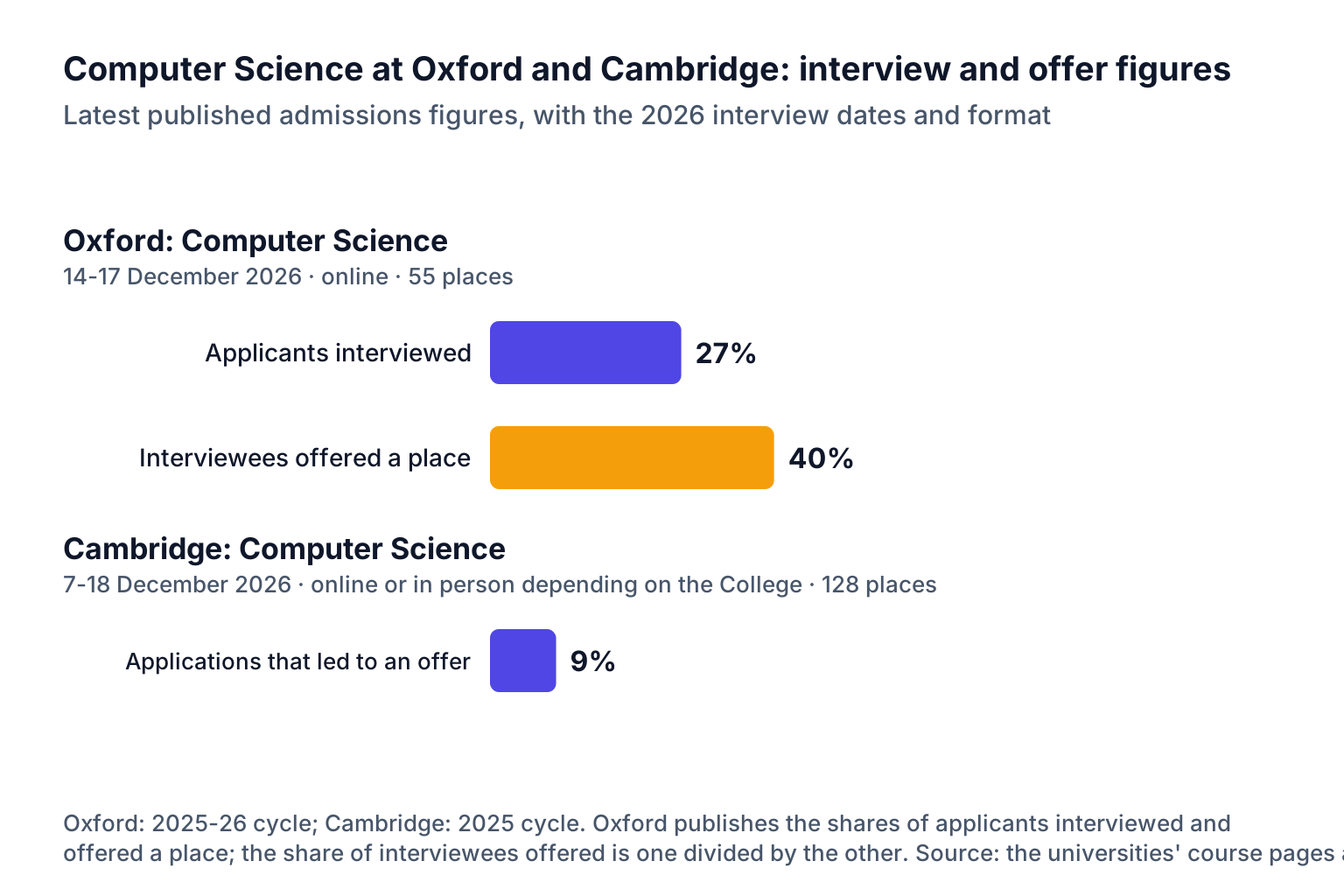
Oxford runs one interview format across all its colleges. At Cambridge, each College sets its own. The table puts the two side by side.
| Oxford | Cambridge | |
|---|---|---|
| Number of interviews | Usually 2 at your first-choice college, plus at least 1 at another college | Varies by College (1 to 2 in the department's examples) |
| Length | Around 30 minutes each | Varies by College, e.g. 25 minutes each at Caius and Peterhouse, or one 30 to 40 minute interview at Churchill |
| Mode | Online | Online or in person, depending on the College |
| Interviewers | Usually two | Two or three in subject interviews. General academic interviews may be with academics from other subjects |
| What happens in the room | Solving a Computer Science problem, thinking aloud | Working through a problem, mostly maths |
| Who is interviewed | All shortlisted applicants | Shortlisted applicants |
Oxford's report on the 2025-26 cycle adds some detail. According to the Department of Computer Science admissions feedback summary, "almost all interviews took place remotely by video call, often using a shared virtual whiteboard." Your second college is assigned algorithmically, not chosen by you. The same report says most applicants were interviewed twice by their first college and once or more by their second. A small number were also invited to further interviews by another college.
The main difference between the two is how predictable the format is. An Oxford computer science interview follows the same pattern wherever you applied. A Cambridge computer science interview depends on the College named in your invitation. Two applicants for the same course can therefore have different numbers of interviews, different lengths and different modes. Do not assume Oxford is in person or that Cambridge is always online.
The whiteboard detail has a practical consequence. Writing working with a mouse or stylus is slower and messier than using pen and paper. Practise sketching a diagram or a short calculation on a shared screen before December so the tool does not slow down your thinking.
Takeaway: if you applied to Cambridge, read your College invitation closely. It is where you will find the number of interviews, their length and whether you join online or in person.
3. Before the interview: admissions tests, written work and pre-reading
At both universities, the admissions test is sat before shortlisting and weighs heavily in it. Oxford lists the TMUA (Test of Mathematics for University Admissions) for this cycle. The department's 2025-26 admissions feedback summary shows that the previous cycle used the MAT, sat on 22 or 23 October 2025. Older advice on Oxford computer science interview questions may still assume the MAT.
Cambridge requires the TMUA as a pre-registered admission test. If you apply to Peterhouse or Trinity, you also take the CSAT, the College's own computer science test.
Oxford's shortlisting combines the admissions test, your UCAS form, contextual information and extenuating circumstances. In 2025-26 the department shortlisted 144 applicants for 58 offers, about two and a half per offer. Your test result also stays in play after shortlisting. The same report says interview scores go into a shared database where tutors see them alongside UCAS forms and test results.
Cambridge does not usually ask for written work. A College may set pre-interview reading or a task, and if it does, it will say so in your invitation.
| University | Interview period | Later round |
|---|---|---|
| Oxford | 14 to 17 December 2026 | Additional interviews 16 to 17 December 2026 |
| Cambridge | 7 to 18 December 2026 (main period) | Winter pool, mid to late January 2027 |
Once you have sat the test, the interview is the next assessed step. Read your invitation the day it arrives and check it for any pre-reading or task.
4. How many applicants are interviewed and offered places
Most applicants never reach interview. For Oxford Computer Science in the 2025-26 cycle, the department's January 2026 report gives this funnel:
- Applications: 531
- Interviewed: 144 (27% of applicants)
- Offers: 58 (40% of those interviewed) Oxford publishes the shares of all applicants interviewed and offered a place; the share of interviewees offered is one divided by the other.
- Places: 55
That year was more generous than usual. Oxford's course page gives a three-year average for 2023 to 2025 of 21% of applicants interviewed and 7% of all applicants successful, with an average intake of 55.
Your interview is not seen only by your first college. In December 2025, according to the department's feedback report, 25 shortlisted applicants were randomly reallocated from oversubscribed colleges, and ten of them received offers from their new colleges. Interview scores and comments go into a shared database that every tutor involved in admissions can see. A strong performance can therefore count for you at a college you did not choose.
Cambridge publishes a different set of figures. In the 2025 cycle, Cambridge Computer Science had 1,739 applications, 163 offers and 128 places. Interview numbers are not given in these figures, so no Cambridge interview rate is stated here.
An interview invitation means you have already passed a selective shortlist. Tutors weigh your interview alongside your admissions test score and UCAS form, as the Oxford report describes. It is not judged on its own.
5. What Oxford computer science interview questions are designed to test
Tutors are not checking whether you already know the answer. Oxford says that at interview it explores "how you tackle unfamiliar problems and respond to new ideas", and that it is "more interested in how you approach problem-solving". Cambridge describes the Cambridge computer science interview in similar terms: it assesses "academic potential" and "how you approach and explain a problem".
Oxford's 2025-26 admissions feedback summary shows how that becomes a mark. Interviews are "academic and subject-focused in nature", and performance is judged against the admissions criteria and "codified on a numeric scale against agreed descriptors". Those scores and comments go into a shared database, where every tutor involved in admissions sees them alongside your UCAS form and test results (Oxford feedback summary).
For Computer Science, this works out in three ways:
- Thinking aloud. Tutors can only score reasoning they can hear. A correct answer reached silently gives them far less to record than a visible line of thought.
- Responding to a hint. When a tutor offers a new idea or pushes back, they are testing whether you can drop your approach and try theirs.
- Using maths you have been taught. Proof, counting, probability and sketching from GCSE, A-level or IB maths are your tools. Recalled facts about programming languages rarely help.
The department's sample interview problems page explains why partial progress counts. Most problems "can be solved in several stages, beginning with easy cases and getting more general", and some can be generalised beyond the question asked. Others have no answer that can be reached "during a half-hour conversation". The page's own hints point the same way: replace large numbers with small ones and try small cases first. So when tutors watch you work through Oxford computer science interview questions, they are watching how you build on a small result and where you take it next.
Being able to explain a wrong turn and recover from it is part of what is scored, so narrate your corrections rather than hiding them.
6. Questions reported at Oxford Computer Science interviews, and practice questions
Every question below can be traced to its source: eight are published by the University of Oxford on the linked page; two come from a practice pack Lucy Cavendish College, Cambridge, compiled to show the kind of question asked at Oxbridge interviews; and one was reported by an applicant describing their own Computer Science interview. Tutors write new material each year, so read these for the kind of thinking they call for, not as a list to learn.
| Question | Reported at | Source |
|---|---|---|
| Death by chocolate. You are locked in a room with your worst enemy. ... Describe your strategy. | Oxford | University of Oxford, published sample question |
| Scribble. The game of Scribble is played with an inexhaustible supply of tiles, and consists of forming 'words' according to certain rules. ... (ii) Given any word, how can you decide whether it can be made or not? | Oxford | University of Oxford, published sample question |
| Missing numbers. Imagine you are given a list of slightly less than 1,000,000 numbers, all different, and each between 0 and 999,999 inclusive. How could you find (in a reasonable time) a number between 0 and 999,999 that is not on the list? | Oxford | University of Oxford, published sample question |
| You are given 10 boxes, each large enough to contain exactly 10 wooden building blocks, and a total of 100 blocks in 10 different colours. ... Show that it is possible to do it so that each box contains at most two different colours. | Oxford | University of Oxford, published sample question |
| Searching for the maximum. The real-valued function f(x), defined for 0 ≤ x ≤ 1, has a single maximum at x = m. ... How would you find the approximate value of m? How accurately could you find m if you could choose only 10 values of x for which to evaluate f(x)? | Oxford | University of Oxford, published sample question |
| Monkey beans. An urn contains 23 white beans and 34 black beans. A monkey takes out two beans; if they are the same, he puts a black bean into the urn, and if they are different, he puts in a white bean from a large heap he has next to him. The monkey repeats this procedure until there is only one bean left. What colour is it? | Oxford | University of Oxford, published sample question |
| How do pirates divide their treasure? ... So, what division should the most senior pirate suggest to the other six? | Oxford | University of Oxford, published sample question |
| Lily-pad lunacy. Eleven lily pads are numbered from 0 to 10. ... How many different ways are there of getting from 0 to 10? | Oxford | University of Oxford, published sample question |
| In computer graphics, we project a 3D object onto a flat screen; taking a cube, what parameters can we use to describe it? | Oxford | Applicant report, Quora |
| Tell me about binary searches. What about their efficiency? | Oxbridge practice pack | Lucy Cavendish College, Cambridge, Oxbridge practice pack |
| It is a fact that, apart from the peripherals, the whole of a computer can be made from NAND gates (a logic gate that produces an output that is false only if all its inputs are true). The Egyptians created NAND gates using marbles rolling down chutes and used them for booby trapping pyramids. So did the Egyptians invent the computer? If not, explain fundamentally why not. | Oxbridge practice pack | Lucy Cavendish College, Cambridge, Oxbridge practice pack |
Our dataset holds 69 further questions reported for these courses, mostly from preparation companies' lists and forum threads that cannot be traced to a university page or a first-hand account, so they are not reproduced here.
7. Working through Cambridge and Oxford computer science interview questions aloud
Most Oxford computer science interview questions, and their Cambridge equivalents, are not meant to be answered in one go. The task usually takes one of a few shapes:
- a puzzle or scenario described in words
- a process with fixed rules you have to reason about
- a counting or probability set-up
- a function or graph whose behaviour you need to pin down
- a claim you are asked to prove
Start small, on purpose. The Oxford Department of Computer Science gives three general hints on its sample interview problems page. First, replace specific numbers with small ones such as 0, one or two. Second, try small cases first. Third, reduce the problem to a smaller version of itself. The same page says most problems "can be solved in several stages, beginning with easy cases and getting more general."
Narrate as you work. Say what you are trying, why you chose it, and what you notice when it works or fails. Write on the paper or whiteboard as you speak so the interviewers can follow you. In 2025-26, almost all Oxford interviews took place by video call, "often using a shared virtual whiteboard", according to the department's admissions feedback.
Treat a hint as new information. Acknowledge it, test it on a small case, and say whether it changes your plan. Dropping an approach and giving your reason is part of the conversation, not a failure.
Don't panic if you never reach an answer. The Oxford department notes that some problems have no definitive answer, "or not answers that can be reached during a half-hour conversation" (sample interview problems).
A small case worked through aloud shows the interviewers more than silence while you search for the full solution.
8. How to prepare for an Oxbridge computer science interview
Preparing for an Oxbridge computer science interview is mostly about practising how you reason out loud, not collecting answers. Focus on five areas.
Re-read what you sent. Go through your personal statement and any submitted work. Check that you could explain every mathematical or computing claim in it from first principles. If you mention an algorithm, be ready to say why it works, not just what it does. Cambridge does not usually require written work, so for a Cambridge computer science interview your statement is the main thing to re-read.
Practise unseen problems aloud. Work with someone who keeps asking "why?" The Oxford Department of Computer Science publishes problems used in past interviews, including a sample interview dialogue for one of them. Use these past Oxford computer science interview questions for reasoning practice, not memorisation. The department says most can be solved in stages, starting with easy cases. Its hints suggest replacing large numbers with 0, one or two. Some problems have no answer reachable "during a half-hour conversation", so practise being comfortable without finishing.
Revisit your maths. Interviews draw on what you have been taught. Go over the A-level or IB Mathematics and Further Mathematics topics you have already covered. Oxford's first-year course list includes discrete mathematics, probability, linear algebra and introduction to proof systems. That list shows the flavour of the course. It is not a list of interview topics.
Change gear after the admissions test. In the 2025-26 cycle, Oxford expected all applicants to sit its admissions test before shortlisting. Once your test is done, switch from timed multiple-choice practice to slow spoken reasoning.
Set up your space. Oxford interviews are online. Cambridge interviews are online or in person, depending on the College. Oxford's department reports that interviews often use a shared virtual whiteboard. For any online interview, it is sensible to have:
- a quiet room and a stable connection
- a camera and microphone you have tested in advance
- paper and pen to hand
- some practice drawing diagrams on a shared whiteboard
Book several short practice sessions of about 30 minutes, which is roughly the length of an Oxford interview. Spread them over the weeks before Oxford's interviews on 14-17 December 2026 and Cambridge's main period of 7-18 December 2026, rather than cramming in one long session.
9. Common mistakes with computer science interview questions at university
The universities' own guidance points to three mistakes. All of them come from treating the interview like a test with a mark scheme.
- Rehearsing answers to question lists. The Lucy Cavendish College interview pack says its questions "are NOT intended for you to prepare specific answers". It adds that "interview questions change each year and interviewers are not looking for pre-prepared answers." A memorised answer also has nothing behind it when the first follow-up arrives.
- Treating the final answer as the goal. Oxford's Department of Computer Science says some of its problems have no definitive answer, "or not answers that can be reached during a half-hour conversation." On Oxford's general sample questions page, Biochemistry tutor Kathryn Scott of Christ Church says getting the correct answer "isn't important." What matters to her is how candidates apply knowledge to an unfamiliar problem, justify conclusions and consider alternatives. That comment comes from a different subject, but it matches the department's framing.
- Jumping straight to the general case. The department's hints suggest working the other way. Swap large numbers such as 10 or 100 for 0, one or two, try small cases first, and reduce the problem to a smaller one. It says most problems "can be solved in several stages, beginning with easy cases and getting more general."
If you catch yourself reciting, stop and reason from the problem in front of you.
10. What to do next before your December interview
This week, re-read your personal statement and mark every claim a tutor could ask you to explain step by step. Anything you cannot rebuild from first principles needs work now.
In the fortnight before the interview:
- Check your invitation for the format and any pre-reading or tasks. At Cambridge these are set by each College and stated in the invitation, and some Cambridge interviews are in person rather than online.
- Test your online set-up in the room you will actually use: camera, microphone, lighting and a writing surface the camera can see.
- Work unseen problems aloud in short daily sessions with someone who keeps asking why.
Note the windows: Oxford interviews run from 14 to 17 December 2026, and Cambridge's main period is 7 to 18 December 2026. Once your invitation arrives, put your date in your calendar and keep the evening before it clear.
Related guides
- Oxford interview dates 2026, every course
- Oxford interview and offer rates by course
- Cambridge interview dates 2026
- What a Cambridge interview is like
- Cambridge offer rates by course
- Oxbridge maths interview questions
- Oxbridge physics interview questions
- Every Oxbridge and medicine interview guide
Course pages
Entry requirements and the latest admissions figures: Oxford Computer Science and Cambridge Computer Science.
FAQ
When are the Oxford computer science interviews in 2026?
Oxford's course page lists Computer Science interviews for 14 to 17 December 2026, with additional interviews on 16 to 17 December 2026.
Are Oxford computer science interviews online?
Yes, Oxford's course page lists the Computer Science interviews as online, and the department reports that in 2025-26 almost all took place by video call, often with a shared virtual whiteboard.
Are Cambridge computer science interview questions mostly maths?
Cambridge's course page says the interview involves working through a problem that is mostly maths, assessing how you approach and explain it.
Can you prepare answers for Oxford computer science interview questions?
Not usefully: Lucy Cavendish College's interview pack states interview questions change each year and interviewers are not looking for pre-prepared answers, so practise reasoning aloud on unseen problems instead.
Why do Oxford computer science interview questions focus on unfamiliar problems?
Oxford says it uses the interview to explore how you tackle unfamiliar problems and respond to new ideas, and that it is more interested in how you approach problem-solving than in the final answer.
References
- Department of Computer Science - Undergraduate Admission - https://www.cs.ox.ac.uk/admissions/undergraduate/how_to_apply/sample_interview_problem.html
- Admissions feedback 2025-26, Department of Computer Science, University of Oxford - https://www.cs.ox.ac.uk/admissions/undergraduate/admissions_statistics/feedback2025.pdf
- Computer Science | Oxford University - https://www.ox.ac.uk/admissions/undergraduate/courses/course-listing/computer-science
- Undergraduate Admissions Statistics, 2025 cycle, University of Cambridge - https://www.undergraduate.study.cam.ac.uk/sites/default/files/2026-05/ug_admissions_statistics_2025_cycle.pdf
- Sample interview questions | Oxford University - https://www.ox.ac.uk/admissions/undergraduate/applying/guide-for-applicants/interviews/sample_questions
- Applicant report: Quora - https://www.quora.com/What-should-I-prepare-for-the-interview-for-mathematics-and-computer-science-at-the-University-of-Oxford
- Interview question pack (sciences and maths), Lucy Cavendish College - https://www.lucy.cam.ac.uk/sites/default/files/inline-files/Interview%20Question%20Pack%20%28Sciences%20&%20Maths%29.pdf