Oxford English Interview Questions: Oxbridge 2026 Guide
By Michael Thompson · Education Specialist; 10 years teaching the IB at Bromsgrove School · Published 27 October 2026 · Updated 28 October 2026
Oxford English interview questions centre on two things: a previously unseen piece of literature that you read and discuss in the interview, and the written work you submitted beforehand. At Oxford, all shortlisted applicants usually have two online interviews with at least two English tutors, on 7-9 December 2026, with additional dates on 14-16 December. Cambridge runs English interviews between 7 and 18 December 2026, online or in person depending on the College, and many include an unseen poem or short passage. Both universities say they are looking for how you think, not what you have memorised. This guide sets out who interviews you, for how long, what you hand over and what tutors say they assess, in the course pages' own words. It also covers how to prepare in the weeks before.
Key Takeaways
- Expect an unseen text: Oxford's English interview includes discussion of a previously unseen piece of literature, and many Cambridge English interviews use an unseen poem or short passage.
- Your written work is fair game: Oxford asks for one piece of writing and Cambridge asks for two pieces before the interview, so re-read what you sent.
- Oxford is online, Cambridge depends on the College: Oxford interviews English applicants online, while Cambridge interviews online or in person depending on the College.
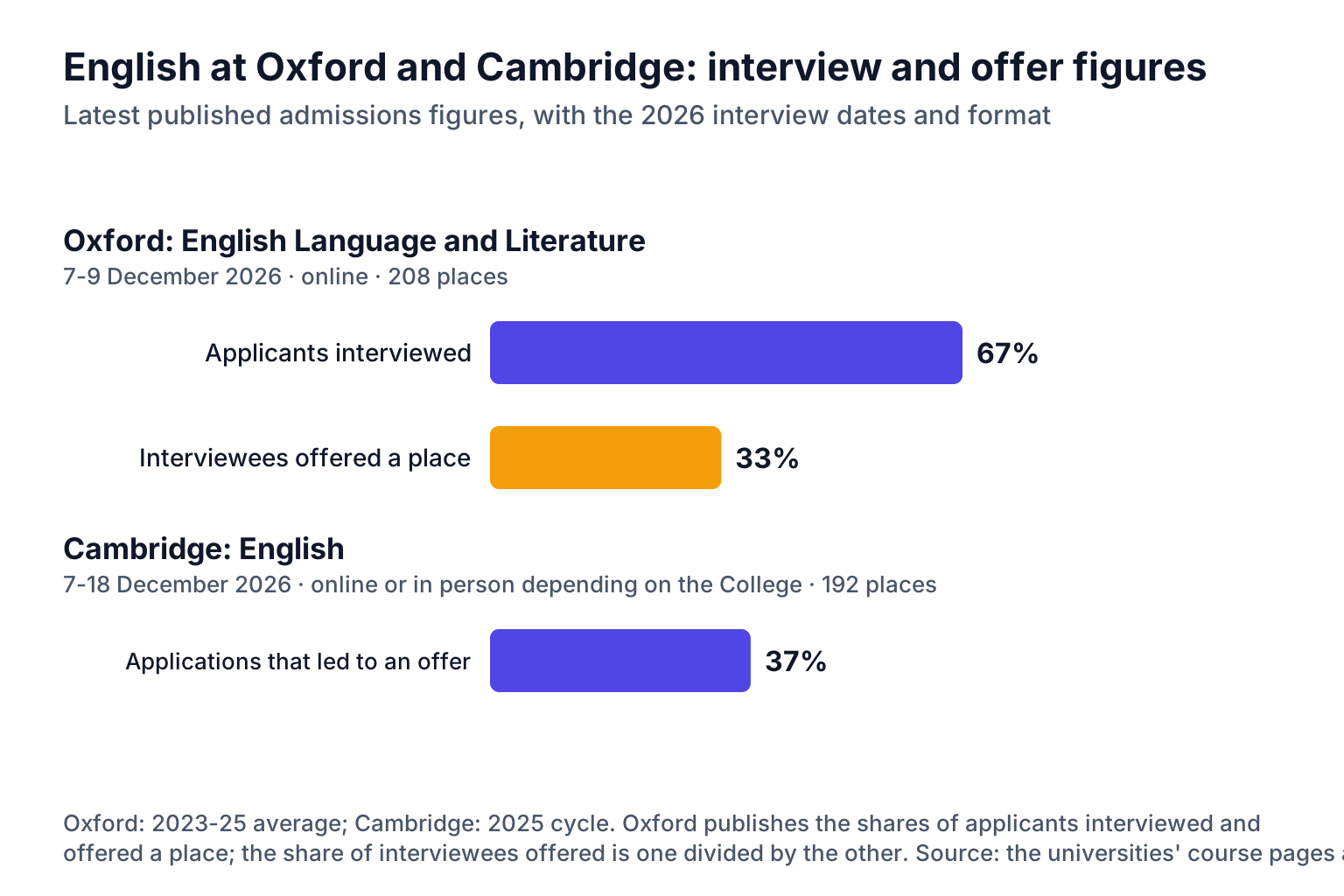
- Two-thirds of Oxford applicants are interviewed: Over 2023-25, Oxford interviewed 67% of English applicants, and 33% of those interviewed were offered a place.
- Tutors assess thinking, not recall: Oxford lists independent reading, analytical ability and flexibility of thought, and Cambridge lists critical and independent thinking, curiosity and enthusiasm.
- Cambridge has no pre-registered test: Cambridge English has no pre-registered test; Gonville & Caius sets a College admission assessment, and the College tells you about any pre-interview reading or tasks in the invitation.
In This Article
- What Oxford English interview questions actually involve
- Oxford English interview vs Cambridge English interview at a glance
- How many English applicants are interviewed and offered places
- Cambridge English interview questions: how Colleges vary
- Written work, admissions tests and pre-reading before the interview
- What tutors assess in Oxbridge English interview questions
- How the unseen poem or passage discussion tends to work
- Questions reported at Oxford English interviews, and practice questions
- How to prepare for English literature interview questions
- Misconceptions tutors correct about the Cambridge and Oxford English interview
- What to do next before your English interview
1. What Oxford English interview questions actually involve
Oxford English interview questions centre on two things: a piece of literature you have not seen before, read and discussed in the interview, and the written work you sent in beforehand. Oxford's English Language and Literature course page lists discussion of a previously unseen piece of literature, with one piece of written work submitted before the interview. The Cambridge English interview follows a similar pattern. Cambridge's English course page says many interviews use an unseen poem or short passage, and applicants submit two pieces of written work.
At Oxford you usually have two online interviews with at least two English tutors. At Cambridge, most applicants spend 35 minutes to one hour in interview in total, varying by College, with two or three interviewers in subject interviews. Section 2 sets out the full comparison.
Oxford's Faculty of Medieval and Modern Languages blog describes interviews as simulating a tutorial, and a Lincoln College tutor calls hers "like a mini tutorial". Both sources come from Modern Languages rather than English, so treat them as a guide to the general shape of an Oxford interview, not a description of English interviews specifically.
In practice, the Oxbridge English interview asks you to do two kinds of task:
- Read an unfamiliar poem or passage and talk through what you notice.
- Discuss your own submitted essay, which may have been written months earlier.
That second task is easy to underestimate. Your written work is the one text in the room you can prepare in advance, so re-read it and be ready to stand by or rethink what you argued.
The takeaway: the interview tests reading and discussion done live. Prepare by practising exactly that, out loud, rather than by learning answers.
2. Oxford English interview vs Cambridge English interview at a glance
| Oxford English Language and Literature | Cambridge English | |
|---|---|---|
| Interview dates 2026 | 7-9 Dec 2026; additional 14-16 Dec 2026 | 7-18 Dec 2026 (main period); winter pool mid to late January 2027 |
| Number of interviews | Usually 2 | Varies by College: most applicants 1-2, some 3-4 |
| Length | Not stated on the course page | 35 min to 1 hour in total for most applicants (varies by College) |
| Mode | Online | Online or in person, depending on the College |
| Interviewers | At least two English tutors | Two or three interviewers in subject interviews; general academic interviews may be with academics from other subjects |
| Task at the interview | Discussion of a previously unseen piece of literature | Unseen poem or short passage in many interviews |
| Written work before the interview | One piece of writing | 2 pieces of written work; pre-interview reading or tasks possible (the College says so in the invitation) |
| Admissions test | Not stated on the course page | No pre-registered admission test; College assessment only (Colleges such as Gonville & Caius provide their own details) |
| What is assessed | Independent reading, exchanging and building on ideas, clarity, analytical ability, flexibility of thought | Understanding of the subject, readiness for high-level study, fit with the Cambridge learning environment, critical and independent thinking, curiosity, enthusiasm |
| Who is interviewed | All shortlisted applicants | Shortlisted applicants |
The practical difference is predictability. Oxford's format is close to uniform: usually two online interviews in a fixed December window, each with English tutors and built around an unseen text. Once you know that, you know most of what the Oxford English interview will involve.
Cambridge is different. Its process depends heavily on your College. Your College decides how many interviews you have and whether they happen online or in person. It also decides whether you are set reading or a task beforehand. It may also put you in front of an academic from another subject in a general interview. This is why Cambridge English interview questions can feel broader than the course alone would suggest.
If you have applied to Cambridge, read your invitation line by line and note any pre-reading, assessment or in-person travel requirement. If you are not placed in December, remember that the winter pool runs into January 2027.
3. How many English applicants are interviewed and offered places
At Oxford, most English applicants reach interview, but far fewer receive an offer. Across the three-year average for 2023-25, Oxford's English Language and Literature course page reports an average of 208 places, with 67% of applicants interviewed and 22% of all applicants successful. In line with those figures, 33% of those interviewed were offered a place. Oxford publishes the shares of all applicants interviewed and offered a place; the share of interviewees offered is one divided by the other.
Cambridge's 2025 cycle covered applications from September 2024 for entry in October 2025 or deferred entry in 2026. For English, it recorded 652 applications, 241 offers and 192 places, according to the University of Cambridge admissions statistics for the 2025 cycle.
At Oxford, an interview invitation is the usual outcome for an English applicant. It does not mean you are nearly through. Two in three applicants reach that stage and one in three of those is offered a place, so the Oxford English interview carries real weight. Treat the invitation as the start of the assessment and prepare as if the decision is still open.
4. Cambridge English interview questions: how Colleges vary
At Cambridge, there is no single interview format for English. The number of interviews, their length and whether they happen online or in person all vary by College, so two applicants for the same course can describe quite different days.
Homerton College is one example. The details below are that College's 2026 arrangements, not a Cambridge-wide rule. According to Homerton's interview page:
- Mode: English is interviewed online for all applicants, including those at school in the UK. Only Music and Mathematics offer an in-person option.
- Number and length: Homerton usually offers two academic interviews, each lasting 25 minutes, typically with two interviewers.
- Who interviews: Interviewers are academics in the field, often including the College Director of Studies. Applicants may also meet academic staff in a closely related subject or a Tutor.
- Online vs in person: Homerton says the level of assessment and the type of questions are the same in either format.
Other Colleges add their own steps. Cambridge lists a College admission assessment at Gonville & Caius, with details provided by the relevant Colleges rather than published centrally. Your College will also say in its invitation whether there is pre-interview reading or a task. A winter pool runs mid to late January 2027, so keep reading any later messages from Cambridge with the same care.
Treat your College's invitation and its interview page as the authoritative brief for your own interview. Neither general advice on Cambridge English interview questions nor Oxford's arrangements replace them.
5. Written work, admissions tests and pre-reading before the interview
Your submitted writing may be on the table when the interview starts. Oxford asks English applicants for one piece of writing before the interview, and tutors may discuss it. Be ready to defend its argument, extend it to texts you did not cover, or explain what you would now argue differently. Changing your mind for a clear reason is a legitimate answer.
Cambridge asks for two pieces of written work. Pre-interview reading or tasks are also possible, and the College will say so in your invitation. One College's published statement shows how this can play out: Homerton says applicants "may be asked about a pre-prepared piece of work."
On admissions tests, the two universities need different checks:
| Oxford | Cambridge | |
|---|---|---|
| Written work before interview | One piece of writing | 2 pieces |
| Admissions test | None listed on the course page | No pre-registered admission test |
| Other assessment | None listed on the course page | College assessment only, for example at Gonville & Caius. Timing and details come from the College |
| Pre-reading | None listed on the course page | Possible. Your invitation will say |
Keep copies of exactly what you submitted, not a later redraft. If you revised the essay after sending it, the tutor has the old version in front of them. Re-read that version and note one point you would now push further and one you would now question.
6. What tutors assess in Oxbridge English interview questions
Both universities publish what their English tutors are looking for, and neither list asks how many books you can name. At Oxford, the criteria are independent reading, exchanging and building on ideas, clarity, analytical ability and flexibility of thought. At Cambridge, they are understanding of the subject, readiness for high-level study, fit with the Cambridge learning environment, critical and independent thinking, curiosity and enthusiasm.
In an English interview, those criteria show up as specific behaviours:
| What tutors list | How it shows in the conversation |
|---|---|
| Analytical ability | Thinking aloud, so the tutor can follow how you get from a word to a reading |
| Exchanging and building on ideas | Taking a tutor's suggestion and extending it, rather than defending your first line |
| Flexibility of thought | Changing your mind when pushed, and saying what changed it |
| Independent reading | Drawing on books you have actually read, not ones you have only read about |
| Critical and independent thinking | Applying close-reading skills you have been taught, not memorised interpretations |
Rehearsed answers to Oxford English interview questions do little against these criteria. What counts is reasoning the tutor can see.
Homerton College, Cambridge, describes its interviews in similar terms. They assess the "ability to discuss topics, to listen, to bring concepts together, and to evaluate arguments" (Homerton College). This is one College's description, but "to listen" matters. When a tutor interjects, the interjection is part of the material you are working with.
Dr Daniela Omlor is a Modern Languages tutor (Tutorial Fellow in Spanish) at Lincoln College, Oxford, not an English tutor. She says tutors value "a measured response over speed" and calls the interview "most certainly not a memory test or a battle of wits" (Lincoln College). Pausing to reread a line is not a weakness.
The takeaway: the conversation is the evidence. Tutors assess the reasoning between your first thought and your final view, so say that reasoning out loud.
7. How the unseen poem or passage discussion tends to work
The task is easy to describe. You are given a poem or short passage you have not seen before and discuss it with the tutors. Oxford describes this as discussion of a previously unseen piece of literature. Cambridge says an unseen poem or short passage is used in many English interviews, so it is common there but not guaranteed.
Neither course page sets out how this part of the Oxford English interview unfolds, so the closest public account comes from a neighbouring subject. Dr Daniela Omlor, a Modern Languages tutor in Spanish at Lincoln College, says candidates get reading time before questions begin. She also says tutors usually ask what the text is about, then about its style and tone and its impact on the reader (Lincoln College Oxford). In practice, an impression only counts once you can point to the words behind it. The Oxford Faculty of Medieval and Modern Languages, again writing about Modern Languages, says follow-up questions are based on the candidate's own analysis (Adventures on the Bookshelf). Your first observations therefore shape where the conversation goes next.
- Annotate during the reading time. Omlor says tutors value "a measured response over speed", so mark up the text before you speak.
- Start from what you notice. Voice, tone, form and imagery are all fair openings.
- Tie each claim to specific words. Quote the phrase, then explain its effect.
- Treat push-back as an invitation. A challenge is usually a prompt to develop your reading, not a sign that you are wrong.
Takeaway: practise saying "this word makes me think..." until anchoring every claim in the text becomes automatic.
8. Questions reported at Oxford English interviews, and practice questions
Every question below can be traced to its source: three are published by the University of Oxford on the linked page, and twelve come from a practice pack Lucy Cavendish College, Cambridge, compiled to show the kind of question asked at Oxbridge interviews. Tutors write new material each year, so read these for the kind of thinking they call for, not as a list to learn.
| Question | Reported at | Source |
|---|---|---|
| Why do you think an English student might be interested in the fact that Coronation Street has been running for 50 years? | Oxford | University of Oxford, published sample question |
| Tell me about [this literary work you have mentioned in your UCAS personal statement] | Oxford | University of Oxford, published sample question |
| JK Rowling has just published a book for adults after the hugely successful Harry Potter series. In what ways do you think that writing for children is different to writing for adults? | Oxford | University of Oxford, published sample question |
| What is the purpose of comedy? | Oxbridge practice pack | Lucy Cavendish College, Cambridge, Oxbridge practice pack |
| Tell me about the last book you read. | Oxbridge practice pack | Lucy Cavendish College, Cambridge, Oxbridge practice pack |
| Is the stage a platform for opinions or just entertainment? | Oxbridge practice pack | Lucy Cavendish College, Cambridge, Oxbridge practice pack |
| Can books be bad for you? | Oxbridge practice pack | Lucy Cavendish College, Cambridge, Oxbridge practice pack |
| Is there a difference between innocence and naivety? | Oxbridge practice pack | Lucy Cavendish College, Cambridge, Oxbridge practice pack |
| Tell me about your favourite poem. | Oxbridge practice pack | Lucy Cavendish College, Cambridge, Oxbridge practice pack |
| What are the positives and negatives of adapting books to films? Is it a positive thing to bring literature to a wider audience? | Oxbridge practice pack | Lucy Cavendish College, Cambridge, Oxbridge practice pack |
| What are the advantages and disadvantages of ignoring context when dealing with works of literature? | Oxbridge practice pack | Lucy Cavendish College, Cambridge, Oxbridge practice pack |
| Why might it be useful for an English student to read the Twilight series? | Oxbridge practice pack | Lucy Cavendish College, Cambridge, Oxbridge practice pack |
| What is the effect of a story within a story? | Oxbridge practice pack | Lucy Cavendish College, Cambridge, Oxbridge practice pack |
| What makes a short story different from a novel? | Oxbridge practice pack | Lucy Cavendish College, Cambridge, Oxbridge practice pack |
| Should poetry be difficult to understand? | Oxbridge practice pack | Lucy Cavendish College, Cambridge, Oxbridge practice pack |
Our dataset holds 115 further questions reported for these courses, mostly from preparation companies' lists and forum threads that cannot be traced to a university page or a first-hand account, so they are not reproduced here.
9. How to prepare for English literature interview questions
Preparing for Oxford English interview questions means rehearsing a conversation, not memorising answers. Spend the weeks before on four things: your own writing, spoken practice on unseen texts, your reading and the room you will sit in.
Start with what you have already sent. Re-read your personal statement and every piece of submitted written work. That is one piece for Oxford and two for Cambridge. For each piece, note:
- the main argument, in one sentence
- its weakest point, meaning the paragraph you would least like to defend
- what you would add or change now
The last note matters because the work is months old and your thinking should have moved on. Saying plainly that you would now argue it differently is stronger than defending a claim you no longer believe.
Practise unseen material out loud. Ask a teacher, parent or friend to listen and keep asking why. Rotate poems and prose from different periods. Give yourself a few minutes' reading time, then talk. Writing an essay plan trains a different skill, and the format rewards reasoning you can say aloud. A Modern Languages tutor at Lincoln College, Oxford says tutors value "a measured response over speed", so practise pausing before you answer.
Keep reading, and only mention what you have read. Oxford lists independent reading among the things English tutors assess. Be ready to talk about books you have genuinely finished, including the parts you disliked.
Check tests and pre-reading. Cambridge English has no pre-registered admission test, but your College may set an assessment or pre-reading. The invitation will tell you. Oxford applicants should confirm current requirements on the Oxford English course page.
Set up a quiet online room. Oxford English interviews are online. Cambridge interviews are online or in person depending on the College, and Homerton lists English among its online-only subjects for 2026. Prepare:
- a quiet room and a stable connection
- a charged device with a tested camera and microphone
- paper and a pen for annotating an unseen text
- a clear warning to everyone at home about the time
Homerton offers help with technology access to applicants eligible for Free School Meals. The Lincoln tutor advises telling the College as soon as possible about a disability or limited access to technology. Her main advice is simply "Be yourself."
10. Misconceptions tutors correct about the Cambridge and Oxford English interview
Several common worries about the interview are answered directly in College guidance. Only Homerton's guidance covers English applicants. The other two sources come from Modern Languages, so treat them as transferable advice rather than English-specific rules.
- Myth: saying you don't know is fatal. Homerton College, Cambridge, in guidance for all its interviewed subjects including English, states that "The answer 'I don't know' is not a wrong answer". It also says you may take time to think and that there are no trick questions (Homerton College).
- Myth: one bad interview ends your chances. Homerton says "A 'bad' interview is not the end of your application" and that interviews are "not more important than any other" part of the process (Homerton College).
- Myth: a fast answer beats a slow one. Dr Daniela Omlor, a Modern Languages (Spanish) tutor at Lincoln College, Oxford, says there are no trick questions and that tutors value "a measured response over speed" (Lincoln College).
- Myth: you must know everything. A former applicant quoted on Oxford's Modern Languages faculty blog said: "Your interviewers are not expecting you to know absolutely everything" (Adventures on the Bookshelf).
Takeaway: practise pausing before you answer. A short, honest silence followed by a reasoned answer matches what these tutors describe valuing.
11. What to do next before your English interview
Start this week with what you have already sent. Re-read your submitted written work and your personal statement, and write down one point in each that you would now argue differently. Tutors will have those pieces to hand, and a change of mind is easier to explain aloud once you have reasoned it through on paper.
In the fortnight before the interview:
- Do several timed, spoken unseen-text practices with someone who keeps asking why, so you build on a reading instead of defending your first one.
- Test your online set-up in the room you will use, if your interview is online.
- Read your invitation and course page again for any College assessment or pre-reading.
Check whether your slot falls on 7-9 or 14-16 December 2026 at Oxford, or within 7-18 December 2026 at Cambridge. Then block that whole day out now.
Related guides
- Oxford interview dates 2026, every course
- What an Oxford interview is like
- Cambridge interview dates 2026
- What a Cambridge interview is like
- Cambridge offer rates by course
- Oxbridge history interview questions
- Oxbridge modern languages interview questions
- Every Oxbridge and medicine interview guide
Course pages
Entry requirements and the latest admissions figures: Oxford English Language and Literature and Cambridge English.
FAQ
Are Oxford English interview questions hard?
They are designed to stretch you rather than catch you out: Oxford interviewed 67% of English applicants over 2023-25 and offered places to 33% of those interviewed, and tutors assess analytical ability and flexibility of thought rather than memorised answers.
How do I prepare for an Oxford English interview?
Re-read your personal statement and the one piece of written work you submitted, then practise discussing unseen poems and passages aloud, because the Oxford interview includes a previously unseen piece of literature.
When are Oxford and Cambridge English interviews in 2026?
Oxford English interviews run on 7-9 December 2026 with additional dates on 14-16 December, and Cambridge's main interview period is 7-18 December 2026, with a winter pool in mid to late January 2027.
Are Oxford English interviews online or in person?
Oxford English interviews are online, usually two interviews with at least two English tutors, whereas Cambridge interviews online or in person depending on the College.
Is there an admissions test for Cambridge English?
Cambridge English has no pre-registered admission test; assessment is by College, such as the admission assessment listed at Gonville & Caius, and your College will say in the invitation if there is pre-interview reading or a task.
Can I say 'I don't know' in a Cambridge English interview?
Homerton College, Cambridge, states that 'I don't know' is not a wrong answer and that applicants may take time to think, which reflects the focus on reasoning rather than recall.
References
- English Language and Literature | Oxford University - https://www.ox.ac.uk/admissions/undergraduate/courses/course-listing/english-language-and-literature
- English, BA (Hons) | Undergraduate Study - https://www.undergraduate.study.cam.ac.uk/courses/english-ba-hons
- Oxford interviews | Adventures on the Bookshelf - https://bookshelf.mml.ox.ac.uk/tag/oxford-interviews
- Oxford Interviews: Tutor Q&A | Lincoln College Oxford - https://lincoln.ox.ac.uk/blog/oxford-interviews-tutor-q-a
- Undergraduate Admissions Statistics, 2025 cycle, University of Cambridge - https://www.undergraduate.study.cam.ac.uk/sites/default/files/2026-05/ug_admissions_statistics_2025_cycle.pdf
- Interviews - https://www.homerton.cam.ac.uk/study-here/undergraduate-study/how-apply/interviews
- Sample interview questions | Oxford University - https://www.ox.ac.uk/admissions/undergraduate/applying/guide-for-applicants/interviews/sample_questions
- Interview question pack (arts, humanities and social sciences), Lucy Cavendish College - https://www.lucy.cam.ac.uk/sites/default/files/inline-files/Interview%20Question%20Pack%20%28AHSS%29.pdf