Oxford History Interview Questions: What Tutors Assess
By Michael Thompson · Education Specialist; 10 years teaching the IB at Bromsgrove School · Published 27 October 2026 · Updated 28 October 2026
Oxford history interview questions usually centre on two things: a short passage of historical writing that you read and talk about, and a discussion of your submitted written work and personal statement. At Oxford this is normally one 30-minute online interview with two tutors, or two 15-minute interviews at some colleges, held 7-11 December 2026 (University of Oxford). Cambridge History interviews run from 35 minutes to an hour in total for most applicants, online or in person depending on the College, between 7 and 18 December 2026 (University of Cambridge). Oxford says it is assessing motivation, enthusiasm and academic potential in history. Cambridge lists understanding of the subject, critical and independent thinking, curiosity and enthusiasm. Below you will find how each university runs the interview, what those assessment words mean in a real conversation, and how to use the weeks before December well.
Key Takeaways
- Two tasks dominate: Expect to discuss a short unseen passage of historical writing and the written work and personal statement you submitted.
- Oxford is online and short: Oxford History interviews are online, normally one 30-minute interview with two tutors (or two interviews of 15 minutes at some colleges), with a possible second interview at a different college.
- Cambridge varies by College: Most Cambridge History applicants have one or two interviews totalling 35 minutes to an hour, online or in person depending on the College, with two or three interviewers.
- No admissions test for single honours History: Oxford's Faculty of History lists no test for History, and Cambridge has no pre-registered admission test, so your preparation time goes into the interview and your written work.
- Reasoning counts more than polish: Hertford College, Oxford, says its tutors look for potential rather than a perfectly polished performance, so thinking aloud and responding to new information matters.
- Know your own submissions cold: Oxford asks for one piece of written work and most Cambridge Colleges ask for two, and tutors may question you on any of it.
In This Article
- What an Oxford History interview and a Cambridge History interview involve
- How the Oxford History interview runs
- How the Cambridge History interview runs
- Oxford vs Cambridge History interviews: where they differ
- What tutors assess behind Oxford history interview questions
- Questions reported at Oxford History interviews, and practice questions
- Working with an unseen passage or primary source
- How to prepare for history interview questions in the weeks before
- Mistaken assumptions about Oxbridge history interview questions
- What to do next before your December interview
1. What an Oxford History interview and a Cambridge History interview involve
Most Oxford history interview questions grow out of two tasks: talking through a short, unseen passage or extract, and discussing work you have already submitted. At Oxford that means your written work and personal statement. At Cambridge it means your submitted written work, plus any pre-interview reading or tasks your College sets.
Who, how long and where: at Oxford, two tutors interview you online for 30 minutes, or two interviews of 15 minutes at some colleges. A Cambridge History interview has two or three interviewers in subject interviews, lasts 35 minutes to one hour in total for most applicants, and runs online or in person depending on the College.
Each university states what it is looking for. Oxford assesses "motivation, enthusiasm and academic potential in history". Cambridge lists understanding of the subject, readiness for high-level study, fit with the Cambridge learning environment, critical and independent thinking, curiosity and enthusiasm.
The format mirrors the teaching. Oxford tutorials usually involve two to four students and a tutor (University of Oxford), and Cambridge supervisions typically require an essay (University of Cambridge). The interview is a short sample of that conversation.
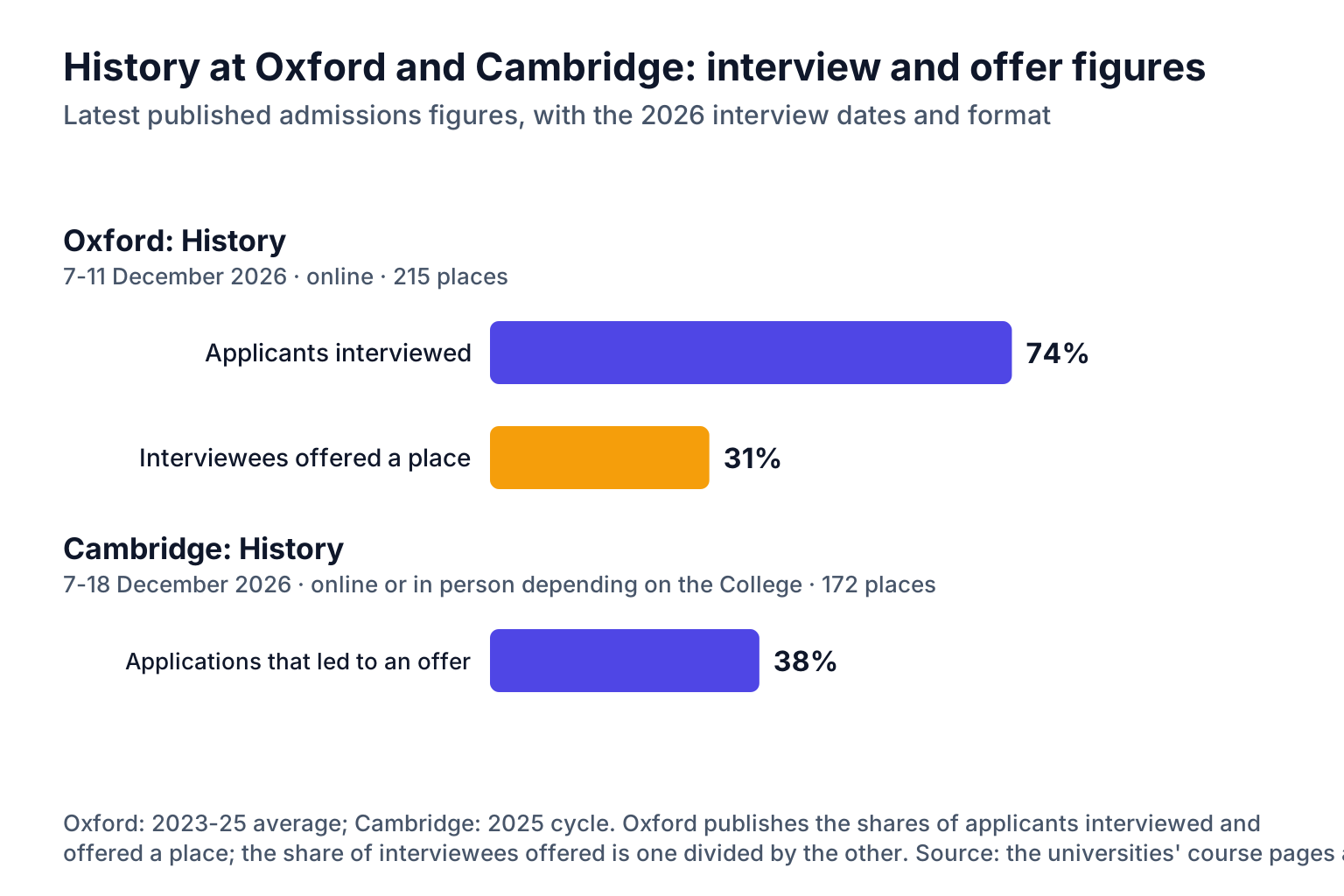
On scale, Oxford interviewed 74% of History applicants for an average intake of 215 across 2023-25 (University of Oxford), and 31% of those interviewed were offered a place. Oxford publishes the shares of all applicants interviewed and offered a place; the share of interviewees offered is one divided by the other. With roughly three in four applicants interviewed, an invitation is the normal next step, not a signal of an offer. Cambridge's 2025 cycle saw 631 applications, 241 offers and 172 places (University of Cambridge admissions statistics).
2. How the Oxford History interview runs
The Oxford History interview is held online, with two tutors, and centres on a short passage plus your own written work. According to the Oxford History course page, the main dates are 7-11 December 2026, with an additional period of 14-17 December 2026. All shortlisted applicants are interviewed. The standard is one 30-minute interview, though some colleges give two 15-minute interviews. You may also be interviewed at a second college.
Before the interview, you submit one piece of written work. The Faculty of History states that interviews are on history and that applicants submit written work on a historical subject.
At the interview, the course page describes:
- a short passage of historical writing to read just before the interview (some colleges only)
- a short passage to read and talk about
- discussion of your written work and personal statement
One college's practice: Hertford
The course page sets the standard, and individual colleges vary. Hertford College gives Single Honours History applicants two interviews on Microsoft Teams:
- First (25-30 minutes): an unfamiliar text by a historian
- Second (15-20 minutes): an unseen primary source
At Hertford, History and Politics or History and Modern Languages applicants have one 30-minute History interview plus a separate interview in their other subject.
A joint-school detail to check
The Faculty of History says joint school applicants may be offered an interview for a relevant single honours course. If you do not want this, you must tell your college after applying. If you are on a joint course, decide now whether you would accept Single Honours History.
3. How the Cambridge History interview runs
Cambridge interviews shortlisted History applicants. The format is set College by College, not centrally. The main interview period runs 7-18 December 2026, and winter pool interviews take place in mid to late January 2027.
- Number and length: this varies by College. Most applicants have one or two interviews and some have three or four. The total is usually 35 minutes to one hour.
- Mode: online or in person, depending on the College.
- Who interviews: subject interviews have two or three interviewers. A general academic interview may be with academics from other subjects. Be ready to explain your historical reading clearly to someone who is not a historian.
- Before the interview: every College except Sidney Sussex asks for two pieces of written work. Your College may also set pre-interview reading or tasks, and the invitation will say so.
- Admission tests: there is no pre-registered admission test. Hughes Hall and St Edmund's set their own College admission assessment, and the College provides the details.
One College's practice: Homerton
The following describes one College's arrangements, not a Cambridge-wide rule. At Homerton College, all History applicants are interviewed online, including those applying for History and Politics or History and Modern Languages. Homerton usually offers two academic interviews of 25 minutes each, usually with two interviewers. They may ask about a pre-prepared piece of work or ask you to consider problems relevant to the subject. The College states that the level of assessment and the type of questions are the same online and in person.
Treat your own College invitation as the authority on format, timing and any pre-reading. Read it carefully the day it arrives.
4. Oxford vs Cambridge History interviews: where they differ
| Oxford | Cambridge | |
|---|---|---|
| Interview dates 2026 | 7-11 Dec 2026; additional 14-17 Dec 2026 | 7-18 Dec 2026 (main period); winter pool mid to late January 2027 |
| Number of interviews | Standard 1 (some colleges give 2 x 15 min); possible second interview at a different college | Varies by College: most applicants 1-2, some 3-4 |
| Length | 30 min (or 2 x 15 min at some colleges) | 35 min to 1 hour in total for most applicants (varies by College) |
| Mode | Online | Online or in person, depending on the College |
| Interviewers | Two tutors | Two or three in subject interviews; general academic interviews may be with academics from other subjects |
| Written work before interview | One piece of writing | 2 pieces at all Colleges except Sidney Sussex |
| Admissions test | None listed for History | No pre-registered test; College assessment at Hughes Hall and St Edmund's |
| Pre-reading or passage | Short passage to read and talk about (at some colleges, read just before the interview) | Pre-interview reading or tasks possible; the College says in the invitation |
| What is assessed | Motivation, enthusiasm and academic potential in history | Understanding of the subject, readiness for high-level study, fit with the Cambridge learning environment, critical and independent thinking, curiosity, enthusiasm |
Oxford is the more predictable format. Every interview is online, and the structure is known in advance: a short passage, then talk about your submitted writing and personal statement. Prepare for Oxford history interview questions by practising passage discussion out loud on screen. Do not rehearse for a room.
Cambridge depends on your College. You might be online or in person. You might also face a general academic interview with people outside History, so read your invitation closely. Your written work load is also heavier. Most applicants have two pieces to revisit, while Oxford applicants have one.
The overlap is larger than the differences. Both universities interview from 7 December 2026. Both centre on your own writing and on material you have not seen before. That mirrors the teaching. Oxford first-years write at least one essay a week (Oxford), and Cambridge supervisions typically require an essay (Cambridge). Re-read every submitted piece as if a tutor will challenge its weakest paragraph.
5. What tutors assess behind Oxford history interview questions
You do not have to guess what Oxford tutors want. The Oxford Faculty of History publishes its selection criteria:
- "Enthusiasm for history"
- "Evidence of historical imagination and understanding, particularly the ability to speculate and compare"
- "The possession of appropriate historical knowledge and the capacity to deploy it"
- "Intellectual curiosity"
- "The capacity to engage with alternative perspectives and/or new information"
- "Capacity for hard work"
- "Accuracy and attention to detail"
If you are applying for a joint school such as History and Politics, these criteria apply to the History side only.
Cambridge uses similar language. Its tutors look for critical and independent thinking, curiosity, enthusiasm and readiness for high-level study. Hertford College, Oxford is more direct. Its tutors say they are interested in "how you develop your ideas, how you engage with our questions, and how you think on your feet," and that they are "looking for potential, not a perfectly polished performance."
What this looks like in the conversation
- Think aloud. Tutors can only assess reasoning they can hear. Say what you notice before you reach a conclusion.
- Speculate and compare when the evidence runs thin. The criteria name this skill directly. A careful "if this were true, it would resemble..." shows historical imagination. Saying nothing does not.
- Change your mind openly. When a tutor introduces new information, adjust your view and explain why. This meets a stated criterion. It is not a lapse.
- Deploy knowledge instead of reciting it. The criterion is the capacity to deploy knowledge, not just to hold it. Apply what you studied for A Level or IB History to the material in front of you. A memorised paragraph will not do that job.
Hertford says the interview partly resembles Oxford's tutorial, where students build on independent work in dialogue with a tutor. Oxford tutorials usually involve two to four students and a tutor. So Oxford history interview questions are best treated as a short trial tutorial. Tutors are checking whether you would do well in that dialogue every week.
6. Questions reported at Oxford History interviews, and practice questions
Every question below can be traced to its source: five are published by the University of Oxford on the linked page; nine come from a practice pack Lucy Cavendish College, Cambridge, compiled to show the kind of question asked at Oxbridge interviews; and four were reported by applicants describing their own History interview (The Student Room reports are named but not linked). Tutors write new material each year, so read these for the kind of thinking they call for, not as a list to learn.
| Question | Reported at | Source |
|---|---|---|
| Imagine we had no records about the past at all, except everything to do with sport - how much of the past could we find out about? | Oxford | University of Oxford, published sample question |
| What can historians not find out about the past? | Oxford | University of Oxford, published sample question |
| Is violence always political? Does 'political' mean something different in different contexts? | Oxford | University of Oxford, published sample question |
| Which person (or sort of person) in the past would you most like to interview, and why? | Oxford | University of Oxford, published sample question |
| What would a historian find interesting about the place where you live? | Oxford | University of Oxford, published sample question |
| You say you enjoy world war one poetry, can we really learn from it and how reliable is it? | Oxford | Applicant report, The Student Room (not linked) |
| What are the main similarities between WW1 poems? | Oxford | Applicant report, The Student Room (not linked) |
| What was Hitler's biggest strategic mistake between 1939 and 1941? | Oxford | Applicant report, The Student Room (not linked) |
| What do you think Hitler's most important aim in Mein Kampf was? | Oxford | Applicant report, The Student Room (not linked) |
| What makes civil wars so different from other wars? | Oxbridge practice pack | Lucy Cavendish College, Cambridge, Oxbridge practice pack |
| What are the links between History and Archaeology? | Oxbridge practice pack | Lucy Cavendish College, Cambridge, Oxbridge practice pack |
| Are modern historians more nihilistic about religion? | Oxbridge practice pack | Lucy Cavendish College, Cambridge, Oxbridge practice pack |
| What are the origins of your first name? What is the significance of given names? How about place names? | Oxbridge practice pack | Lucy Cavendish College, Cambridge, Oxbridge practice pack |
| Do you think modern history is more relevant than ancient and medieval history? | Oxbridge practice pack | Lucy Cavendish College, Cambridge, Oxbridge practice pack |
| Tell me about your favourite museum. What's the role of a museum? | Oxbridge practice pack | Lucy Cavendish College, Cambridge, Oxbridge practice pack |
| What can we conclude from reading an ancient or medieval historian's work, apart from the facts? | Oxbridge practice pack | Lucy Cavendish College, Cambridge, Oxbridge practice pack |
| Does History repeat itself? Would it be worth studying if it didn't? | Oxbridge practice pack | Lucy Cavendish College, Cambridge, Oxbridge practice pack |
| What place that you have been to recently interested you the most historically? | Oxbridge practice pack | Lucy Cavendish College, Cambridge, Oxbridge practice pack |
Our dataset holds 143 further questions reported for these courses, mostly from preparation companies' lists and forum threads that cannot be traced to a university page or a first-hand account, so they are not reproduced here.
7. Working with an unseen passage or primary source
In an Oxford History interview, you will often be handed material you have never seen. At some colleges, you get a short passage of historical writing to read just before the interview. Hertford College gives more detail. Its first interview uses an unfamiliar text written by a historian, and its second uses an unseen primary source.
The task depends on the material. With the historian's text, Hertford says tutors want you to explain the argument, give your own view of it and connect it to what you have studied. With the primary source, your job is to interpret it and consider what historians could learn from it.
Use the reading time to sort the material before you form a view:
- The claim: what is the author arguing, recording or trying to persuade someone of?
- The evidence: what supports the claim, and what is missing?
- The type of source: is it a historian's argument or something produced at the time?
- What you would want to know: who wrote it, for whom, and why?
That last step matches the Faculty's criteria of "historical imagination and understanding, particularly the ability to speculate and compare" and "the capacity to engage with alternative perspectives and/or new information" (Oxford Faculty of History). Comparing the passage with a period you already know counts as good method, not a dodge.
Expect the passage to fall outside your syllabus. Oxford's options run from the declining years of the Roman Empire to the present and include North American, Latin American, Asian and African history (University of Oxford). Cambridge's course draws on sources ranging from medieval plague records to Hollywood films (University of Cambridge). The unfamiliarity is deliberate: tutors are testing your method, not how much you have covered.
8. How to prepare for history interview questions in the weeks before
Most of your preparation should go into the two things tutors will put in front of you: your own written work and an unfamiliar text. Everything else is logistics.
Re-read everything you submitted. Oxford asks for one piece of written work. Most Cambridge Colleges ask for two; Sidney Sussex is the exception, so check its own page. Read each piece alongside your personal statement, which the Oxford Faculty of History asks you to use to "introduce yourself as a historian". For each essay, note:
- the weakest step in the argument
- what you would change if you wrote it now
- what you have read since that supports or complicates it
Practise unseen material out loud. Choose extracts by historians and short primary sources from outside your syllabus. Then talk through them with someone who keeps asking why. Summarise the argument, judge it, and say out loud when your view shifts. Silent reading feels productive but does not train the skill on show. Hertford's History tutors say they are interested in "how you think on your feet" and want "potential, not a perfectly polished performance." Practise pausing, too. Homerton states that you may take time to think and that "The answer 'I don't know' is not a wrong answer."
Check whether you have a test. The Oxford Faculty of History lists no admissions test for History, Ancient and Modern History, History and English or History and Modern Languages. History and Economics and History and Politics require the TARA (UAT UK). If you applied for a joint course, confirm your test arrangements before the interview weeks. Cambridge has no pre-registered admission test. Hughes Hall and St Edmund's set a College assessment, and the College provides the details.
Set up a quiet room. Hertford interviews on Microsoft Teams and needs a device with a microphone and webcam. A few days before, test your connection, camera, lighting and background noise. Keep paper and a pen within reach for notes on a passage. Homerton offers help accessing technology to applicants eligible for Free School Meals, plus a Disability Adjustments form. Check your own College's interview page for equivalent support.
Keep the calendar clear. Oxford's additional interview dates run 14-17 December 2026. Cambridge's winter pool runs mid to late January 2027. Avoid booking travel or other commitments in either period.
Takeaway: this week, write three sentences on the weakest point of each submitted essay. Then spend one session talking through an unseen extract with someone who keeps asking why.
9. Mistaken assumptions about Oxbridge history interview questions
Several common worries about Oxbridge history interview questions run against what colleges actually publish. Each point below comes from a named college or tutor, so read it as that source's stated position, not a rule for every college.
- "I need a polished performance." Hertford College, Oxford, says its History tutors are "looking for potential, not a perfectly polished performance" (Hertford College).
- "Saying 'I don't know' is fatal, and there will be trick questions." Homerton College, Cambridge, states that "The answer 'I don't know' is not a wrong answer." It adds that applicants will not be asked trick questions and may take time to think before responding (Homerton College).
- "The interview decides everything." Homerton says interviews are not the only basis for offers (Homerton College).
- "Online is easier, or harder." Homerton says the level of assessment and the type of questions are the same online and in person (Homerton College). This matters at Cambridge, where the mode depends on the college.
- "Sweeping claims about evidence sound confident." This warning comes from outside History. Alison Salvesen, an Oxford tutor in Asian and Middle Eastern Studies, says arguing "The Bible says" or "Archaeology proves" is "much too simplistic" (University of Oxford).
The same caution carries over to History sources. When you discuss a source, say what it can show and what it cannot.
10. What to do next before your December interview
This week, re-read your submitted written work and personal statement and note one point in each you would now argue differently. Both can come up in discussion, and a considered second thought shows more than a defence of every line.
In the fortnight before the interview:
- Run two or three practice sessions reading an unseen extract aloud with someone who keeps asking why.
- Test your whole online set-up at a similar time of day: camera, microphone, connection and a quiet room. Oxford interviews are online, and at Cambridge the format depends on the College.
- Check your College invitation for any pre-reading and the exact interview format.
Keep 14-17 December free as well: Oxford lists it as an additional interview period. Block out mid to late January 2027 as well, in case your Cambridge application goes into the winter pool.
Related guides
- Oxford interview dates 2026, every course
- Cambridge interview dates 2026
- What a Cambridge interview is like
- Cambridge offer rates by course
- Oxbridge English interview questions
- Oxbridge law interview questions
- Every Oxbridge and medicine interview guide
Course pages
Entry requirements and the latest admissions figures: Oxford History and Cambridge History.
FAQ
Are Oxford history interviews online or in person?
Oxford History interviews are online, normally one 30-minute interview with two tutors (or two interviews of 15 minutes at some colleges), while Cambridge interviews are online or in person depending on the College.
How many Oxford History applicants get an interview?
On Oxford's three-year average for 2023-25, 74% of History applicants were interviewed for an average of 215 places, and 31% of those interviewed were offered a place.
Is there an admissions test for Oxford or Cambridge History?
Oxford's Faculty of History lists no admissions test for single honours History (History and Politics and History and Economics require the TARA), and Cambridge has no pre-registered admission test, though Hughes Hall and St Edmund's set a College assessment.
Will I be interviewed at more than one college?
At Oxford a second interview at a different college is possible, and at Cambridge most History applicants have one or two interviews, with some having three or four, depending on the College.
Can I say 'I don't know' in a Cambridge history interview?
Homerton College, Cambridge states that 'I don't know' is not a wrong answer, that applicants will not be asked trick questions, and that they may take time to think before answering.
Do tutors ask about my submitted written work?
Yes: Oxford's course page lists discussion of your submitted written work and personal statement as part of the interview, and Cambridge Colleges (all except Sidney Sussex) ask for two pieces of written work before interview.
References
- History | Oxford University - https://www.ox.ac.uk/admissions/undergraduate/courses/course-listing/history
- History, BA (Hons) | Undergraduate Study - https://www.undergraduate.study.cam.ac.uk/courses/history-ba-hons
- Undergraduate Admissions Statistics, 2025 cycle, University of Cambridge - https://www.undergraduate.study.cam.ac.uk/sites/default/files/2026-05/ug_admissions_statistics_2025_cycle.pdf
- Making an Application | Faculty of History - https://www.history.ox.ac.uk/making-application
- History & Joint Schools - Hertford College | University of Oxford - https://www.hertford.ox.ac.uk/applicants/subjects/history-interviews
- Interviews - https://www.homerton.cam.ac.uk/study-here/undergraduate-study/how-apply/interviews
- Sample interview questions | Oxford University - https://www.ox.ac.uk/admissions/undergraduate/applying/guide-for-applicants/interviews/sample_questions
- Interview question pack (arts, humanities and social sciences), Lucy Cavendish College - https://www.lucy.cam.ac.uk/sites/default/files/inline-files/Interview%20Question%20Pack%20%28AHSS%29.pdf