Oxford Maths Interview Questions: What Oxbridge Expects
By Michael Thompson · Education Specialist; 10 years teaching the IB at Bromsgrove School · Published 27 October 2026 · Updated 28 October 2026
Oxford maths interview questions are mathematical problems and definitions that you work through aloud with Oxford academic tutors, typically two per interview, in online sessions of about 25 minutes each (University of Oxford). Cambridge sets mathematical problems to solve with two or three interviewers, for about 20 to 40 minutes, online or in person depending on the College (University of Cambridge). Neither university is checking whether you have memorised answers. Oxford says it assesses how you think when doing mathematics, and Cambridge says it assesses how you think about and tackle mathematical problems. This guide covers how each interview runs in December 2026, what tutors are looking for, and how to use the weeks after the TMUA to practise thinking aloud.
Key Takeaways
- Oxford interviews are online and about 25 minutes long: You can expect one to two interviews at your first-choice college and at least one at another college, between 14 and 17 December 2026.
- Cambridge format depends on the College: Most applicants have one or two interviews of about 20 to 40 minutes between 7 and 18 December 2026, online or in person, and some Colleges add a written assessment.
- Tutors assess how you think, not what you recall: Both course pages describe the interview as a test of how you approach mathematics, so explaining your reasoning out loud matters as much as reaching an answer.
- The TMUA comes first: Oxford candidates sit the TMUA in October (12 to 16 October 2026), there is no pass mark, and shortlisting decisions follow in November.
- Most Oxford applicants are not interviewed: In the 2025/26 cycle Oxford interviewed 589 of 2,052 Mathematics applicants and made 208 offers, while Cambridge interviews all realistic applicants, over 80% in recent years.
- Practise unseen problems aloud with someone who asks why: Rehearsing your reasoning out loud, and changing course when challenged, is the closest practice to the real interview.
In This Article
- What Oxford maths interview questions ask you to do
- How the Oxford maths interview and Cambridge maths interview run
- Before the interview: TMUA, written work and pre-reading
- How many applicants reach interview and get offers
- Questions reported at Oxford and Cambridge Mathematics interviews, and practice questions
- What tutors assess in Oxbridge maths interview questions
- Thinking aloud through an unseen problem
- How to prepare in the weeks before a maths interview
- Setting up for an online maths interview
- What to do next before December
1. What Oxford maths interview questions ask you to do
Oxford maths interview questions ask you to work through unseen mathematical problems and definitions aloud with academic tutors, so they can watch your reasoning as it happens. A Cambridge Mathematics interview works the same basic way: you are given mathematical problems to solve and talk through. Neither is a test of memorised answers.
Here are the three things most applicants want to know first:
| Oxford maths interview | Cambridge maths interview | |
|---|---|---|
| What you do | Work through mathematical problems and definitions aloud | Solve mathematical problems |
| Who with | Oxford academic tutors, typically two per interview | Two or three interviewers in subject interviews |
| How long | About 25 minutes each | About 20 to 40 minutes per interview |
| What is assessed | "How you think when doing mathematics" | "How you think about and tackle mathematical problems" |
Both universities describe the goal in terms of how you think, not what you already know. The Oxford wording is about thinking while doing mathematics. The Cambridge wording adds tackling problems. In both cases, a half-finished but clearly reasoned attempt tells the interviewers more than a correct answer you cannot explain.
The material is usually one of a few kinds: a problem to attempt, a definition to work with, the outline of a proof, or a graph to interpret. The definition element at Oxford is worth noticing. A-level and IB courses mostly reward applying a method you have already practised. Being handed an unfamiliar definition and asked to reason from it is a different skill, and it is one you can practise in advance.
Oxford's course page describes the degree itself this way: "Often the solution to a problem will require you to think outside its original framing." That line describes the course, not an interview rule. It still gives you a fair idea of the habit of mind the tutors teach.
Takeaway: practise working through problems aloud from a bare definition, not just from worked examples.
2. How the Oxford maths interview and Cambridge maths interview run
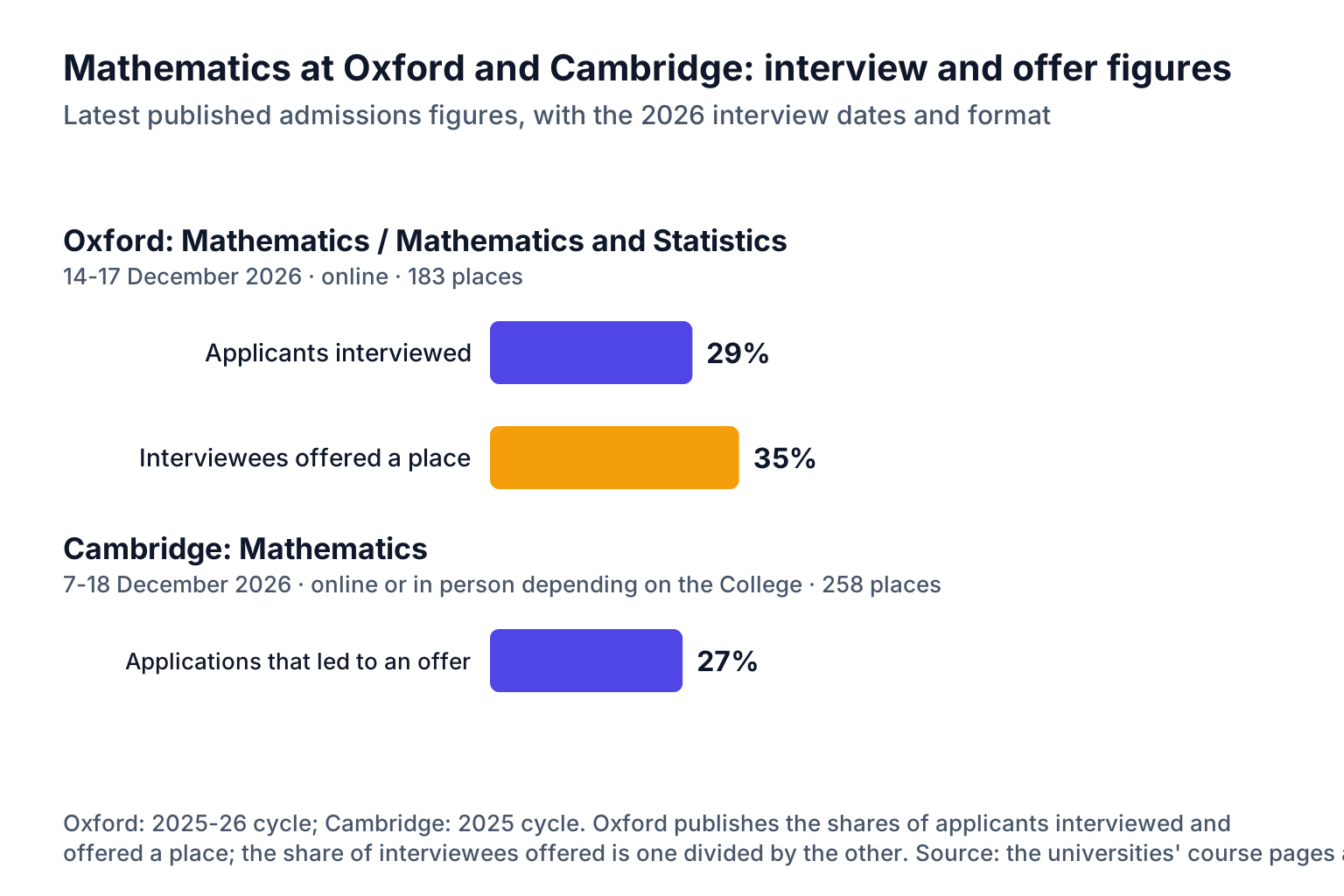
Both universities interview Mathematics applicants in December, but the format is less alike than the shared "Oxbridge" label suggests. Here are the two side by side.
| Oxford | Cambridge | |
|---|---|---|
| Dates 2026 | 14-17 Dec 2026, plus additional dates 16-17 Dec 2026 | 7-18 Dec 2026 (main period); winter pool mid to late January 2027 |
| Number of interviews | 1-2 at your first-choice college, plus at least 1 at another college | Varies by College: most applicants have 1-2, some have 3-4 |
| Length | About 25 minutes each | About 20-40 minutes each |
| Mode | Online | Online or in person, depending on the College |
| Interviewers | Oxford academic tutors, typically two per interview | Two or three in subject interviews; general academic interviews may be with academics from other subjects |
| What happens | Mathematical problems and definitions worked through aloud | Mathematical problems to solve; written assessment at interview at some Colleges |
| Who is interviewed | All shortlisted applicants | All realistic applicants (over 80% in recent years) |
The differences come down to consistency. Oxford's process is the same for everyone shortlisted: it is always online, and it is spread across more than one college. Cambridge leaves the detail to each College, so the number of interviews, whether you sit them online or in person, and whether a written assessment is part of the day all depend on where you applied.
Each format has a practical consequence for the Oxford maths interview and the Cambridge maths interview:
- At Oxford, expect at least two sets of tutors. An interview at a college you did not name is a standard part of the process. Prepare to explain your reasoning more than once to people who have not met you.
- At Cambridge, a general academic interview may not be with a mathematician. If an academic from another subject is in the room, practise explaining why a method works in plain words, not only in notation.
- Cambridge's winter pool runs into late January 2027. Avoid fixed commitments in that window until you know your outcome.
Takeaway: if you applied to Cambridge, read your College's invitation closely. That letter tells you the mode, the number of interviews and any written element. A general guide like this one cannot.
3. Before the interview: TMUA, written work and pre-reading
Both universities ask Mathematics applicants to sit the Test of Mathematics for University Admissions (TMUA) before any interview. At Cambridge it is a pre-registered admission test, sat before interview invitations go out.
At Oxford, the TMUA is required for Maths, Computer Science and joint honours courses, and there is no pass mark (Mathematical Institute). Tutors combine your score with your UCAS application and information about your school background. They then shortlist about three applicants per place because they "can't interview all our applicants in the time available." In practice, your TMUA score is a major factor in whether you are shortlisted.
Oxford TMUA and interview timeline, 2026-27 (Mathematical Institute)
| Stage | Date |
|---|---|
| Booking deadline | 28 September 2026 (6pm UK) |
| TMUA test dates | 12-16 October 2026 |
| UCAS deadline | 15 October 2026 (6pm UK) |
| Shortlisting | November 2026 |
| Interviews | December 2026 |
| Decisions | January 2027 |
If you were expecting the MAT, note that Oxford ran it from 2007 to 2025 and it does not run for the 2026 round. Oxford says the TMUA's topics are "very similar" and that "the spirit of problem-solving is common to both tests" (Mathematical Institute). MAT past papers still help you practise problem-solving.
For the Cambridge maths interview, written work is not usually required. Your College may set pre-interview reading or tasks, and it will tell you in the invitation. Read your invitation in full as soon as it arrives.
4. How many applicants reach interview and get offers
At Oxford, the shortlist does much of the filtering before anyone sits down with a tutor. Oxford's 2025/26 Mathematics admissions statistics record 2,052 applications, 589 applicants interviewed, 208 offers and 183 places. That means 29% of applicants were interviewed, and 35% of those interviewed were offered a place. Oxford publishes the shares of all applicants interviewed and offered a place; the share of interviewees offered is one divided by the other.
The Oxford Mathematics course page gives a slightly different set of figures: 32% of applicants interviewed, 9% successful and an average intake of 183. Both are correct. The course page uses a three-year average for 2023 to 2025, while the 29% figure covers the single 2025/26 cycle.
| Oxford Mathematics, 2025-26 cycle | |
|---|---|
| Applications | 2,052 |
| Interviewed | 589 (29% of applicants) |
| Offers | 208 (35% of those interviewed) |
| Places | 183 |
Cambridge received 2,032 Mathematics applications in its 2025 cycle, made 555 offers and filled 258 places, according to the Cambridge 2025 cycle admissions statistics. Cambridge says it interviews all realistic applicants, over 80% in recent years, but publishes no count (University of Cambridge).
If Oxford invites you, you are already in the group the Mathematical Institute shortlists at about three applicants per place. Prepare for the Oxford maths interview questions as a realistic contender for one of those places.
5. Questions reported at Oxford and Cambridge Mathematics interviews, and practice questions
Every question below can be traced to its source: two are published by the University of Oxford on the linked page; twelve come from a practice pack Lucy Cavendish College, Cambridge, compiled to show the kind of question asked at Oxbridge interviews; and one was reported by an applicant describing their own Mathematics interview (The Student Room reports are named but not linked). Tutors write new material each year, so read these for the kind of thinking they call for, not as a list to learn.
| Question | Reported at | Source |
|---|---|---|
| How many ways are there to cover a 2 x n rectangular grid with 2 x 1 tiles? | Oxford | University of Oxford, published sample question |
| Imagine a ladder leaning against a vertical wall with its feet on the ground. The middle rung of the ladder has been painted a different colour on the side, so that we can see it when we look at the ladder from the side on. What shape does that middle rung trace out as the ladder falls to the floor? | Oxford | University of Oxford, published sample question |
| What is the square root of i? | Cambridge | Applicant report, The Student Room (not linked) |
| How many squares can be made from a grid of ten by ten dots (ignore diagonal squares)? | Oxbridge practice pack | Lucy Cavendish College, Cambridge, Oxbridge practice pack |
| Twenty balls are placed in an urn. ... o The number of blue balls drawn is strictly greater than the number of yellow balls drawn. | Oxbridge practice pack | Lucy Cavendish College, Cambridge, Oxbridge practice pack |
| I am an oil baron in the desert and I need to deliver oil to four different towns which happen to lie on a straight line. ... Where should I position my warehouse in order to drive the shortest distance possible? Roads are no problem since I have a friend who is a sheikh and will build me as many roads as I like for free. | Oxbridge practice pack | Lucy Cavendish College, Cambridge, Oxbridge practice pack |
| A golfer driving from the tee swings his club so that the head completes a (virtually) complete circle in 0.5s. Make a reasoned estimate of the maximum distance he could hit the ball. | Oxbridge practice pack | Lucy Cavendish College, Cambridge, Oxbridge practice pack |
| Draw graphs of: y=sin(1/x) y=xsin(1/x) y=(x^3)sin(1/x) | Oxbridge practice pack | Lucy Cavendish College, Cambridge, Oxbridge practice pack |
| What was the most beautiful proof in A-Level Mathematics? | Oxbridge practice pack | Lucy Cavendish College, Cambridge, Oxbridge practice pack |
| Draw the graph of (2x+3)/(x^2+1) | Oxbridge practice pack | Lucy Cavendish College, Cambridge, Oxbridge practice pack |
| There is a pile of 129 coins on a table, all unbiased except for one which has heads on both sides. Bob chooses a coin at random and tosses it eight times. The coin comes up heads every time. What is the probability that it will come up heads the ninth time as well? | Oxbridge practice pack | Lucy Cavendish College, Cambridge, Oxbridge practice pack |
| Here is a model of a dodecahedron. Without counting, work out how many edges it has. How many vertices? If a string is tied inside the dodecahedron between vertices, forming a cube, how many possible positions could there be for a cube inside the dodecahedron? | Oxbridge practice pack | Lucy Cavendish College, Cambridge, Oxbridge practice pack |
| What is the integral of x squared multiplied by the cosine of x cubed? | Oxbridge practice pack | Lucy Cavendish College, Cambridge, Oxbridge practice pack |
| Sketch y=cos(x) and y=cos(2x), then shade the area represented by the integral of cos(x) from pi to zero. | Oxbridge practice pack | Lucy Cavendish College, Cambridge, Oxbridge practice pack |
| If you could have half an hour with any mathematician, living or dead, who would you choose? | Oxbridge practice pack | Lucy Cavendish College, Cambridge, Oxbridge practice pack |
Our dataset holds 50 further questions reported for these courses, mostly from preparation companies' lists and forum threads that cannot be traced to a university page or a first-hand account, so they are not reproduced here.
6. What tutors assess in Oxbridge maths interview questions
Both universities sum up the target in one line. Oxford's Mathematics course page says the interview assesses how you think when doing mathematics. Cambridge's Mathematics course page says it assesses how you think about and tackle mathematical problems. Neither mentions speed or a final answer. In the conversation, that shows up in three ways.
Thinking aloud. Tutors can only assess reasoning they can hear. At Oxford, problems and definitions are worked through aloud, typically with two tutors, in about 25 minutes per interview. A correct answer reached in silence tells them less than a half-finished route explained step by step, because the route is the evidence. Say what you notice, what you are assuming and which method you are trying.
Changing your mind when pushed. Treat a tutor's hint or objection as new information, not a verdict. Say openly that an approach has stalled, explain why, and name what you will try next. Defending a dead end uses up limited time and hides the flexibility being assessed.
Using what you have been taught. Oxford maths interview questions, like Cambridge maths interview questions, draw on school mathematics applied in unfamiliar ways rather than on university content. The TMUA follows the same logic: Oxford says it tests "depth of mathematical understanding" at roughly the fourth term of A-levels, rather than breadth, and is designed to be approachable without Further Mathematics (Oxford Mathematical Institute). Knowing why a standard result is true is worth more here than topics read ahead.
A cross-subject illustration, from Biochemistry rather than Mathematics: on Oxford's sample interview questions page, whose questions "come direct from the tutors who conduct the interviews", a Biochemistry tutor says "getting the correct answer isn't important here."
When you practise, judge yourself on whether a listener could follow your reasoning, not just on whether you reached the answer.
7. Thinking aloud through an unseen problem
The material you are handed will be unfamiliar on purpose. It might be a multistep problem, a graph to sketch or interpret, a definition to work with, or a claim to prove or disprove. None of it is designed to be solved from memory, which is why university maths interview questions reward method over recall.
A practical method for any unseen material:
- Clarify any term or definition you are unsure of before you start.
- Try small or special cases, and say out loud what pattern you notice.
- State your assumptions so the tutors can see where your reasoning begins.
- Connect the problem to a method you already know from A-Level or IB.
- Keep talking while you work, including when you are stuck.
- Treat each prompt as extra information, not as a sign you have failed.
- Revise your conclusion when the evidence changes, and say why.
Why does partial progress said aloud count? Oxford says its Mathematics interview assesses how you think when doing mathematics, with problems and definitions worked through aloud. Cambridge says it assesses how you think about and tackle mathematical problems. Neither describes a check on whether you reach the final answer. A correct result reached in silence shows the tutors much less than a half-finished attempt where they can follow every step and see where you went wrong.
Step 4 matters more than it looks. Oxford's course page notes that "often the solution to a problem will require you to think outside its original framing". Saying "this looks like a sequence problem, but it might be easier as a graph" is exactly the kind of reframing tutors can only reward if they hear it.
Practise the seven steps aloud on unfamiliar problems until narrating your reasoning feels as normal as writing it down.
8. How to prepare in the weeks before a maths interview
Your main practice window is short. The TMUA runs from 12 to 16 October 2026, Oxford makes shortlisting decisions in November 2026 and interviews take place in December 2026, per Oxford's Mathematical Institute. That leaves roughly November into early December for interview practice, after the test is behind you.
Start with your own application. Re-read your personal statement and mark every piece of mathematics you mention. If you name a theorem, a book chapter or a topic beyond A-level, be ready to explain it from first principles. Being able to name it is not enough. For a Cambridge maths interview, written work is not usually required, but check your invitation carefully: your College will say there if it has set any pre-interview reading or tasks.
Practise unseen problems out loud with someone who keeps asking "why?" Your partner can be a teacher, a classmate or a family member. They do not need to follow the mathematics. Their job is to interrupt, object and ask you to justify each step. Short, regular sessions work better than one long rehearsal, because they train you to talk through a problem you have not seen before.
Use the free official resources:
- Oxford's weekly Oxford Maths Admissions Test Livestream, its free recorded summer 2026 webinars and its TMUA flashcards (Mathematical Institute)
- UAT-UK past papers, which give you a supply of unseen problems to practise aloud
- UAT-UK's Notes on Logic and Proof, which covers Section 2 of the TMUA specification. It also suits interview preparation, because it trains the step-by-step justification tutors ask you to say out loud.
Watch a live mock interview. Worcester College, Oxford, is running a free online interview workshop on Tuesday 17 November 2026, from 16:30 to 18:00. It includes a live Mathematics mock interview and a Q&A with the college's admissions team (Worcester College). Tickets are limited to one per person.
This week: list every piece of maths in your personal statement and explain one of them aloud to your partner.
9. Setting up for an online maths interview
Your Oxford maths interview will take place online. At Cambridge, the mode is online or in person depending on the College, so confirm what your invitation says rather than assuming. If you are shortlisted at Oxford, expect one or two interviews at your first-choice college and at least one at another, each lasting about 25 minutes. Your set-up has to work reliably across several calls.
None of the following is a university requirement, but each is sensible preparation:
- A quiet room where nobody will walk in halfway through a proof.
- A reliable connection and a charged device, with the charger within reach.
- Something to write on that you can hold up to the camera or describe clearly as you work.
- A test call in the same room at the same time of day, so you spot glare on paper or a noisy household before the real interview.
Then run at least one full practice session aloud in that exact set-up. Writing and talking at the same time feels awkward until you have done it a few times. Practising beforehand means the interview is not your first attempt.
10. What to do next before December
Start with admin, not maths. As soon as your interview invitation arrives, write down your exact interview dates, the mode, and any pre-reading or written assessment it mentions. Check them against Oxford's 14-17 December window or Cambridge's 7-18 December window. Cambridge Colleges set their own arrangements, so the invitation is the only place some details appear.
For the fortnight before the interview:
- Do two or three practice sessions aloud with someone who keeps asking why.
- Run one full session in the exact set-up you will use on the day.
- Re-read your personal statement one final time.
Then plan beyond December. Oxford decisions arrive in January 2027, per Oxford's Mathematical Institute. Cambridge's winter pool runs from mid to late January 2027. Keep those weeks as clear as you can, and check your email throughout.
Related guides
- Oxford interview dates 2026, every course
- What an Oxford interview is like
- Cambridge interview dates 2026
- What a Cambridge interview is like
- Cambridge offer rates by course
- Oxbridge computer science interview questions
- Oxbridge physics interview questions
- Every Oxbridge and medicine interview guide
Course pages
Entry requirements and the latest admissions figures: Oxford Mathematics / Mathematics and Statistics and Cambridge Mathematics.
FAQ
Are Oxford maths interview questions hard?
They are designed to be unfamiliar rather than memorised: Oxford says the interview assesses how you think when doing mathematics, so tutors expect to watch you work through problems and definitions aloud that you have not seen before.
Where do Oxford maths interview questions come from?
They are set by the Oxford academic tutors who interview you, typically two per interview, and Oxford's sample interview questions page says its published examples come direct from the tutors who conduct the interviews.
Does every Oxford maths applicant get an interview?
No: Oxford interviews only shortlisted applicants, about three per place, and in the 2025/26 cycle it interviewed 589 of 2,052 Mathematics applicants (29%), using TMUA scores alongside the UCAS application and school context.
How do you get into Oxford for maths?
Oxford asks for A*A*A, with the A*s in Maths and Further Maths if available. You apply by the 15 October 2026 UCAS deadline, sit the TMUA in October, and, if shortlisted, attend online interviews in December; 9% of applicants were successful on the 2023 to 2025 average.
References
- Mathematics / Mathematics and Statistics | Oxford University - https://www.ox.ac.uk/admissions/undergraduate/courses/course-listing/mathematics
- TMUA | Mathematical Institute - https://www.maths.ox.ac.uk/study-here/undergraduate-study/tmua
- Admissions feedback 2025-26, Mathematical Institute, University of Oxford - https://www.maths.ox.ac.uk/system/files/inline-files/Feedback%202025.pdf
- Undergraduate Admissions Statistics, 2025 cycle, University of Cambridge - https://www.undergraduate.study.cam.ac.uk/sites/default/files/2026-05/ug_admissions_statistics_2025_cycle.pdf
- Mathematics, BA (Hons) and MMath | Undergraduate Study - https://www.undergraduate.study.cam.ac.uk/courses/mathematics-ba-hons-mmath
- Sample interview questions | Oxford University - https://www.ox.ac.uk/admissions/undergraduate/applying/guide-for-applicants/interviews/sample_questions
- Interview question pack (sciences and maths), Lucy Cavendish College - https://www.lucy.cam.ac.uk/sites/default/files/inline-files/Interview%20Question%20Pack%20%28Sciences%20&%20Maths%29.pdf
- Online Interview Workshop - November 2026 - Worcester College - https://www.worc.ox.ac.uk/news-events/events/online-interview-workshop-171126