Oxford Modern Languages Interview Questions: Oxbridge Guide
By Michael Thompson · Education Specialist; 10 years teaching the IB at Bromsgrove School · Published 27 October 2026 · Updated 28 October 2026
Oxford modern languages interview questions are built around three tasks: discussing a short text you read during the interview, a grammar exercise with a brief conversation in your target language, and a discussion of your personal statement. Each interview runs for about 30 minutes, online, typically with two Oxford academic tutors. At Cambridge, the Modern and Medieval Languages (MML) interview follows a similar pattern but varies by College: most applicants have one or two interviews totalling 35 minutes to an hour, online or in person, after submitting two pieces of written work. This guide sets out how each interview runs, what tutors say they are assessing in the course pages' own words, and how to use the weeks before December.
Key Takeaways
- Oxford interviews are online and about 30 minutes long: There is typically one interview per language or subject, usually with two tutors, and all shortlisted applicants are interviewed.
- Expect a text, a grammar exercise and a conversation in the language: Oxford's course page lists a short text to read during the interview, a grammar exercise, a brief conversation in the target language and discussion of your personal statement.
- Cambridge varies by College: Most MML applicants have one or two interviews lasting 35 minutes to an hour in total, online or in person, with two or three interviewers in subject interviews.
- Cambridge has a College assessment, not a pre-registered test: All Colleges set a 40-minute discursive response in the foreign language and a 20-minute discursive response in English on Thursday 19 November 2026.
- Tutors assess potential, not memorised answers: Oxford looks for potential in language and literature and suitability for tutorial teaching, and Cambridge looks for critical and independent thinking, curiosity and enthusiasm.
- Your own application is preparation material: Your personal statement is discussed at Oxford, and Cambridge asks for two pieces of written work before interview, so re-read both before December.
In This Article
- What a Modern Languages interview at Oxford and Cambridge involves
- How the Oxford Modern Languages interview runs
- How the Cambridge MML interview runs
- Oxford vs Cambridge Modern Languages interview: where they differ
- What Oxford Modern Languages interview questions are designed to test
- Questions reported at Oxford Modern Languages interviews, and practice questions
- How to prepare for a Cambridge or Oxford Modern Languages interview
- Setting up for an online languages interview
- Mistakes that sources warn against
- What to do next before your Modern Languages interview
1. What a Modern Languages interview at Oxford and Cambridge involves
Oxford modern languages interview questions, and their Cambridge MML counterparts, draw on three things: a short text you discuss (in the target language or in English), a conversation in the target language, and what you submitted. At Oxford that means your personal statement. At Cambridge it means your two pieces of written work.
The format differs between the two. The Oxford Modern Languages course page describes an online interview of about 30 minutes, typically with two academic tutors; the Oxford interview format guide covers what every course shares. The Cambridge Modern and Medieval Languages course page gives a total of 35 minutes to one hour for most applicants, with two or three interviewers in subject interviews. Cambridge interviews are online or in person depending on the College.
Each university states what it is assessing:
- Oxford: "potential in language and literature" and "suitability for tutorial teaching".
- Cambridge: understanding of the subject, readiness for high-level study, fit with the Cambridge learning environment, critical and independent thinking, curiosity and enthusiasm.
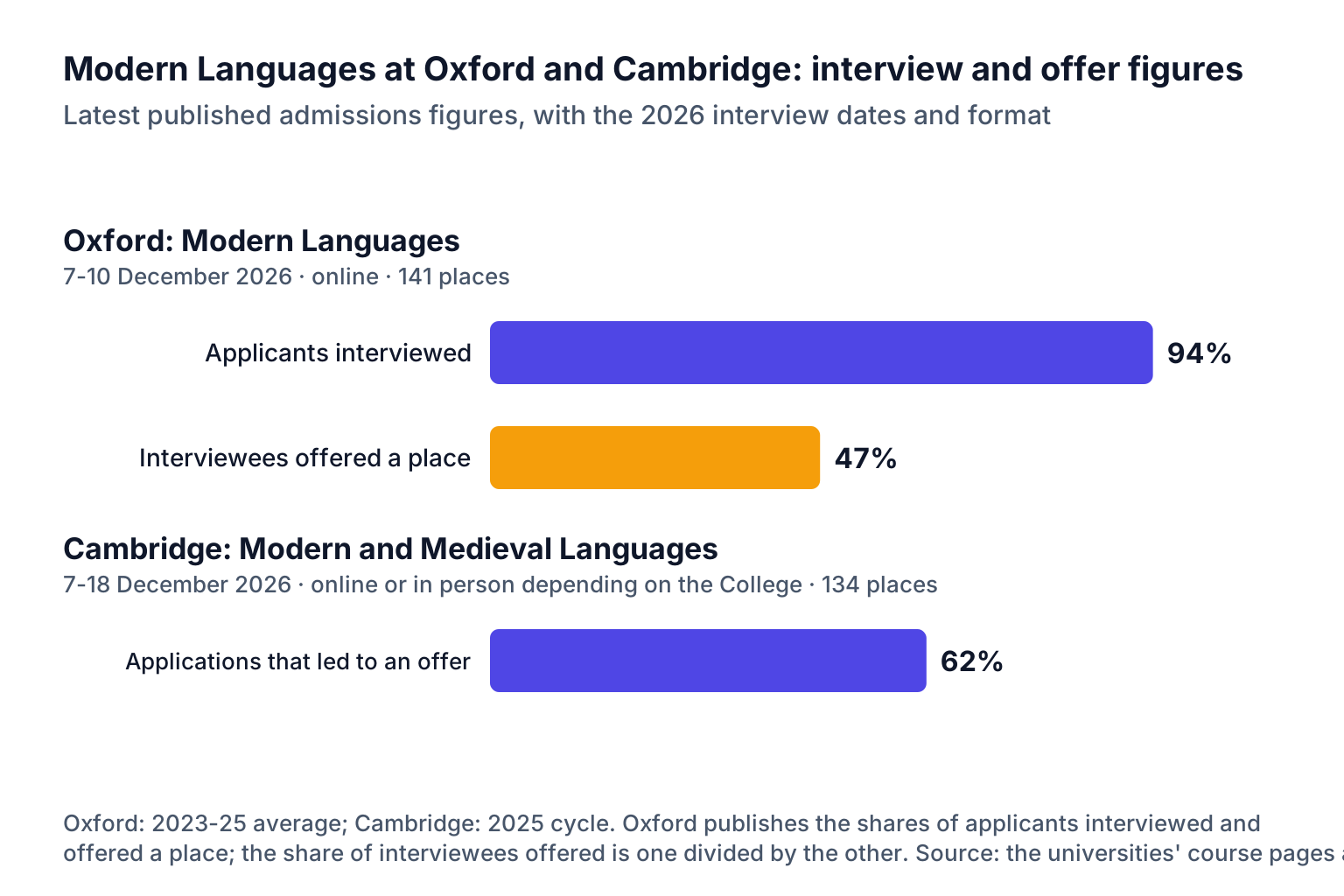
The numbers show where the decision is made. Oxford's published admissions statistics (three-year average, 2023-25) record 141 places, with 94% of applicants interviewed and 47% of those interviewed offered a place. Oxford publishes the shares of all applicants interviewed and offered a place; the share of interviewees offered is one divided by the other. Because almost everyone is interviewed, the interview is where roughly half of candidates are separated from the rest. For Cambridge MML, the 2025 cycle statistics show 265 applications, 164 offers and 134 places.
Anything you submitted is likely to come up in the conversation. Re-read it as if a tutor will ask you to defend it.
2. How the Oxford Modern Languages interview runs
The Oxford Modern Languages interview is online. For 2026, interviews run on 7-10 December, with additional interviews on 14-16 December 2026 (every course's dates are in the Oxford interview dates guide). All shortlisted applicants are interviewed, so keep both windows clear until you know your slot.
Expect one interview per language or subject, each lasting approximately 30 minutes. Because Oxford lets you study one language or two, an applicant for two languages should expect an interview for each. Each interview is typically run by two Oxford academic tutors.
Inside those 30 minutes, the interview usually covers three things:
- A short text that you read during the interview and then discuss with the tutors.
- A grammar exercise and a brief conversation in the target language. Part of the interview may be conducted in the foreign language.
- Your personal statement. The tutors may pick up anything you have written about your reading or interests.
The reading and the grammar exercise both happen in the room. That means you can't learn answers in advance. You can only get comfortable reading something unseen and talking about it while the clock runs.
If you are applying for two languages, each interview has its own text, grammar and conversation. Re-read the parts of your personal statement that relate to each language separately. A slip in one interview does not have to follow you into the next, so treat each one as a fresh start.
Takeaway: plan for each interview as a separate 30-minute conversation covering reading, language accuracy and your own stated interests.
3. How the Cambridge MML interview runs
The Cambridge MML interview has no single format. Your College decides how many interviews you have, how long they last and whether they happen online or in person, so the invitation letter is the document to read most closely.
The main interview period runs from 7-18 December 2026, with the winter pool (when shortlisted applicants can be reconsidered by another College) interviewing in mid to late January 2027. Here is how the rest is set:
| Feature | What to expect |
|---|---|
| Number of interviews | Varies by College: most applicants have 1-2, some have 3-4 |
| Total length | 35 minutes to 1 hour for most applicants, varying by College |
| Mode | Online or in person, depending on the College |
| Interviewers | Two or three in subject interviews; general academic interviews may include academics from other subjects |
Before the Cambridge modern languages interview, you submit two pieces of written work. Some Colleges also set pre-interview reading or tasks, and if yours does, the invitation will say so. Read it line by line rather than skimming for the date.
There is no pre-registered admission test. Instead, every College sets a College admission assessment on Thursday 19 November 2026: a discursive response in the foreign language (40 minutes) and a discursive response in English (20 minutes). That date falls weeks before the December interviews, so both pieces of writing are finished before you meet anyone.
Language choice matters too. Cambridge's course page says all MML students study two languages, and one can be started from scratch, except French, which requires A level or IB Higher Level. If you are applying with French, prepare for French to be a language you could be interviewed in.
Takeaway: find your College's interview details in the invitation, then note 19 November and the two pieces of written work in your calendar.
4. Oxford vs Cambridge Modern Languages interview: where they differ
| Oxford | Cambridge | |
|---|---|---|
| Interview dates 2026 | 7-10 December 2026; additional dates 14-16 December 2026 | 7-18 December 2026 (main period); winter pool mid to late January 2027 |
| Number of interviews | Typically one per language or subject | Varies by College: most applicants have 1-2, some have 3-4 |
| Length | Approximately 30 minutes each | 35 minutes to 1 hour in total for most applicants, varying by College |
| Mode | Online | Online or in person, depending on the College |
| Interviewers | Oxford academic tutors, typically two per interview | Two or three in subject interviews; general academic interviews may include academics from other subjects |
| What is handed over or discussed | A short text to read and discuss, a grammar exercise, a brief conversation in the target language, and your personal statement | Your written work and any pre-interview reading or tasks your College sets |
| What is submitted or sat beforehand | Not specified in the interview details | College admission assessment on Thursday 19 November 2026 (Discursive response in Foreign Language, 40 minutes; Discursive response in English, 20 minutes) and two pieces of written work |
| Who is interviewed | All shortlisted applicants | Shortlisted applicants |
The Oxford Modern Languages interview is uniform. Every shortlisted applicant is interviewed online, for about 30 minutes per language, so if you apply for two languages, expect two interviews. At Cambridge, your College decides the mode, the number of interviews and their length. Read your invitation closely, because two applicants for the same course can have very different days. Cambridge applicants also sit the November College assessment and send in two pieces of written work before any interview, so tutors already have your writing in front of them when you meet.
5. What Oxford Modern Languages interview questions are designed to test
Oxford says it assesses two things at a Modern Languages interview: potential in language and literature and suitability for tutorial teaching. Both make more sense once you see what they mean in the room.
- Potential in language and literature means working with a text you have not seen before. You read a short passage during the interview and discuss it. Nobody expects you to already know it.
- Suitability for tutorial teaching means responding to a tutor's follow-up, not delivering a prepared set piece. The interview is closer to a small tutorial than to a presentation.
Thinking aloud
Oxford modern languages interview questions are built to show how you work, not whether you land on one right answer. Reasoning through a passage or a grammar point out loud gives the two tutors something to respond to. Oxford's sample interview questions page includes a Modern Languages question, listed in section 6, that asks what is lost when a foreign work is read only in translation: there is no single right answer, only a case to build and defend. A hint from a tutor is part of the process, not a sign you have failed.
Changing your mind when pushed
Cambridge lists critical and independent thinking and curiosity among the qualities it assesses. If a tutor points to a detail in the text and you revise your reading to account for it, that shows the thinking Cambridge describes. Defending a reading the text no longer supports does not.
Using what you have been taught
Languages interview questions at university level test reading and reasoning, not recall. Apply the grammar and literary analysis from your A-level or IB course to the unseen text in front of you. Name the tense, notice the register and ask why the writer chose a particular word.
6. Questions reported at Oxford Modern Languages interviews, and practice questions
Every question below can be traced to its source: five are published by the University of Oxford on the linked page; three come from a practice pack Lucy Cavendish College, Cambridge, compiled to show the kind of question asked at Oxbridge interviews; and 13 were reported by applicants describing their own Modern Languages interview. Tutors write new material each year, so read these for the kind of thinking they call for, not as a list to learn.
| Question | Reported at | Source |
|---|---|---|
| Should poetry be difficult to understand? | Oxford | University of Oxford, published sample question |
| What makes a novel or play political? | Oxford | University of Oxford, published sample question |
| What makes a short story different from a novel? | Oxford | University of Oxford, published sample question |
| What do we lose if we only read a foreign work of literature in translation? | Oxford | University of Oxford, published sample question |
| In a world where English is a global language, why learn French? | Oxford | University of Oxford, published sample question |
| Can you apply the books you've mentioned in your personal statement to other situations or works of literature? | Oxford | Applicant report, whatshotblog.com |
| When do you think the poem was written? | Oxford | Applicant report, carambalache.wordpress.com |
| Why not continue learning Mandarin? | Oxford | Applicant report, whatshotblog.com |
| Did you study these texts in class or read them for leisure? | Oxford | Applicant report, whatshotblog.com |
| Did you find Flaubert's work difficult to read? | Oxford | Applicant report, whatshotblog.com |
| What English books have you read recently? | Oxford | Applicant report, whatshotblog.com |
| What are some issues with translation? | Oxford | Applicant report, whatshotblog.com |
| Why not Spanish or German? | Oxford | Applicant report, whatshotblog.com |
| What other language would you like to learn and why? | Oxford | Applicant report, whatshotblog.com |
| Is Gatsby still relevant in today's society? | Oxford | Applicant report, whatshotblog.com |
| What similarities and differences are there between the sonnet and Madame Bovary? | Oxford | Applicant report, whatshotblog.com |
| Can we consider Madame Bovary a role model? | Oxford | Applicant report, whatshotblog.com |
| Which language do you want to pick? | Oxford | Applicant report, carambalache.wordpress.com |
| Why haven't there been many French operas? | Oxbridge practice pack | Lucy Cavendish College, Cambridge, Oxbridge practice pack |
| What are the differences between Spain and Latin America? | Oxbridge practice pack | Lucy Cavendish College, Cambridge, Oxbridge practice pack |
| How does Le Monde differ from English broadsheets? | Oxbridge practice pack | Lucy Cavendish College, Cambridge, Oxbridge practice pack |
Our dataset holds 116 further questions reported for these courses, mostly from preparation companies' lists and forum threads that cannot be traced to a university page or a first-hand account, so they are not reproduced here.
7. How to prepare for a Cambridge or Oxford Modern Languages interview
Preparation works best in the order the process runs. Cambridge applicants face a written assessment before any interview, so they should start there. Oxford applicants can move straight to interview material.
Do the Cambridge assessment work first. The College admission assessment is on Thursday 19 November 2026, under three weeks before the main Cambridge interview period of 7-18 December 2026. It has two discursive responses: 40 minutes in the foreign language and 20 minutes in English. The foreign-language task gets twice the time, so practise writing an argued response in your target language against the clock, not only in English.
Re-read what you sent. Oxford tutors discuss your personal statement. Cambridge interviewers have your two pieces of written work. For every book, film or idea you named, be ready to say what you think of it and why, then defend that view. If you no longer agree with something you wrote, decide now how you would put it differently.
Practise unseen material aloud. Take short passages, some in your target language and some in English:
- Read each passage once.
- Talk through what it does with a friend, parent or teacher who keeps asking "why?".
- Point to specific words or choices rather than summarising the plot.
This mirrors the short text read during the Oxford interview and the discursive tasks in the Cambridge assessment.
Speak the language in short bursts. Oxford French interview candidates, like those in every other language, face a grammar exercise and a brief conversation in the target language. A few minutes of unscripted speaking each day will help more than one long session the night before.
Revise grammar actively. Go back through the grammar from your A-level or IB course and explain each rule out loud, for instance when the subjunctive is triggered or why an agreement changes. Explaining shows you understand a rule. Reciting a table only shows you memorised it. Language work makes up around 50% of both first-year and final examinations at Oxford, so grammar is the foundation of the degree, not a side issue.
Check your Cambridge invitation. Some Colleges set pre-interview reading or tasks and name them in the invitation. Complete them before the interview and keep brief notes you can talk from.
8. Setting up for an online languages interview
Check the mode in your invitation first. The Oxford Modern Languages interview is held online. At Cambridge, interviews are online or in person depending on the College.
If yours is online, sort out the basics early:
- A room you can keep for the whole slot. Oxford interviews last approximately 30 minutes. At Cambridge, most applicants spend 35 minutes to an hour in total, depending on the College. Allow a margin either side.
- A stable connection. Sit close to the router, or use a wired connection if you can.
- A working camera and microphone. Check them on the device you will actually use.
- A test call a few days before. Do it at the same time of day if possible.
Oxford gives you a short text to read during the interview. Make sure your screen is large and clear enough to read comfortably. If the instructions you receive allow notes, keep paper and a pen nearby.
Part of the interview may be in the foreign language, and audio lag is harder to handle in a second language. You may hear the end of a sentence late and start talking over the tutor. Practise a short spoken exchange in the target language on a video call beforehand. Get used to leaving a brief pause before you reply.
9. Mistakes that sources warn against
Only two mistakes come up clearly in the published sources, and both concern how you answer rather than how much you know.
- Scripting answers. The Interview Question Pack (AHSS) hosted by Lucy Cavendish College, Cambridge says its questions are "NOT intended for you to prepare specific answers ahead of your interview". It adds that "Interview questions change each year and interviewers are not looking for pre-prepared answers." Use any list of Oxford modern languages interview questions to practise reasoning out loud, not to memorise replies.
- Oversimplifying. On Oxford's sample interview questions page, Asian and Middle Eastern Studies tutor Alison Salvesen describes a one-line, absolute answer as "much too simplistic". Her comment is about her own subject, but the general lesson carries over: tutors expect answers that are qualified and grounded in evidence.
When you practise, treat any answer that fits in one confident line as unfinished. Add the qualification and the evidence before you move on.
10. What to do next before your Modern Languages interview
This week, re-read your personal statement and any written work you submitted, and mark every text or idea you could be asked to expand on. Tutors build on what you gave them, so a book you mentioned in passing is fair ground.
In the fortnight before the interview:
- Read a short unseen passage each day and talk about it aloud, ideally to someone who keeps asking you to justify your points.
- Rehearse a brief conversation in the target language so that switching out of English feels routine.
- Test your online set-up at the time of day your slot is likely to fall. Oxford holds these interviews online, with main dates of 7-10 December 2026.
If you applied to Cambridge, check your College invitation for any pre-reading. Confirm whether your interview is online or in person, because this varies by College.
Related guides
- Oxford interview and offer rates by course
- Cambridge interview dates 2026
- Cambridge offer rates by course
- Oxbridge English interview questions
- Oxbridge philosophy interview questions
- Every Oxbridge and medicine interview guide
Course pages
Entry requirements and the latest admissions figures: Cambridge Modern and Medieval Languages.
FAQ
How long is the Oxford Modern Languages interview?
Each Oxford Modern Languages interview lasts approximately 30 minutes, and applicants typically have one interview per language or subject, usually with two academic tutors.
Is the Oxford Modern Languages interview online or in person?
Oxford's course page lists the Modern Languages interview as online, held on 7-10 December 2026 with additional interviews on 14-16 December 2026.
Will part of the interview be in the foreign language?
At Oxford, part of the interview may be conducted in the foreign language, including a grammar exercise and a brief conversation in the target language.
Does Cambridge MML have an admissions test?
Cambridge MML has no pre-registered admission test; instead all Colleges set a College assessment on Thursday 19 November 2026 with a 40-minute discursive response in the foreign language and a 20-minute discursive response in English.
How many interviews do Cambridge MML applicants have?
It varies by College: most applicants have one or two interviews totalling 35 minutes to an hour, some have three or four, and interviews are online or in person depending on the College.
Should I prepare answers to Modern Languages interview questions?
The interview question pack hosted by Lucy Cavendish College, Cambridge states that interview questions change each year and interviewers are not looking for pre-prepared answers, so practise reasoning aloud on unseen material instead.
References
- Modern Languages | Oxford University - https://www.ox.ac.uk/admissions/undergraduate/courses/course-listing/modern-languages
- Modern and Medieval Languages, BA (Hons) | Undergraduate Study - https://www.undergraduate.study.cam.ac.uk/courses/modern-medieval-languages-ba-hons
- Undergraduate Admissions Statistics, 2025 cycle, University of Cambridge - https://www.undergraduate.study.cam.ac.uk/sites/default/files/2026-05/ug_admissions_statistics_2025_cycle.pdf
- Sample interview questions | Oxford University - https://www.ox.ac.uk/admissions/undergraduate/applying/guide-for-applicants/interviews/sample_questions
- Applicant report: whatshotblog.com - https://whatshotblog.com/oxford-interview-modern-languages/
- Applicant report: carambalache.wordpress.com - https://carambalache.wordpress.com/2014/11/07/oxford-interviews-for-modern-languages/
- Interview question pack (arts, humanities and social sciences), Lucy Cavendish College - https://www.lucy.cam.ac.uk/sites/default/files/inline-files/Interview%20Question%20Pack%20%28AHSS%29.pdf