Oxford Law Interview Questions: Oxbridge 2026 Guide
By Michael Thompson · Education Specialist; 10 years teaching the IB at Bromsgrove School · Published 26 October 2026 · Updated 28 October 2026
Oxford law interview questions test how you reason aloud rather than what law you already know: you work through legally related questions, logical puzzles and possibly a legal extract with academic tutors. At Oxford, every shortlisted applicant has at least two online interviews at their first college, each lasting no more than 30 minutes and typically led by two tutors. Cambridge runs its Law interviews differently, with the format, length and mode (online or in person) set by each College and two or three interviewers in subject interviews. Both universities say plainly what they are looking for: Oxford assesses reasoning and analytical ability, while Cambridge looks for your ability to form and defend a logical argument, recognise counter-arguments and revise your view when given new information. This guide sets out how each interview runs, what you may be handed beforehand, what tutors mean by those criteria and how to prepare in the weeks before the December 2026 interviews.
Key Takeaways
- Oxford interviews are online and short: Shortlisted Oxford Law applicants have at least two interviews at their first college, each no more than 30 minutes, usually with two academic tutors.
- Cambridge varies by College: The number, length and mode (online or in person) of Cambridge Law interviews depend on the College, with two or three interviewers in subject interviews.
- Some Colleges set reading in advance: Cambridge Colleges may ask for written work or set pre-interview reading, and some, such as Trinity and St Catharine's, send a problem or texts to read beforehand.
- Reasoning matters more than legal knowledge: Oxford assesses reasoning and analytical ability, and Cambridge states that no prior study of law is needed.
- Changing your mind can count in your favour: Cambridge explicitly assesses whether you can revise your view when given new information, so updating an argument under pressure is part of the task.
- Dates are fixed in December 2026: Oxford Law interviews run 7 to 9 December with an additional day on 11 December, and the Cambridge main period runs 7 to 18 December.
In This Article
- What Oxford law interview questions actually involve
- How the Oxford law interview and Cambridge law interview compare
- What you may be given before or during the interview
- Questions reported at Oxford and Cambridge Law interviews, and practice questions
- What tutors are assessing and how it shows in the conversation
- How competitive Oxbridge Law is: the admissions numbers
- How to prepare for Oxford and Cambridge law interview questions
- Setting up for an online Law interview
- Mistakes to avoid with Oxbridge law interview questions
- What to do next before your Law interview
1. What Oxford law interview questions actually involve
Oxford law interview questions ask you to reason aloud about a legal scenario, a logical puzzle or a short legal extract with academic tutors. They do not test how much law you can recite. The same applies at a Cambridge law interview. You work through unseen material in real time, and the tutors watch how you think.
Oxford's Law (Jurisprudence) course page says interviews involve "legally related questions" and "logical puzzles", and you may be given a legal extract to discuss. In Oxford's words, what is assessed is your "reasoning and analytical ability". Oxford academic tutors run the interviews, typically two per interview.
Cambridge's Law course page says no prior study of law is needed. It lists three things tutors assess:
- Forming and defending a logical argument
- Recognising counter-arguments to your own position
- Revising your views in light of new information
The third strand is easy to underrate. When a tutor adds a fact that weakens your position, sticking rigidly to your first answer does not show strength. Cambridge names the willingness to adjust as part of what it assesses. The material is also unseen, so memorised case law will not carry the conversation. Your reasoning about what is in front of you does that.
Takeaway: treat the interview as a supervised reasoning exercise on unseen material. Practise thinking out loud through an unfamiliar problem rather than rehearsing answers.
2. How the Oxford law interview and Cambridge law interview compare
| Oxford | Cambridge | |
|---|---|---|
| Interview dates 2026 | 7 to 9 December 2026, plus an additional date on 11 December 2026 | 7 to 18 December 2026 (main period); winter pool mid to late January 2027 |
| Number of interviews | At least 2 at your first college | Varies by College |
| Length | No more than 30 minutes | Varies by College |
| Mode | Online | Online or in person, depending on the College |
| Who interviews | Oxford academic tutors, typically two per interview | Two or three interviewers in subject interviews; general academic interviews may be with academics from other subjects |
| Before the interview | Sit the LNAT | Sit the LNAT; some Colleges set written work, reading or tasks, confirmed in your invitation |
| Admissions test | LNAT | LNAT, described as a pre-registered admission test |
| Who is interviewed | All shortlisted applicants | Shortlisted applicants |
Sources: Law (Jurisprudence), University of Oxford; Law, BA (Hons), University of Cambridge.
The main difference is who sets the format. At Oxford, the course page describes one format for every Law applicant. You can plan around fixed dates, an online interview, at least two interviews at your first college and a 30-minute ceiling, per the Oxford course page. At Cambridge, your College decides. The number of interviews, their length and whether you join online or in person can all differ between two applicants for the same course, according to the Cambridge course page.
Cambridge also lists a winter pool in mid to late January 2027, after the main December interview period.
One detail is easy to miss. A Cambridge general academic interview may be led by someone who does not teach Law. That makes it worth practising reasoning you can explain without legal shorthand. The same habit also helps with Oxford law interview questions, where the tutors are lawyers but still want to follow each step of your thinking.
Takeaway: read your interview invitation line by line when it arrives, especially for Cambridge. It is where your College confirms the number of interviews, their length, the mode, and any reading or tasks you need to complete beforehand.
3. What you may be given before or during the interview
What lands in front of you depends on the university, and at Cambridge it also depends on the College.
At Oxford, the material arrives during the interview itself. The Oxford Law (Jurisprudence) course page says you may be given a legal extract to discuss, alongside legally related questions and logical puzzles. You read it there and reason about it on the spot.
At Cambridge, some of the work can come first. The Cambridge Law course page explains that some Colleges ask for written work. Pre-interview reading or tasks are possible, and your College will say so in the invitation. Some Colleges, such as Trinity and St Catharine's, give a problem or texts to read beforehand. Both publish illustrations of the format: Trinity's law factual scenario example and St Catharine's sample law interview texts. Use them to see what the material looks like, not as a forecast of what you will get.
Reading a scenario or passage in advance is not the same as rehearsing a speech. In practice it means you:
- Annotate it by marking the facts that matter and any words whose meaning seems open.
- Identify the issue and the competing positions each side could take.
- Be ready to explain your reading, including why you favoured one interpretation over another.
The trade-off is that advance reading removes the surprise but gives you time to form a view. Expect that view to be tested.
If your invitation includes reading, budget time to read it more than once and note where you are unsure. Those uncertain points are worth raising openly rather than hiding.
4. Questions reported at Oxford and Cambridge Law interviews, and practice questions
Every question below can be traced to its source: five are published by universities and their Colleges on the linked page; nine come from a practice pack Lucy Cavendish College, Cambridge, compiled to show the kind of question asked at Oxbridge interviews; and one was reported by an applicant describing their own Law interview (The Student Room reports are named but not linked). Tutors write new material each year, so read these for the kind of thinking they call for, not as a list to learn.
| Question | Reported at | Source |
|---|---|---|
| If the punishment for parking on double yellow lines were death, and therefore nobody did it, would that be a just and effective law? | Oxford | University of Oxford, published sample question |
| Concocting evidence 'You are the sheriff of a small town on the American frontier 150 years ago. ... Do you concoct the evidence to save the town from violence and potentially prevent the deaths of numerous people? Would your answer be different if: 1) You discovered that the real murderer was the son of another prominent local family, and you believed it highly likely revealing the killer's identity would lead to violence between the two families which could well result in numerous deaths? 2) You knew that the homeless man had been convicted of another murder and was on the run from a death sentence from another town? 3) You did have evidence of the homeless man's guilt in the murder of the young woman, but you knew it would be rejected by the court on a 'technicality' of evidence rules? Would you concoct new evidence?' | Oxford | University of Oxford, published sample question |
| What does it mean for someone to 'take' another's car? | Oxford | University of Oxford, published sample question |
| Should it be illegal to run a red light in the middle of the night on an empty road? | Oxford | University of Oxford, published sample question |
| If a cyclist is travelling in the opposite direction in a one way road and gets hit by a brick dropped by a builder overhead, what can he do? | Oxford | Applicant report, The Student Room (not linked) |
| Reading a short judgment: what are the facts of the case, what did the parties argue, what did the judge decide and why, and can you deduce a legal rule from the judgment that could be used to decide similar cases in the future? | Cambridge | St Catharine's College, Cambridge, published sample question |
| Do you enter a contract when you get on a bus? | Oxbridge practice pack | Lucy Cavendish College, Cambridge, Oxbridge practice pack |
| What is 'necessity'? Are there any times when a defence of necessity would not be appropriate? | Oxbridge practice pack | Lucy Cavendish College, Cambridge, Oxbridge practice pack |
| A man stabbed another man in his sleep, not realising that his victim had already died in his sleep from a heart attack. Should the stabber be convicted of murder? | Oxbridge practice pack | Lucy Cavendish College, Cambridge, Oxbridge practice pack |
| Should the use of mobile phones be banned on public transport? | Oxbridge practice pack | Lucy Cavendish College, Cambridge, Oxbridge practice pack |
| Tell me about a case that you find particularly interesting. | Oxbridge practice pack | Lucy Cavendish College, Cambridge, Oxbridge practice pack |
| Does a girl scout have a political agenda? | Oxbridge practice pack | Lucy Cavendish College, Cambridge, Oxbridge practice pack |
| What is best: a written or non-written constitution? | Oxbridge practice pack | Lucy Cavendish College, Cambridge, Oxbridge practice pack |
| Can you imagine a world without laws? | Oxbridge practice pack | Lucy Cavendish College, Cambridge, Oxbridge practice pack |
| Why should justice not be retributive? | Oxbridge practice pack | Lucy Cavendish College, Cambridge, Oxbridge practice pack |
Our dataset holds 179 further questions reported for these courses, mostly from preparation companies' lists and forum threads that cannot be traced to a university page or a first-hand account, so they are not reproduced here.
5. What tutors are assessing and how it shows in the conversation
Both universities publish what their Law tutors are looking for, and neither list mentions legal knowledge. Oxford says the interview assesses "reasoning and analytical ability". Cambridge names three strands: forming and defending a logical argument, recognising counter-arguments, and revising views on new information.
The Cambridge course page also says that no prior law is needed. That shapes how you should approach Oxford law interview questions and their Cambridge equivalents. Tutors cannot assume you have studied law, so they test you on the material they hand you: the facts of a scenario or the extract in front of you. Applying that material carefully counts for more than reciting a memorised rule that may not even fit the facts.
In the conversation, those published criteria show up as four behaviours:
- Thinking aloud so the tutors can follow each step. If you go silent and then announce a finished answer, they have no reasoning to assess.
- Taking a position on the scenario or extract and giving reasons for it. Listing every possible view without choosing one does not count as an argument.
- Spotting the strongest objection to your own view and naming it yourself, without waiting for a tutor to raise it.
- Adjusting your answer when a tutor changes a fact or offers new information, and explaining why the change matters.
The last point is easy to misread under pressure. A changed fact does not necessarily mean your first answer was wrong. Revising your view on new information is one of the strands Cambridge says it assesses. A reasoned shift shows that strand. Holding your first answer whatever the new fact is does not.
Practise reasoning aloud in a fixed shape: "I think X, because Y, though Z cuts against it, and here is why I still land on X (or why Z changes my mind)." Use that structure on unseen passages until stating the objection becomes a habit.
6. How competitive Oxbridge Law is: the admissions numbers
Both universities publish Law admissions figures, but they count them in different ways, so read each set on its own terms.
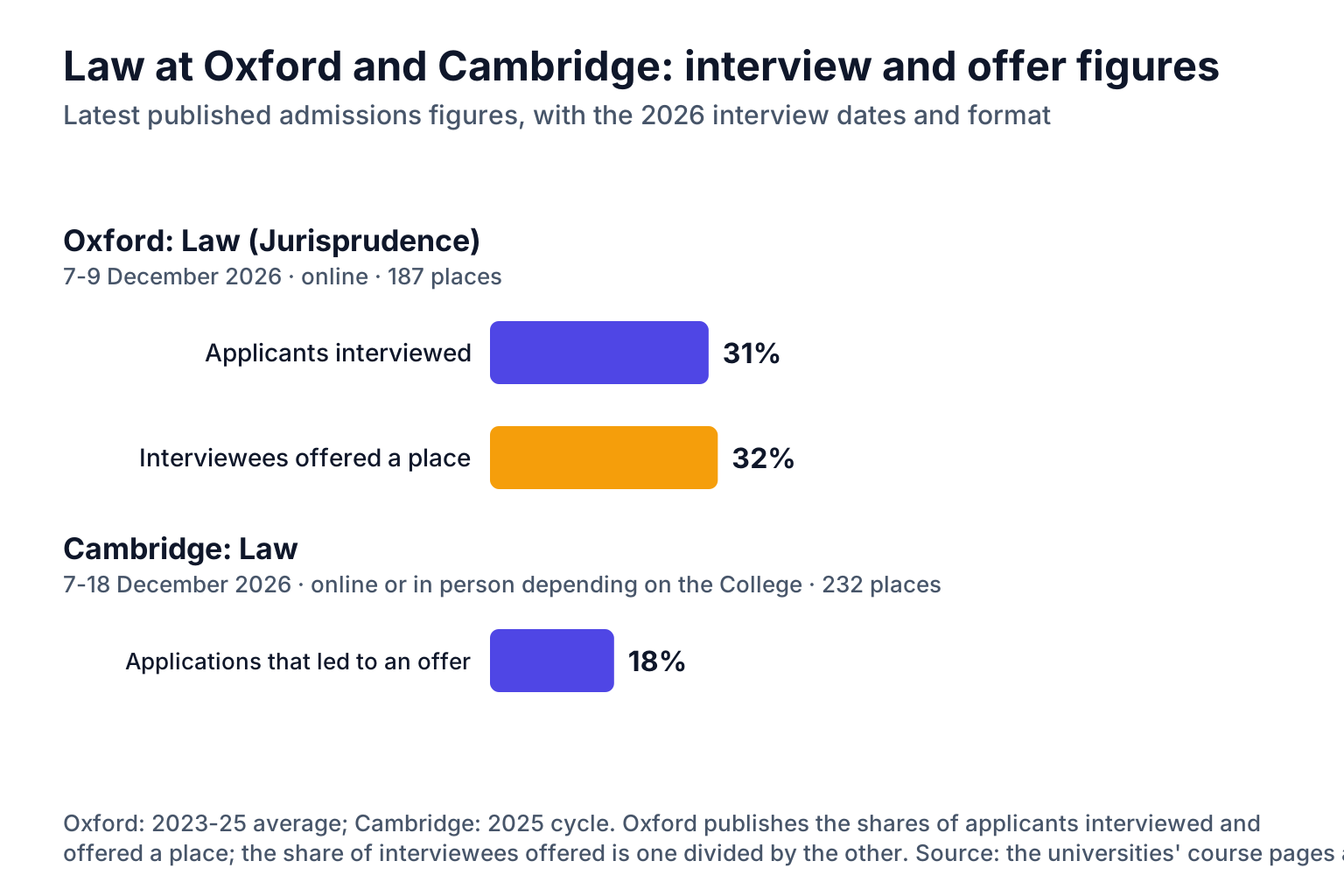
- Oxford, three-year average (2023 to 2025): 187 places, with 31% of applicants interviewed and 10% offered a place, according to the University of Oxford Law (Jurisprudence) course page; dividing one by the other, about 32% of those interviewed received an offer.
- Cambridge, 2025 cycle (applications from September 2024 for entry in October 2025 or deferred entry in 2026): 1,654 applications, 291 offers and 232 places, according to Cambridge's 2025 cycle admissions statistics.
The Oxford figures are an average across three years. The Cambridge figures cover one cycle. A side-by-side ratio would mislead, so treat them as two separate snapshots.
Note what the 32% measures. It is the share of interviewees who received offers, not the share of all applicants, calculated from Oxford's two published shares. Cambridge also reports offers and places as separate figures, so the two numbers are not interchangeable.
If you have an interview invitation, you have already passed the first filter. Law interview questions at both universities reward reasoning practised aloud. Spend your remaining time on that practice rather than on the odds.
7. How to prepare for Oxford and Cambridge law interview questions
Most of the preparation for Oxford law interview questions and their Cambridge equivalents comes down to two things: knowing your own application thoroughly and reasoning aloud about material you have not seen before. Cambridge states that no prior study of law is needed (University of Cambridge), so learning cases by heart is not the goal.
Re-read everything you submitted
Go back through your personal statement line by line. Some Cambridge Colleges also ask for written work (University of Cambridge), so re-read that too. For each argument, prepare three things:
- The strongest objection someone could raise against it
- What new information would change your view
- How you would extend the point one step further than you did on paper
If you mention a book or a case, assume you may have to explain it, not just name it.
Practise unseen material aloud
Find someone who will keep asking "why?" after every answer. They do not need to know any law. Their job is to stop you settling on a conclusion too early. For material, use the Colleges' own published formats:
- Trinity's Law factual scenario example
- St Catharine's sample interview texts
- Lucy Cavendish's interview question pack for arts, humanities and social sciences applicants
Work through each one cold, then talk your reasoning through before you look at any guidance. Once you have read a file, it is no longer unseen, so save some for later sessions.
The admissions test is behind you
Oxford lists the LNAT as one step of its process (University of Oxford), and Cambridge describes it as a pre-registered admission test (University of Cambridge). By interview season you have sat it. Put your time into talking, not test practice.
Plan around the fixed dates
| Oxford | Cambridge | |
|---|---|---|
| Interview dates | 7 to 9 December 2026, plus an additional day on 11 December | Main period 7 to 18 December 2026 |
| What to check | Your invitation and timings | Your invitation for any pre-reading or tasks |
Sources: University of Oxford, University of Cambridge.
Keep the whole window clear. The Cambridge period runs for nearly two weeks, so avoid booking anything you cannot move.
Schedule several short practice sessions on unseen passages rather than one long one. Oxford interviews last no more than 30 minutes, so sessions of about that length match the real thing and keep each passage fresh.
8. Setting up for an online Law interview
Your Oxford Law interview will take place online, according to the University of Oxford Law (Jurisprudence) course page. At Cambridge, interviews are online or in person depending on the College, per the Cambridge Law course page. Confirm which applies to your College before you plan anything else.
None of the following is a university rule. It is simply what an online interview needs:
- A quiet room where nobody will walk in for the whole slot.
- A reliable connection, ideally close to the router or on a wired link.
- A charged device, kept plugged in during the call.
- A test call with a friend or teacher a few days before.
- Paper and a pen within reach.
The pen matters more than it looks. Oxford says you may be given a legal extract to discuss. Jotting down who did what in a scenario keeps your reasoning organised while you talk it through.
Run a full practice call from the same room and device you will use on the day.
9. Mistakes to avoid with Oxbridge law interview questions
Most avoidable errors come from preparing for a different interview from the one the tutors actually describe. Each follows from what the universities' own course pages say they assess.
- Cramming legal knowledge. The University of Cambridge says no prior study of law is needed. Hours spent memorising case names can crowd out the skill being tested. A half-remembered rule is also harder to defend under questioning than reasoning built from the material in front of you.
- Hunting for the "right" answer. Cambridge says it assesses whether you can form and defend a logical argument, recognise counter-arguments and revise your view when given new information. Oxford names reasoning and analytical ability. When a tutor pushes back, refusing to budge can show less than adjusting your position and explaining why.
- Skipping the pre-reading. Some Cambridge Colleges set reading, a problem or a task before the interview, and the College says so in the invitation (Cambridge). Read the whole invitation on the day it arrives.
Prepare by working on the reasoning the tutors describe on their own course pages, not by revising law you have not yet been taught.
10. What to do next before your Law interview
Start with what the tutors already have in front of them. This week, re-read your personal statement and any submitted written work, and note the arguments you would need to defend. Mark any claim you could not explain from first principles if a tutor pushed back on it.
In the fortnight before the interview:
- Check your invitation for pre-reading or written tasks. At Cambridge, your College says in the invitation whether there is material to read beforehand.
- Practise unseen passages aloud with someone who keeps asking why. A friend or parent with no legal background works well, because they will not let you skip steps in your reasoning.
- Run a test call if your interview is online. Every Oxford Law interview is online, and some Cambridge Colleges interview online too.
Ask your practice partner for a date now, then check your invitation again the night before.
Related guides
- Oxford interview dates 2026, every course
- What an Oxford interview is like
- Oxford interview and offer rates by course
- Cambridge interview dates 2026
- What a Cambridge interview is like
- Cambridge offer rates by course
- Oxbridge history interview questions
- Oxford PPE interview questions
- Every Oxbridge and medicine interview guide
Course pages
Entry requirements and the latest admissions figures: Oxford Law (Jurisprudence) and Cambridge Law.
FAQ
Are Oxford law interview questions hard?
They are designed around unseen legally related questions, logical puzzles and possibly a legal extract, so the challenge is reasoning on the spot rather than recalling legal knowledge, and Oxford says it assesses reasoning and analytical ability.
How hard is it to get into Oxford law?
On Oxford's three-year average for 2023 to 2025, there were 187 places, 31% of applicants were interviewed and 10% were offered a place, so about a third of those interviewed received an offer.
What do you need to get into Oxford law?
Oxford Law applicants sit the LNAT admissions test, and shortlisted applicants then have at least two online interviews assessing reasoning and analytical ability.
How long is the Oxford law interview?
Each Oxford Law interview lasts no more than 30 minutes, and shortlisted applicants have at least two interviews at their first college, typically with two tutors per interview.
Do you need to have studied law for a Cambridge law interview?
No, Cambridge states that no prior study of law is needed and assesses your ability to form and defend a logical argument, recognise counter-arguments and revise your view on new information.
References
- Law (Jurisprudence) | Oxford University - https://www.ox.ac.uk/admissions/undergraduate/courses/course-listing/law-jurisprudence
- Law, BA (Hons) | Undergraduate Study - https://www.undergraduate.study.cam.ac.uk/courses/law-ba-hons
- Law factual scenario example, Trinity College Cambridge - https://www.trin.cam.ac.uk/download/law-factual-scenario-example/?wpdmdl=33088&ind=1621889709482&refresh=0f2787de&filename=Law_Factual_Scenario_Example.pdf
- Sample law interview texts, St Catharine's College Cambridge - https://www.caths.cam.ac.uk/sites/default/files/Law%20Interview%20Texts%20%28Sample%29.pdf
- University of Oxford, published sample question - https://www.ox.ac.uk/admissions/undergraduate/applying/guide-for-applicants/interviews/sample_questions
- Interview question pack (arts, humanities and social sciences), Lucy Cavendish College - https://www.lucy.cam.ac.uk/sites/default/files/inline-files/Interview%20Question%20Pack%20%28AHSS%29.pdf
- Undergraduate Admissions Statistics, 2025 cycle, University of Cambridge - https://www.undergraduate.study.cam.ac.uk/sites/default/files/2026-05/ug_admissions_statistics_2025_cycle.pdf