Best UK Universities for Psychology (2026 Guide)
By Michael Thompson · Former IB Diploma Programme coordinator; 10 years at Bromsgrove School · Published 5 July 2026
Choosing among the best UK universities for psychology is harder than it looks, because the single most important factor - British Psychological Society (BPS) accreditation - is invisible in most league tables. Without a BPS-accredited degree, you cannot gain the Graduate Basis for Chartered Membership (GBC) that every route into clinical, educational, forensic, or counselling psychology requires. Beyond accreditation, the split between BSc and BA programmes changes how much statistics, biology, and lab work you encounter, and the university you choose shapes which research specialisms you can access at postgraduate level. This guide groups universities by research strength and named specialism, maps the entry-requirement spread honestly, and tells you what to check before you apply.
Key Takeaways
- BPS accreditation is non-negotiable: Only a BPS-accredited degree confers the Graduate Basis for Chartered Membership needed to train as a chartered or clinical psychologist - check the BPS register course by course, not just the department's homepage.
- BSc and BA routes differ meaningfully: A BSc typically carries more statistics, neuroscience, and laboratory work; a BA often allows more flexibility with arts or social-science modules - your choice affects both day-to-day study and later postgraduate entry requirements.
- Research strength varies by specialism: Universities cluster around distinct strengths - clinical and neuroscience, forensic and criminal, developmental and child, or experimental - so match the department to your intended career pathway rather than to a single overall rank.
- Entry requirements spread across a wide band: Offers range from the highest tariff (Oxford's three-A-grade range) down to mid-tariff institutions, and some courses require a science GCSE or A-level while others do not.
- IB students should confirm science HL expectations: Most universities publish an IB total-point equivalent and some specify a Higher Level science or maths requirement - always read the individual course page rather than the department's general entry page.
- A placement year changes graduate outcomes: Several strong departments offer an optional sandwich year in industry or a clinical placement, which can strengthen applications for competitive postgraduate training programmes.
In This Article
- Why BPS Accreditation Is the First Thing to Check
- BSc vs BA Psychology: Which Should You Choose?
- Universities Strong in Clinical Psychology and Neuroscience
- Universities Strong in Forensic and Criminal Psychology
- Universities Strong in Developmental and Child Psychology
- Postgraduate Routes: Masters and Doctorate Programmes
- Entry Requirements: From Most to Least Selective
- Comparison Table: Featured Universities at a Glance
- Placement Years and Industry Experience in Psychology
- What to Do Next
1. Why BPS Accreditation Is the First Thing to Check
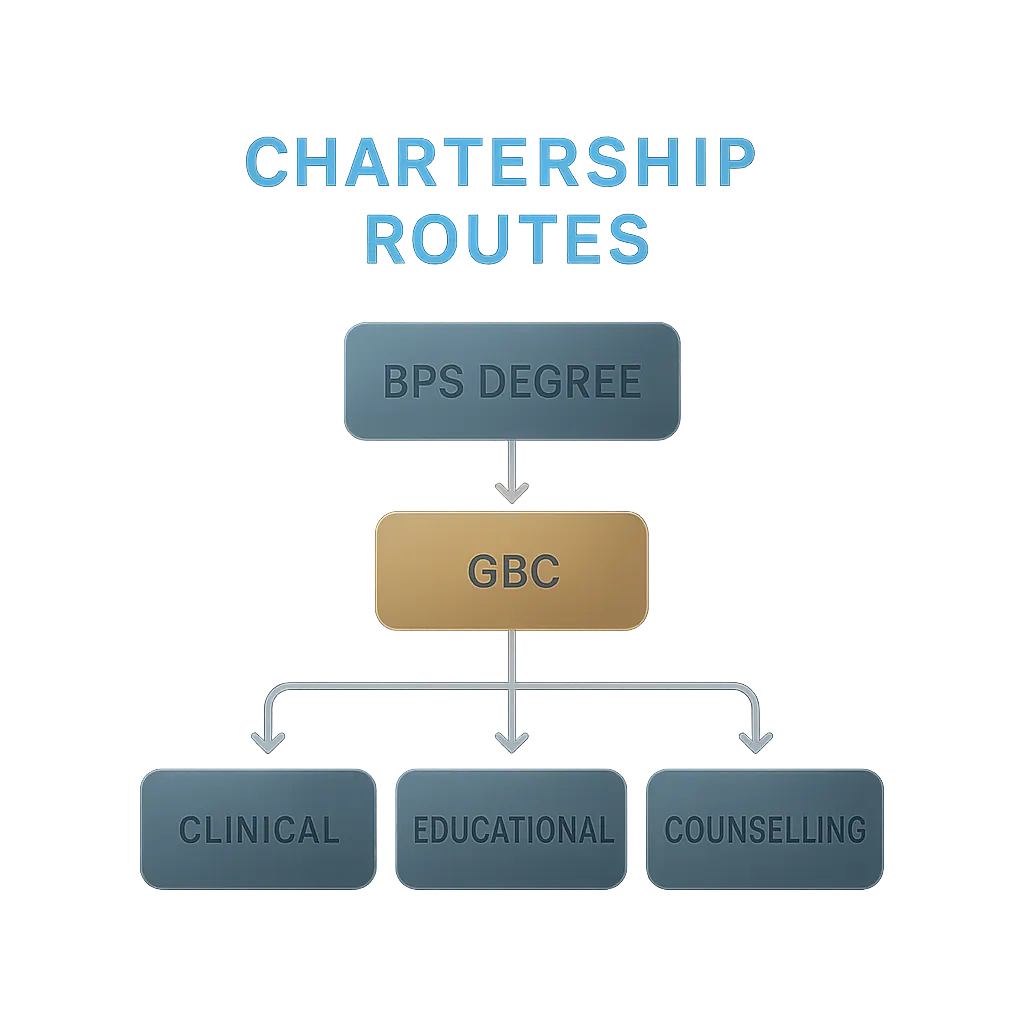
Choosing the best UK universities for psychology is not purely a matter of league table position. Before rankings, open days, or module lists, there is one checkbox that determines whether a degree opens the door to professional psychology training in the UK: British Psychological Society (BPS) accreditation.
BPS accreditation confers Graduate Basis for Chartered Membership (GBC). GBC is the prerequisite for every regulated postgraduate training route in the UK, including clinical, forensic, educational, and counselling psychology programmes. Without it, you cannot apply to a Doctorate in Clinical Psychology (DClinPsy) or most other professional training courses, regardless of your grade.
The critical gotcha is that accreditation is awarded to individual courses, not to departments. A university's flagship single honours BSc may be fully accredited while a joint honours route, a named pathway, or a conversion course at the same institution carries no GBC eligibility at all. This catches applicants who assume a well-regarded psychology department covers everything it teaches.
Oxford is a useful worked example. Both of Oxford's undergraduate Psychology degree courses hold BPS accreditation, conferring eligibility for Graduate Basis of Chartered Membership. Note the precision there: both courses, stated explicitly. That is exactly what you need to confirm for any course you are considering.
Check the BPS website directly for the exact course code and intake year you are applying to. The accredited course list is updated annually, and the 2025 or 2026 entry list may differ from prior years. Do not rely on a university prospectus alone.
2. BSc vs BA Psychology: Which Should You Choose?
The degree title matters more than most applicants realise, and the difference is not simply aesthetic.
A BSc in Psychology is structured around psychology as a natural science. Expect compulsory modules in quantitative research methods, inferential statistics, and biological or cognitive neuroscience, plus laboratory practicals where you collect and analyse real data. Entry requirements reflect this science orientation: Sussex's BSc, for example, requires GCSE Mathematics at grade 4 (grade C) or above, even if your A-levels are not science-based.
A BA in Psychology typically trades some of that lab and stats content for breadth. You may be able to combine psychology with sociology, philosophy, or linguistics, which suits students with a humanities background or a clear interest in counselling, social psychology, or qualitative research traditions.
The less obvious trade-off: some postgraduate training routes specify a preference for BSc-route graduates. Programmes leading to clinical or educational psychology registration look for strong research-methods and statistical foundations. If your long-term aim is a Doctorate in Clinical Psychology (DClinPsy) or a place on an educational psychology training programme, check the entry criteria before assuming either route is equivalent.
A practical checklist before you apply:
- Confirm whether the programme is BPS-accredited for Graduate Basis for Chartered Membership (GBC), regardless of whether it is a BSc or BA.
- Check the specific A-level and GCSE requirements for each title at each institution separately, as they often differ within the same university.
- If your A-levels are entirely arts or humanities subjects, a BA route may be more accessible, but verify it still delivers the research-methods content postgraduate programmes expect.
3. Universities Strong in Clinical Psychology and Neuroscience
Oxford sits at the top for research-intensive psychology in the UK. According to the Department of Experimental Psychology, Oxford ranked 3rd in the world and 1st in Europe for Psychology in the QS 2021 rankings, and came 1st of all UK institutions in the 2014 Research Excellence Framework for Psychology, Psychiatry and Neuroscience. In that same REF submission, 95% of Oxford's research was rated world-leading or internationally excellent.
What makes Oxford unusual is the undergraduate teaching model. Rather than large lectures alone, students receive one-to-one or small-group college tutorials alongside university-wide resources. Both undergraduate courses carry BPS accreditation, giving graduates eligibility for the Graduate Basis for Chartered Membership.
On the research side, the department has close links with the FMRIB Centre for MRI and the OHBA Centre for MEG, making it one of the few UK undergraduate environments where students are proximate to [clinical neuroimaging at scale](/guides/best-universities-for-medicine-uk).
For those focused on the best universities for clinical psychology doctorate UK, Oxford offers the Doctorate in Clinical Psychology, validated by the University of Oxford and run through Harris Manchester College.
One gotcha worth knowing: research-intensive universities typically require a first-class or upper-second undergraduate degree for entry to clinical psychology masters and doctorate programmes. Applying with a 2:2, even from a strong institution, will close most doors at this level. Check entry requirements early rather than treating postgraduate entry as a fallback.
Explore the department and course details on the Oxford Experimental Psychology department page.
4. Universities Strong in Forensic and Criminal Psychology
Forensic and criminal psychology are among the most searched specialisms at undergraduate level, which means course titles have multiplied faster than genuine research infrastructure. A department can slot a "forensic psychology" module into a general BSc without housing a single academic whose primary research sits in that area. The result: two courses with identical titles can offer very different intellectual environments.
The practical test is straightforward. Go to the department's own staff pages and look for academics listed under forensic or criminal psychology as their research specialism. If the staff list shows one or two people teaching forensic modules alongside a broader portfolio, that is a named module, not a research centre. If you find a cluster of staff publishing in offender behaviour, eyewitness testimony, or criminal justice psychology, the department has genuine depth.
A few points worth confirming before you apply:
- BPS accreditation at undergraduate level is still required for the forensic route, exactly as for any other applied branch. Chartership in forensic psychology runs through the BPS Division of Forensic Psychology, which is a separate route from the Division of Clinical Psychology, with its own competency framework and supervised practice requirements.
- Joint honours in criminology and psychology are common, but the BPS accreditation often attaches only to the single-honours psychology degree. Confirm with the admissions team which award carries accreditation before accepting an offer.
When you have a shortlist, cross-check individual university psychology department pages for named research groups rather than relying on course titles alone.
5. Universities Strong in Developmental and Child Psychology
Developmental and child psychology sit within a broader psychology degree at most UK universities, so the module list alone tells you relatively little. The more reliable signal is whether the department runs an active infant or child lab. A named module called "Child Development" can be taught entirely from textbooks; a department with a dedicated child development research suite means undergraduates encounter real studies, real data collection, and sometimes participant observation with children.
Sussex is worth examining here. Its facilities include a child development research suite and a human psychophysiology laboratory, and it was ranked equal 10th in the UK for Psychology in the ShanghaiRanking Global Ranking of Academic Subjects 2023, placing it among the stronger research environments for this specialism. It also landed in the top 20 in the UK for Psychology, Psychiatry and Neuroscience research in REF 2021. See the Sussex psychology department profile for entry requirements and course details.
One important distinction for readers thinking about educational psychology as a career: **educational psychology is a protected profession in the UK, separate from child psychology as an academic specialism.** Entry to the Doctorate in Educational Psychology (DEd Psych) requires a BPS-accredited undergraduate degree plus substantial relevant experience, typically working with children in educational settings. A BSc with child development modules gets you the degree component, but the experience element needs deliberate planning alongside your studies, not after them.
6. Postgraduate Routes: Masters and Doctorate Programmes
Postgraduate psychology in the UK splits into three distinct tracks, and choosing the wrong one wastes time and money.
The three MSc types worth knowing:
- Conversion MSc - designed for graduates without a BPS-accredited undergraduate degree. Completing one confers Graduate Basis for Chartership (GBC), the entry ticket to any accredited doctoral programme. Without GBC, clinical and educational psychology doctorates are closed to you regardless of grades.
- MRes (Master of Research) - a research-training degree that prepares you for a PhD or DPhil. Oxford's Department of Experimental Psychology offers both a full-time two-year MRes and a part-time four-year MRes. Neither holds BPS accreditation, so they do not confer GBC on their own.
- Specialist taught MSc - topic-specific programmes in clinical, forensic, counselling, child, or educational psychology. Accreditation status varies by course; always check whether the specific programme, not just the department, carries BPS approval.
Funded doctoral research
Oxford participates in the ESRC Grand Union Doctoral Training Partnership alongside Brunel University London and the Open University. A counter-intuitive detail many applicants miss: you cannot apply directly for ESRC studentships. Funding is allocated through standard departmental admissions, and the department nominates candidates internally.
The DClinPsy route
The clinical psychology doctorate (DClinPsy) is commissioned by NHS England, not offered by universities in the conventional sense. Places are highly competitive and almost all programmes expect substantial assistant psychologist experience before you can seriously compete for a place.
Counselling psychology doctorates offer a parallel professional route for those drawn to therapeutic practice over NHS clinical work, and are worth comparing directly if your interest sits closer to counselling than clinical assessment.
7. Entry Requirements: From Most to Least Selective
Psychology entry requirements spread across a wide range, and knowing where each tier sits helps you build a realistic UCAS list.
The selectivity range, roughly mapped:
- Oxford sits at the highest end, with conditional offers typically requiring A\*AA or equivalent.
- Research-intensive Russell Group departments generally sit in the upper-mid band, clustering around AAA to ABB at A-level.
- Post-1992 universities and specialist institutions tend to make more flexible offers, sometimes as low as BBC or below.
Science subject expectations
This is where applicants are most often caught out. Some BSc Psychology courses expect or prefer a science A-level (biology is the most commonly listed), while others are indifferent to subject combination. At GCSE level, mathematics is a separate condition at some institutions. Sussex's BSc Psychology, for example, requires GCSE Mathematics at grade 4 (grade C) or above as a mandatory entry condition. The non-obvious catch: this GCSE maths condition can quietly disqualify an applicant who has strong A-levels but dropped maths early.
Most universities publish an IB offer alongside A-level requirements. Sussex requires 34 points from the full IB Diploma, and some departments additionally specify a Higher Level science, maths, or psychology subject. Always read the individual course page for the specific HL wording, as it varies considerably by institution.
BTEC applicants should not assume they are automatically excluded. Sussex accepts DDD in Applied Science or Health and Social Care as a BTEC equivalent, showing that not all psychology departments are A-level-only.
Use UCAS course pages rather than department homepages for the most current requirements, including any science subject conditions. Department pages are often updated less frequently than the official UCAS listing.
8. Comparison Table: Featured Universities at a Glance
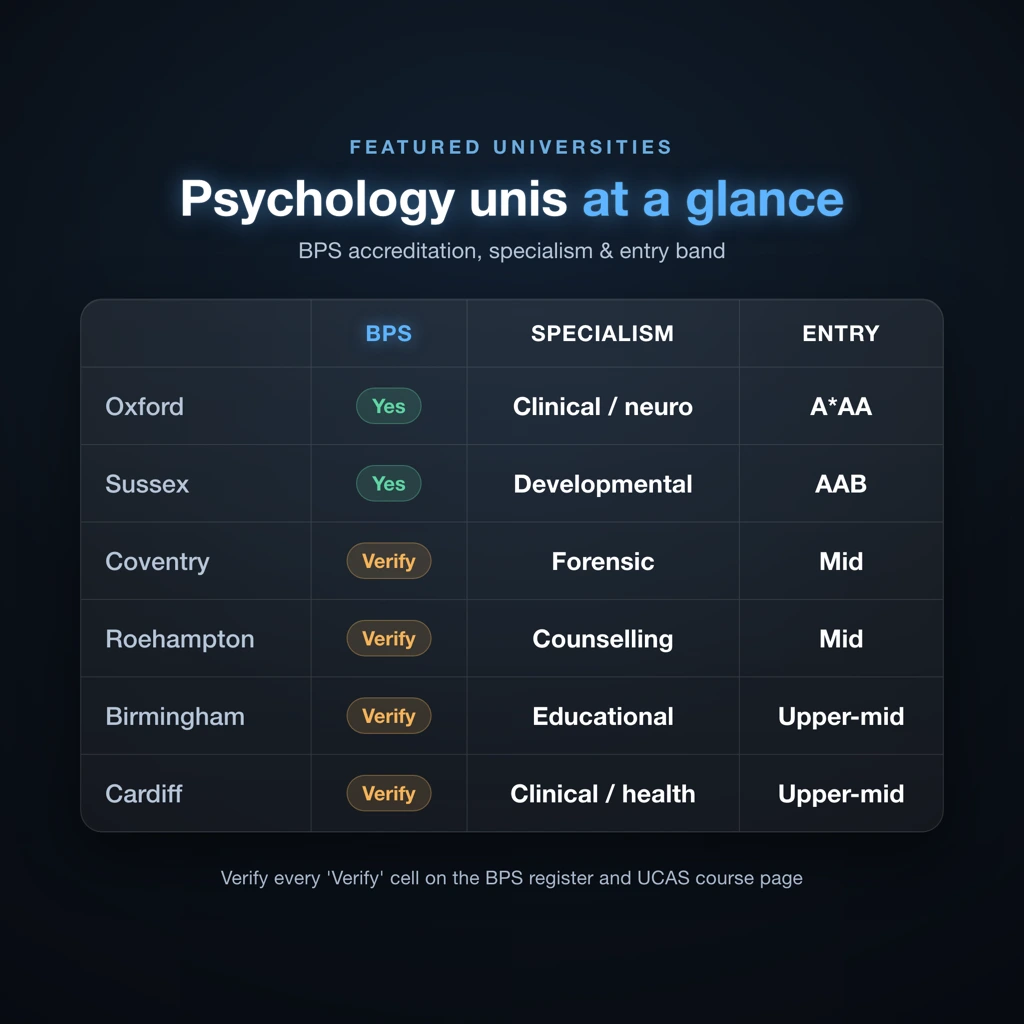
| University | BPS Accredited | Degree Type | Research Focus | Entry Band | Placement Year Available |
|---|---|---|---|---|---|
| Oxford | Yes (source) | BA and BSc | Clinical, neuroscience, experimental | Highest (A\*AA typical) | Verify on course page |
| Sussex | Yes (source) | BSc | Developmental, psychophysiology | Upper-mid (AAB) | Verify on course page |
| Coventry | Verify on BPS site | BSc | Forensic and criminal psychology | Mid (verify) | Verify on course page |
| Roehampton | Verify on BPS site | BSc | Counselling and child psychology | Mid (verify) | Verify on course page |
| Birmingham | Verify on BPS site | BSc | Educational and developmental | Upper-mid (verify) | Verify on course page |
| Cardiff | Verify on BPS site | BSc | Clinical, health, neuroscience | Upper-mid (verify) | Verify on course page |
One non-obvious point: Oxford offers both a BA and a BSc in psychology, and the degree title genuinely differs in emphasis, not just in name. The BSc sits within experimental psychology; the BA allows more combination with philosophy or linguistics. Both carry BPS accreditation, but the route to Graduate Basis for Chartered Membership is the same from either.
> Important: Accreditation status, entry requirements, and placement availability change annually. Verify every cell marked "Verify on course page" directly on the BPS accredited courses register and the relevant UCAS course page before you apply. A course that held BPS accreditation last year may be under review this cycle.
9. Placement Years and Industry Experience in Psychology
A sandwich year in psychology places you in a clinical, educational, forensic, or research setting for roughly 12 months between your second and final year. This extends the degree to four years. Some institutions charge a reduced fee for that year; others charge nothing. The figure varies by university, so check the course fee page directly before comparing offers.
The less obvious point: a placement year does not substitute for the post-graduation experience that competitive doctoral routes require. Both the Doctorate in Clinical Psychology (DClinPsy) and the Doctorate in Educational Psychology (DEd Psych) expect candidates to have accumulated relevant paid assistant-level work after graduation, typically as an Assistant Psychologist or Trainee Educational Psychologist. A placement counts as a signal of commitment, but selection panels look for post-degree hours in supervised roles.
On UCAS, sandwich and placement-year variants carry separate course codes from the standard three-year degree. If you search only by subject, the four-year version may not appear. Filter explicitly for "with placement year" or "sandwich" when building your shortlist, and apply to each code separately if you want both options on the table.
10. What to Do Next
Your shortlist is only as useful as the accreditation check behind it. Before the January UCAS deadline, go to bps.org.uk and pull up the BPS list of accredited undergraduate programmes for 2025/26 entry. Confirm that every course on your shortlist appears on it. A degree that looks strong on a league table but lacks BPS accreditation will not count as the Graduate Basis for Chartership, which closes the door to clinical, educational, and forensic training routes later.
One non-obvious gotcha: joint honours courses are sometimes listed separately from single honours at the same university, and not all joint courses hold accreditation. Check the exact course title, not just the department.
For deeper research, browse our psychology subject hub and compare individual departments directly on our university pages.
FAQ
What are the best UK universities for psychology?
The best choice depends on your intended specialism - Oxford leads on research metrics for experimental and clinical neuroscience, Sussex is strong for developmental psychology, and several other departments lead on forensic or counselling research - but BPS accreditation must be confirmed for every course you apply to.
Which universities are good for psychology in the UK?
Strong departments exist across the tariff range; research-intensive universities tend to score highly on REF and QS metrics, but post-1992 universities often offer placement years and more flexible entry routes - the right fit depends on specialism, degree type, and intended postgraduate pathway.
What is the best UK university for clinical psychology?
For undergraduate study feeding into clinical routes, look for BPS-accredited BSc programmes at departments with active clinical or health psychology research groups; the clinical psychology doctorate (DClinPsy) itself is NHS-commissioned, so the quality of your post-graduation experience matters as much as undergraduate institution.
Do I need a BSc rather than a BA to become a clinical psychologist?
BPS accreditation, not the BSc/BA label, is the formal requirement for GBC - however, some postgraduate clinical training programmes prefer applicants with strong quantitative research methods training, which the BSc route usually provides more of.
What are the entry requirements for psychology at UK universities?
Entry requirements span a wide band from the highest tariff (Oxford) to mid-tariff at post-1992 institutions; some courses require GCSE Maths or a science A-level, IB offers typically include a total-point requirement such as Sussex's 34 points, and BTEC routes are accepted at some departments - always check the specific UCAS course page.
What is the best UK university for forensic psychology?
Identify departments with active forensic psychology research groups rather than simply named modules; ensure the undergraduate degree carries BPS accreditation, since GBC is required for the forensic psychology chartership route through the BPS Division of Forensic Psychology.
References
- Why Apply to Oxford? - Department of Experimental Psychology - https://www.psy.ox.ac.uk/study/Undergraduate-teaching/why-apply-to-oxford
- Psychology | University of Sussex | UCAS - https://www.ucas.com/explore/courses/9edb1e8f-fb03-cf80-8929-6499d137e5ef/psychology?studyYear=2027
- Graduate Courses in Psychology - Department of Experimental Psychology - https://www.psy.ox.ac.uk/study/graduate