Best UK Universities for Computer Science 2026
By Michael Thompson · Former IB Diploma Programme coordinator; 10 years at Bromsgrove School · Published 5 July 2026
The best UK universities for computer science range from intensely mathematical departments where formal methods and algorithms dominate, to applied schools where you ship code from day one. Choosing between them is not simply a matter of following a single league table: The Guardian, the Complete University Guide, and QS all weight different factors, and the university that tops one may not suit your goals at all. What actually matters is the balance between theory and practice, whether the course holds British Computer Society (BCS) accreditation, whether a placement year is built in, and how the entry requirements map onto what you can realistically offer. This guide lines those factors up across the most searched-for UK departments so you can make a like-for-like comparison.
Key Takeaways
- No single ranking tells the full story.: The Guardian, QS, and the Complete University Guide each use different measures, so cross-referencing two or more gives a more reliable picture than relying on one list.
- BCS accreditation is course-specific, not institution-wide.: Check the individual course page rather than assuming a prestigious university's whole CS offering is accredited by the British Computer Society.
- A-level Maths is effectively compulsory at competitive departments.: Many top courses also list Further Maths as desirable or required, and IB offers typically specify Higher Level Maths Analysis and Approaches.
- Placement years significantly affect graduate outcomes.: A year in industry gives you employer contacts and a CV entry before you graduate; gov.uk graduate outcome data is the most reliable source for comparing earnings trajectories.
- NCSC-certified degrees signal rigour for cyber security routes.: The National Cyber Security Centre maintains a public list of certified degrees at undergraduate and postgraduate level, including variants with a year in industry.
- Specialisms vary sharply by department.: AI, cyber security, data science, computer games programming, and graphics each cluster at different institutions, so map your intended specialism before shortlisting.
In This Article
- How Computer Science Courses Vary Across UK Universities
- How to Read Computer Science Rankings in the UK
- Theory-Heavy vs Applied: Grouping UK Universities by Emphasis
- BCS Accreditation: What It Signals and Why You Should Check It
- Placement Years and Why They Matter for Graduate Routes
- Entry Requirements: The Maths Gate and the IB Route
- Spotlight on Top UK Computer Science Departments
- UK University Computer Science Comparison Table
- Masters and Postgraduate Computer Science in the UK
- What to Do Next
1. How Computer Science Courses Vary Across UK Universities
Choosing from the best uk universities for computer science is harder than it looks, because the label "computer science" covers a wide spectrum of degrees. UCAS lists over 1,800 computer science courses across UK institutions, and they are not interchangeable.
At one end of the spectrum sit theory-heavy programmes built around formal methods, algorithms, logic, and type theory. These degrees treat computing as a branch of mathematics and are designed to produce graduates who can reason about systems from first principles. At the other end sit applied and vocational programmes centred on web development, enterprise software, games programming, or specific platforms.
Most universities sit somewhere between these poles, but they cluster noticeably. Specialisms vary sharply by institution: some departments are known for AI and machine learning research, others for cyber security, data science, or graphics and games programming. A department that publishes heavily in AI will shape its undergraduate curriculum accordingly, even if that is not obvious from the course title.
This distinction matters more than students usually expect when they are applying. A theory-heavy degree, with its grounding in algorithms and formal reasoning, is the natural preparation for a PhD or research role. An applied degree, with industry projects and real toolchains, tends to suit direct industry entry or a conversion MSc in a specific domain. Picking the wrong fit is not fatal, but it does mean working against the grain of your own course from year one.
2. How to Read Computer Science Rankings in the UK
No single table gives you the full picture. The Guardian, QS, Complete University Guide, and Times/Sunday Times each weight different measures - student satisfaction, research output, graduate prospects, entry standards - so the same university can sit ten places apart depending on which table you open. The Guardian explicitly uses eight measures covering the full student lifecycle and says its rankings "indicate how likely each department is to deliver a positive all-round experience to future students." QS, by contrast, leans heavily on academic reputation surveys. That distinction matters: a department could score brilliantly on research citations yet have mediocre teaching satisfaction scores, or vice versa.
A concrete example of how the numbers shift: Oxford ranked first in the UK for Computer Science and Information Systems in The Guardian's 2024 table. The same department held the top global position in the Times Higher Education 2020 World University Rankings by Subject, ahead of Caltech, Cambridge, and Stanford. That THE ranking is now five years old, so treat it as context rather than a current claim. Meanwhile, Cambridge sits at #2 in the UK in the Complete University Guide 2026 - a department with its own notable history as the first computer science department established in the country.
The non-obvious gotcha: **a university can rank highly on research metrics while offering undergraduates very little research contact time.** League table positions rarely reflect how much of that research culture actually reaches a first-year student.
Use rankings to build a shortlist of roughly ten universities, then check each department's own pages for the factors that will shape your day-to-day experience: BCS accreditation status, placement year availability, and whether the course's specialism matches what you actually want to study.
3. Theory-Heavy vs Applied: Grouping UK Universities by Emphasis
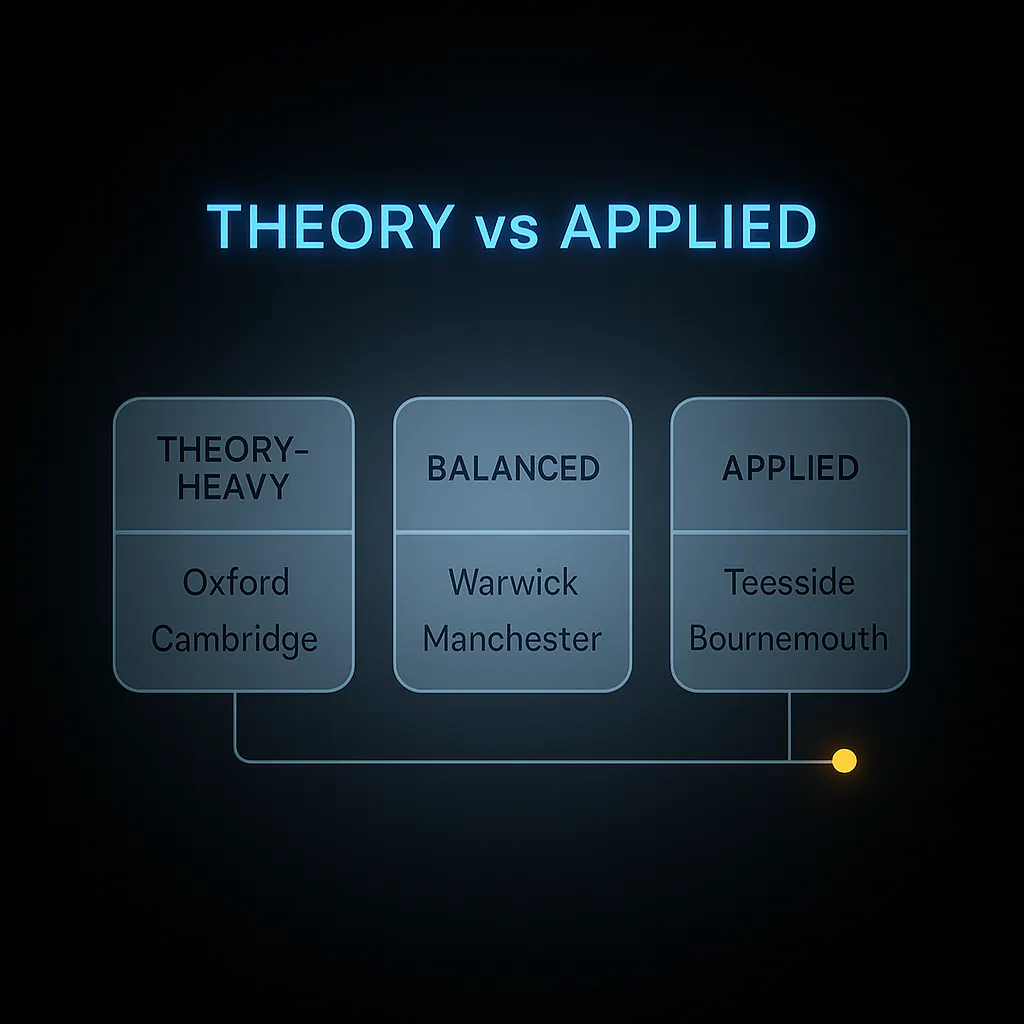
UK computer science departments sit on a spectrum. At one end are institutions where the degree is fundamentally an exercise in mathematical reasoning and formal methods. At the other are programmes built around studios, game engines, and industry briefs. Knowing which end you're closer to matters more than chasing a single league table position.
The theory-heavy end includes Oxford, Cambridge, Imperial, and Edinburgh. Cambridge's department was the first in the country, and the course covers OCaml, Prolog, chip design, and formal verification alongside more applied material, per the university's own course pages. The surrounding area, known as "Silicon Fen," hosts over 1,000 specialist computing and advanced technology companies, which means placement and recruitment connections are strong despite the theoretical emphasis. Edinburgh carries particular weight in AI, with roots going back decades before the current wave of interest in machine learning.
The applied and creative-tech end includes Abertay, Teesside, Northumbria, and Bournemouth. These are the universities to look at for computer games programming, creative computing, and production-focused software development. Abertay, in Dundee, has a reputation built specifically around games education.
The middle ground covers research-led universities such as Warwick, Southampton, Manchester, and UCL. These combine publishable research with strong industry links and tend to offer the most varied specialism options, including cyber security pathways. Royal Holloway holds full NCSC certification for both a BSc and an MSci in Computer Science (Cyber Security), making it a standout choice if security is your direction.
The non-obvious point: UCAS lists 1,803 computer science courses across UK institutions. That breadth makes prestige-first filtering a poor strategy. Filter by specialism first, then check how the department weights theory against application.
4. BCS Accreditation: What It Signals and Why You Should Check It
BCS (British Computer Society) accreditation means the Society has reviewed a course and confirmed it meets the professional standards required for progression toward Chartered IT Professional (CITP) status. For students with an eye on structured professional development, it is a meaningful signal. For everyone else, it is largely invisible in day-to-day study.
The important gotcha: accreditation is course-specific, not institution-wide. A university may hold BCS recognition for its MEng Computer Science while its BSc Software Engineering sits unaccredited on the same campus. Never assume that a strong department reputation carries over to every programme it offers. Check the individual course page, not the department homepage.
Cyber security students have a parallel quality signal to look for: NCSC certification. The National Cyber Security Centre publishes a public list of certified degrees at undergraduate, integrated master's, and postgraduate levels. Named fully certified programmes include:
- Undergraduate: Royal Holloway BSc and MSci in Computer Science (Cyber Security), including year-in-industry variants, certified to 30/09/2031
- Integrated master's: University of Southampton, certified to 30/09/2031
- Postgraduate: University of Edinburgh MSc Cyber Security, Privacy and Trust (to 30/09/2029); King's College London MSc Cyber Security (to 30/09/2026) and MSc Advanced Cyber Security via distance learning (to 30/09/2029)
If BCS or NCSC certification matters to your career plan, search for it explicitly on the course page rather than assuming the institution's reputation covers it.
5. Placement Years and Why They Matter for Graduate Routes
A sandwich placement, or year in industry, extends a standard three-year BSc to four years. The extra year sits between second and final year, and the student works full-time for a real employer, usually on a paid contract. That's the structural difference from a standard degree: it isn't a short internship bolted on as an extra module.
Placement years show up in course titles and UCAS listings, so check carefully. UCAS lists King's College London with a student ambassador studying Computer Science with a year in industry, confirming the variant exists there. Royal Holloway, University of London offers year-in-industry variants of both its BSc and MSci in Computer Science (Cyber Security), both of which hold NCSC full certification expiring 30/09/2031. Anglia Ruskin lists multiple start dates per year at its Cambridge campus, signalling flexible study modes worth investigating if timing matters to you.
The counter-intuitive point: placement students return to final year already connected to a hiring network. Many receive graduate offers before they sit their final exams, which means the year in industry functions as a 12-month working interview.
For comparing how placement graduates actually fare against non-placement graduates on salary and employment rates, the right source is gov.uk Graduate Outcomes data, not prospectus claims. Check the figures there rather than trusting any number a university quotes in its marketing.
6. Entry Requirements: The Maths Gate and the IB Route
Almost every competitive CS department treats A-level Maths as a minimum, not a preference. Without it, your application will likely be screened out before anyone reads your personal statement. At the most theory-heavy universities, Further Maths moves from desirable to effectively required, because the degree opens at a pace that assumes familiarity with proof, matrices, and complex numbers from week one.
The non-obvious gotcha: a university can appear mid-table in rankings yet demand higher entry grades than a higher-ranked rival. Entry tariff and research prestige do not move in lockstep.
The UCAS data illustrates the spread clearly. At Aberystwyth alone, the BSc requires 96-120 UCAS points while the MComp requires 136-144 points, and the Bangor MComp sits at 128-144 points. The phrase "top universities" covers a wide band of entry requirements, not a single threshold.
- Competitive departments typically phrase offers in total points, with the most selective courses sitting in the region of 38-40 points.
- Higher Level Maths is almost universally required, and most competitive departments specify HL Maths Analysis and Approaches (AA) rather than Applications and Interpretation (AI). AA is the proof-focused option; AI is weighted toward statistics and modelling, and some admissions teams consider it insufficient preparation for a theory-heavy curriculum.
- SL Maths, regardless of strand, is rarely accepted at selective departments.
Offers shift year to year, and course pages are updated more frequently than any guide. Check the specific course page on UCAS for current conditional offers before making any decisions based on figures you read here or elsewhere.
7. Spotlight on Top UK Computer Science Departments
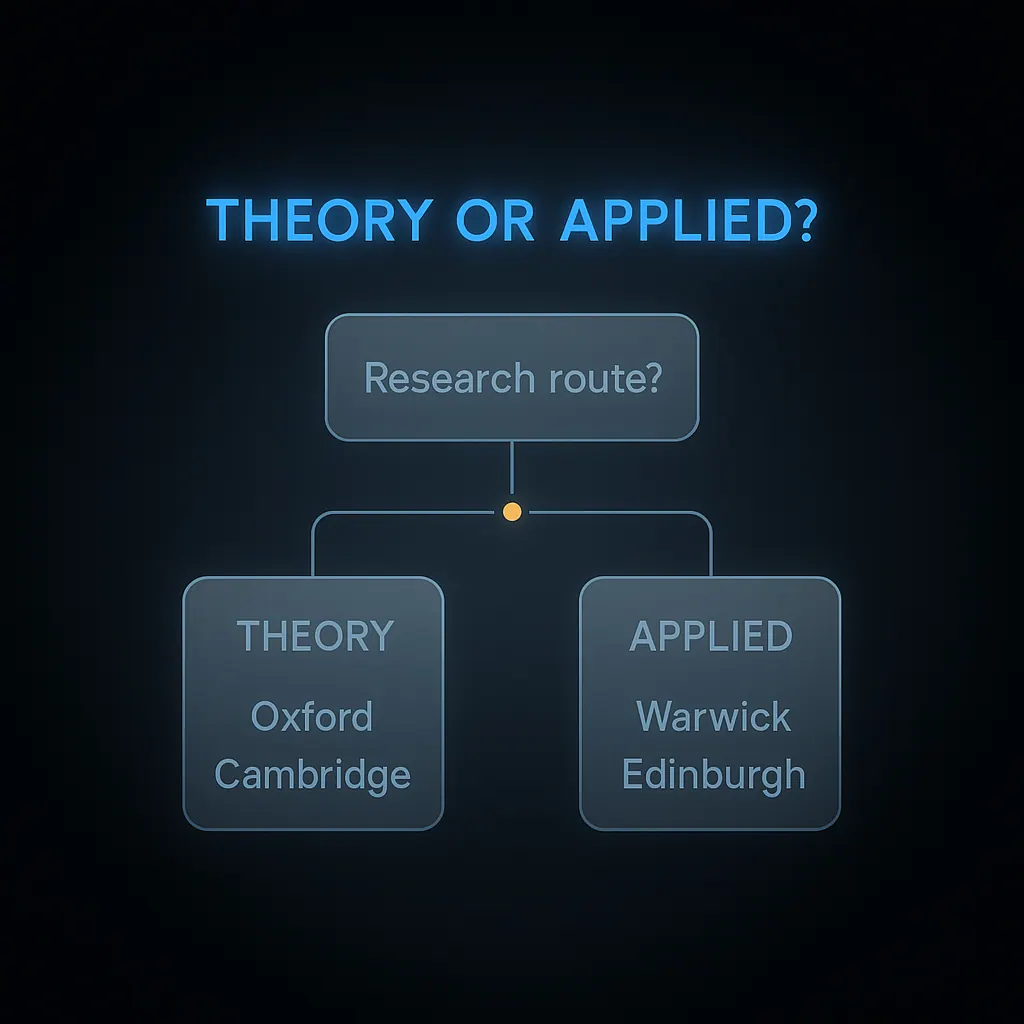
Six departments consistently appear at the top of computer science ranking uk university tables. Here is what makes each one distinct.
Oxford topped the Guardian's UK Computer Science and Information Systems rankings in 2024 (Guardian ranking, Oxford) and held the number one position globally in the Times Higher Education World University Rankings by Subject in 2020 (THE world ranking, Oxford). The department leans heavily toward theory: logic, algorithms, and formal methods run through most of its programmes. If you want research-led teaching at undergraduate level, few places in the UK match it.
Cambridge was ranked second in the UK for Computer Science by the Complete University Guide 2026 (Cambridge undergraduate course page). It was the first Computer Science department in the country, with roots stretching back to Alan Turing's theoretical work in the 1930s. The BA/MEng route lets you convert a three-year degree into a four-year integrated master's without reapplying, and the surrounding Silicon Fen cluster of over 1,000 specialist technology companies gives internship access that is hard to replicate elsewhere.
Royal Holloway holds NCSC full certification for both a BSc and an MSci in Computer Science (Cyber Security), including year-in-industry variants, with certification running to 2031. For undergraduates who want a cyber-focused degree with a structured employer placement built in, this is one of the few programmes where the accreditation and the placement route are packaged together at both degree levels.
Edinburgh carries a strong AI heritage alongside its NCSC-certified MSc in Cyber Security, Privacy and Trust, certified to 2029. The combination of postgraduate cyber certification and one of the UK's longest-established AI research groups makes it a natural choice for students aiming at the best uk universities for masters in computer science.
King's College London holds NCSC full certification for two postgraduate awards: an MSc in Cyber Security and an MSc Advanced Cyber Security delivered via distance learning part-time (NCSC certified degrees). At undergraduate level, KCL offers an MSci Computer Science, an integrated programme that adds a master's year to the standard three-year degree, with a year-in-industry option available (UCAS subject guide).
Warwick holds NCSC full certification for its BSc (NCSC certified degrees) and sits at an unusually balanced point between theory and applied work. If you want a department that takes formal methods seriously without abandoning systems and software engineering, Warwick is worth shortlisting alongside the more obviously research-heavy names above.
8. UK University Computer Science Comparison Table
| University | Theory/Applied Emphasis | Standout Specialism | Placement Option | BCS/NCSC Accreditation | Typical Entry Band |
|---|---|---|---|---|---|
| Oxford | Theory-heavy | Foundations, logic, verification | Check course page | Check course page | A*AA (very high) |
| Cambridge | Theory-heavy | Computation theory, chip design | Check course page | Check course page | AAA (very high) |
| Royal Holloway | Applied/Cyber | Cyber security (BSc and MSci) | Year in industry variants available | NCSC-certified (expires 30/09/2031) | Check course page |
| Edinburgh | Balanced | Cyber security, AI | Check course page | NCSC-certified MSc (expires 30/09/2029) | Check course page |
| King's College London | Applied | Cyber security (MSc) | Check course page | NCSC-certified postgraduate (expires 30/09/2029) | Check course page |
| Warwick | Balanced | Theory, algorithms | Check course page | NCSC-certified Bachelor's | Check course page |
| Southampton | Balanced | Cyber security (integrated master's) | Check course page | NCSC-certified integrated master's (expires 30/09/2027) | Check course page |
One thing worth noting: Royal Holloway's NCSC certification covers both a BSc and an MSci, including year-in-industry variants, which is relatively uncommon. Most institutions hold certification for a single named degree, so if cyber security is your intended direction, the breadth of Royal Holloway's accredited provision is worth comparing against departments with a single certified route.
Accreditation and entry bands: NCSC certification status and BCS accreditation can be withdrawn or updated between cycles. Always verify on the individual course page before applying. Entry bands in this table are indicative only and do not account for contextual offers.
9. Masters and Postgraduate Computer Science in the UK
Postgraduate computer science in the UK splits into two distinct tracks, and choosing the wrong one is a common and expensive mistake.
Integrated master's degrees (MComp, MEng, MSci) are four-year undergraduate programmes. Royal Holloway, for example, holds NCSC certification for its MSci in Computer Science (Cyber Security), including a year-in-industry variant, certified until 30 September 2031. You commit at the application stage, so there is no "upgrade" route if you decide in year two.
Taught MSc programmes are postgraduate entry, typically one year. The Cambridge MPhil in Advanced Computer Science is a 9-month full-time programme: students select five taught modules from areas including networking, category theory, and natural language processing, complete a mandatory research skills course, and submit a project report in early June. The pass mark is 60%, applied separately to modules and the project. It is explicitly designed as PhD preparation, not a conversion route.
For cyber security specifically, check NCSC-certified postgraduate degrees before applying. The University of Edinburgh's MSc Cyber Security, Privacy and Trust holds full certification until 30 September 2029, and King's College London holds full certification for two postgraduate cyber security degrees.
The counter-intuitive trade-off when comparing the best UK universities for MSc computer science: conversion MScs (aimed at non-CS graduates) and specialist deepening MScs often share a name but have entirely different prerequisites and academic depth. Check the entry requirements carefully before shortlisting.
10. What to Do Next
Pick up the shortlist you built while reading the comparison table and act on it now. One non-obvious gotcha worth remembering: a course titled "Computer Science" and one titled "Computing" at the same university can have different BCS accreditation status, different entry requirement profiles, and different industrial placement structures, so checking the individual UCAS course page matters more than checking the department homepage.
This week, open the UCAS course search, filter by your preferred specialism (artificial intelligence, games programming, maths and computer science, or another), and on each result page confirm the BCS accreditation status and current entry requirements directly. Do not assume last year's offer level applies.
Browse our computer science subject guide for deeper breakdowns by specialism, and check the university profile pages for any departments that stood out in the spotlight section.
FAQ
What are the best UK universities for computer science?
Oxford ranked first in the UK for Computer Science in The Guardian's 2024 rankings, while Cambridge is ranked second in the UK by the Complete University Guide 2026 - but the 'best' university depends on whether you prioritise research depth, a specific specialism like AI or cyber security, placement options, or BCS accreditation.
Which universities are good for computer science in the UK?
Beyond Oxford and Cambridge, universities including Royal Holloway, Edinburgh, King's College London, Warwick, and Southampton are recognised for specific strengths - Royal Holloway and Edinburgh hold NCSC-certified cyber security degrees, for instance - so the right choice depends on your intended specialism and career route.
What is the best UK university for a computer science degree?
There is no single answer: theory-heavy departments like Oxford and Cambridge suit those aiming for research or highly technical roles, while applied programmes at institutions such as Abertay or Teesside are well regarded for games programming and industry-ready skills.
Do I need A-level Maths to study computer science at a UK university?
For most competitive UK computer science courses, A-level Maths is required or strongly expected; the most theory-heavy departments also list Further Maths as desirable, and IB applicants are typically expected to offer Higher Level Maths Analysis and Approaches.
What does BCS accreditation mean for a computer science degree?
BCS (British Computer Society) accreditation signals that a course meets professional standards and can count towards Chartered IT Professional (CITP) status - but it is awarded per course, not per university, so you must check the individual course page rather than assuming an institution's entire CS offering is accredited.
Which UK universities offer NCSC-certified cyber security degrees?
The NCSC maintains a public list of certified degrees at ncsc.gov.uk; fully certified undergraduate and postgraduate programmes include those at Royal Holloway University of London, University of Edinburgh, King's College London, University of Warwick, and University of Southampton, among others.
References
- Search | All results | "computer science" | UCAS - https://www.ucas.com/explore/search/all?query=computer+science
- Top for Computer Science in the UK according to The Guardian university rankings - https://www.cs.ox.ac.uk/news/2188-full.html
- Oxford ranked first in world for Computer Science - https://www.cs.ox.ac.uk/news/1742-full.html
- Computer Science, BA (Hons) and MEng | Undergraduate Study - https://www.undergraduate.study.cam.ac.uk/courses/computer-science-ba-hons-meng
- NCSC-certified degrees | National Cyber Security Centre - https://www.ncsc.gov.uk/information/ncsc-certified-degrees
- Computer Science Subject Guide | Why Study Computer Science? | UCAS - https://www.ucas.com/explore/subjects/computer-science
- MPhil in Advanced Computer Science | Postgraduate Study - https://www.postgraduate.study.cam.ac.uk/courses/directory/cscsmpacs