Best UK Universities for Nursing: 2026 Guide
By Michael Thompson · Former IB Diploma Programme coordinator; 10 years at Bromsgrove School · Published 5 July 2026
The best UK universities for nursing are those whose degrees are approved by the Nursing and Midwifery Council - without NMC approval, graduates cannot register to practise, making it the single most important thing to check before you apply. UCAS lists over 760 nursing courses across the UK, spanning four distinct fields: adult, children's, mental health, and learning disability nursing. Entry requirements, placement regions, funding, and which fields a university actually offers vary far more than most applicants expect. This guide maps the landscape so you can compare courses on the factors that will shape three years of your life, not just league-table positions.
Key Takeaways
- NMC approval is non-negotiable: A nursing degree must be approved by the Nursing and Midwifery Council before you enrol - graduates of unapproved programmes cannot register to practise in the UK.
- Four fields, one application: Nursing divides into adult, children's, mental health, and learning disability; most applicants choose one field at application stage, though some universities offer dual-field programmes.
- Clinical placement hours are substantial: Placements make up at least half of a nursing degree and can span a wide geographic region, so travel time and transport costs are a real part of the course to plan for.
- The NHS Learning Support Fund provides a training grant: Eligible nursing students in England can receive a non-repayable training grant through the NHS Learning Support Fund - check the current figure on the official NHS website.
- Entry requirements span a wide band: Typical UCAS Tariff offers range from around 96 points at some providers to 136 or above at more selective ones, and almost every university requires an interview plus health and DBS checks.
- IB students have a clear route in: Universities accept the IB Diploma, usually specifying a total-point range alongside Higher Level requirements, often expecting a science at HL, though wording varies by institution.
In This Article
- Why NMC Approval Is the First Thing to Check
- The Four Fields of Nursing - and How to Choose One
- Clinical Placements: Hours, Regions, and the Travel Reality
- NHS Learning Support Fund: The Training Grant Explained
- Entry Requirements: From Most to Least Selective
- University Comparison Table: NMC Approval, Fields, Placements, and Entry Bands
- Best UK Universities for Specific Nursing Fields
- What the Rankings Don't Tell You About Nursing Degrees
- What to Do Next
1. Why NMC Approval Is the First Thing to Check
Choosing among the best UK universities for nursing starts with one question that has nothing to do with league tables: is the course approved by the Nursing and Midwifery Council (NMC)? The NMC is the statutory regulator for nurses and midwives across the UK. Without an NMC-approved degree, you cannot register to practise. Full stop.
The counter-intuitive part is that approval attaches to individual programmes, not to universities as a whole. A university can hold a Gold Award in the Teaching Excellence Framework and still have a specific nursing course under regulatory scrutiny at the same time. Anglia Ruskin University (ARU) is a live example: as of July 2026, the NMC is conducting an extraordinary review of ARU's mental health nursing course, following concerns raised about teaching standards and oversight. ARU self-reported the issue to the NMC, describing it as "purely a matter for mental health nursing." Its other programmes are not publicly named in the review, but the episode shows that problems can be field-specific rather than institution-wide.
The practical lesson: check NMC approval status on the NMC's own website and on each individual course page before you apply, not after you receive an offer. A university's general reputation is not a proxy for regulatory standing on a specific programme.
2. The Four Fields of Nursing - and How to Choose One
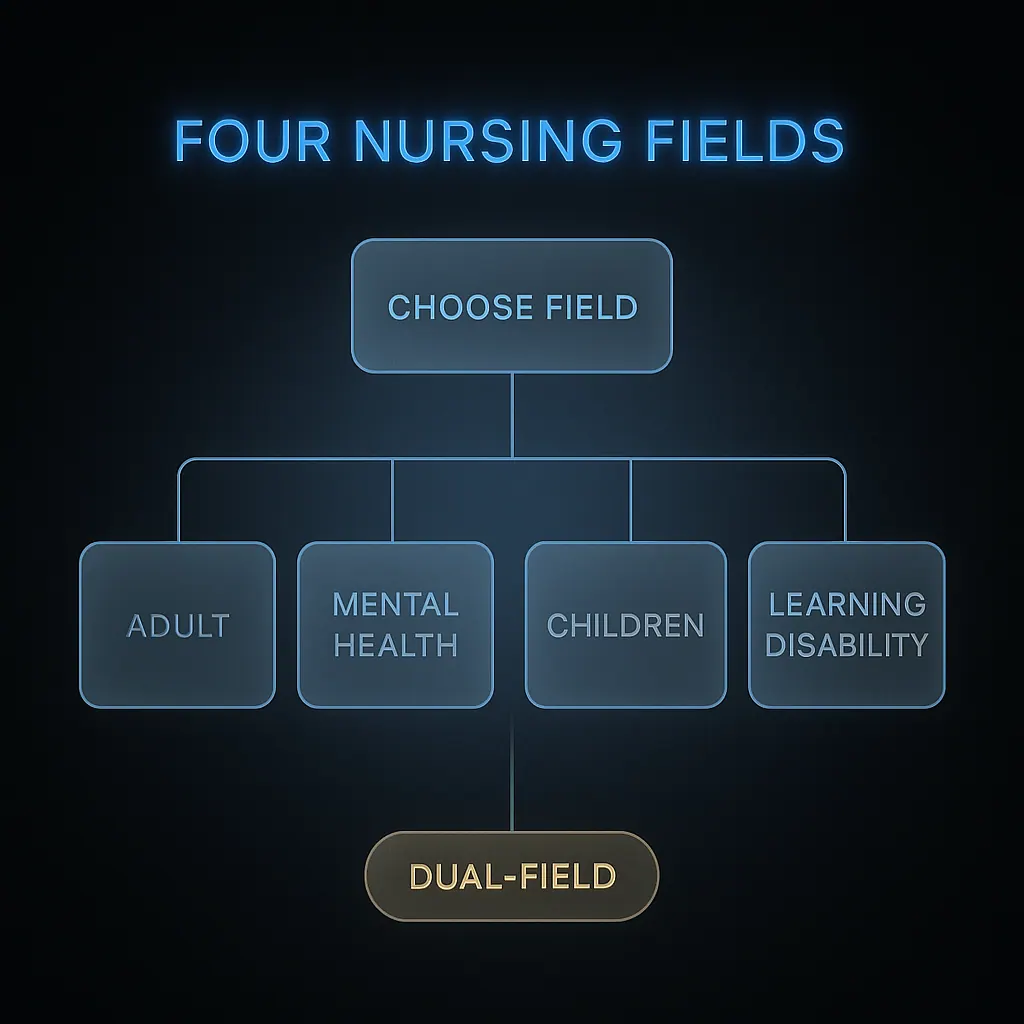
Nursing in the UK is not one degree. It is four distinct regulated fields, and your UCAS application names a specific field from the start. You do not apply to "nursing" generically and decide later.
The four fields are:
- Adult nursing - care of adults across acute, community, and specialist settings. The largest field by course volume, with 234 courses listed on UCAS.
- Children's (paediatric) nursing - care of infants, children, and young people, typically up to age 18. Often listed as "child" or "children's" nursing on UCAS.
- Mental health nursing - working with people experiencing conditions such as psychosis, depression, eating disorders, and addiction, across inpatient and community services.
- Learning disability nursing - supporting people with learning disabilities to manage health needs and access services. The smallest field by course volume and the one most students overlook.
The field-specific structure has a practical consequence most applicants miss. If you apply for adult nursing and later want to practise in mental health, you would need to return for a further qualification. Choosing the right field at application stage matters more than choosing the right university.
Dual-field programmes let you qualify in two fields simultaneously. Anglia Ruskin University offers MNurs Nursing (Adult and Children), Edge Hill University offers both MSci Adult and Learning Disabilities and MSci Adult and Mental Health, and University of Plymouth offers MNurs dual-field programmes in Adult and Child, and Adult and Mental Health. These are longer degrees, typically four years, and more demanding on placement hours.
When deciding which field fits you, work experience is the most reliable guide. Shadowing in an NHS ward, a CAMHS service, or a community learning disability team will tell you more than any prospectus. If you have not yet gained experience in your preferred field, arrange it before you write your personal statement.
3. Clinical Placements: Hours, Regions, and the Travel Reality
Clinical placements make up at least half of every NMC-approved nursing degree. That is not a minor detail. It means you will spend a significant portion of your three years working in real healthcare settings, not sitting in lectures, and your daily experience will be shaped more by where those placements are located than by anything on the university campus.
The non-obvious gotcha: most universities draw their placement pool from NHS trusts and health boards spread across an entire region, not just the town the university sits in. A student based in a city-centre halls of residence can easily find themselves placed at a rural community hospital an hour away, with no direct public transport link, on an early shift that starts at 7am. [Travel costs and time add up quickly](/guides/best-student-cities-uk), and this catches many students off guard.
Placement variety matters too. The best nursing degrees rotate students through a mix of settings:
- Acute wards (medical, surgical, emergency)
- Community and district nursing teams
- Specialist units such as oncology, theatres, or intensive care
Not every university offers the same breadth, and the mix differs between fields. A mental health nursing student will have very different placement partners than a child nursing or adult nursing student at the same institution.
At every open day, ask two specific questions: which NHS trusts or health boards does this university hold placement contracts with, and how far are the most distant sites? The answers will tell you more about daily student life than any prospectus photo.
4. NHS Learning Support Fund: The Training Grant Explained
Nursing students in England have access to a funding source that sits entirely outside the standard student loan system: the NHS Learning Support Fund. It provides a non-repayable training grant, meaning it does not need to be paid back and does not affect your loan balance.
The counter-intuitive point that catches many applicants off guard is that receiving the grant does not reduce your eligibility for a student maintenance loan. The two funding streams are independent. You can draw down a maintenance loan from Student Finance England and receive the NHS Learning Support Fund payment at the same time.
Because the grant figure is reviewed periodically, the brief here does not quote a specific amount. Check the current figures directly on the NHS Business Services Authority page for the Learning Support Fund before you apply.
The picture is different outside England. Scotland, Wales, and Northern Ireland each run their own funding arrangements for nursing students, some of which are more generous than the English model, so comparing home-nation packages is worth doing before you decide where to study.
Practical step: confirm your chosen university and field of nursing appear on the eligible programmes list before you accept an offer. Not every course qualifies automatically.
5. Entry Requirements: From Most to Least Selective
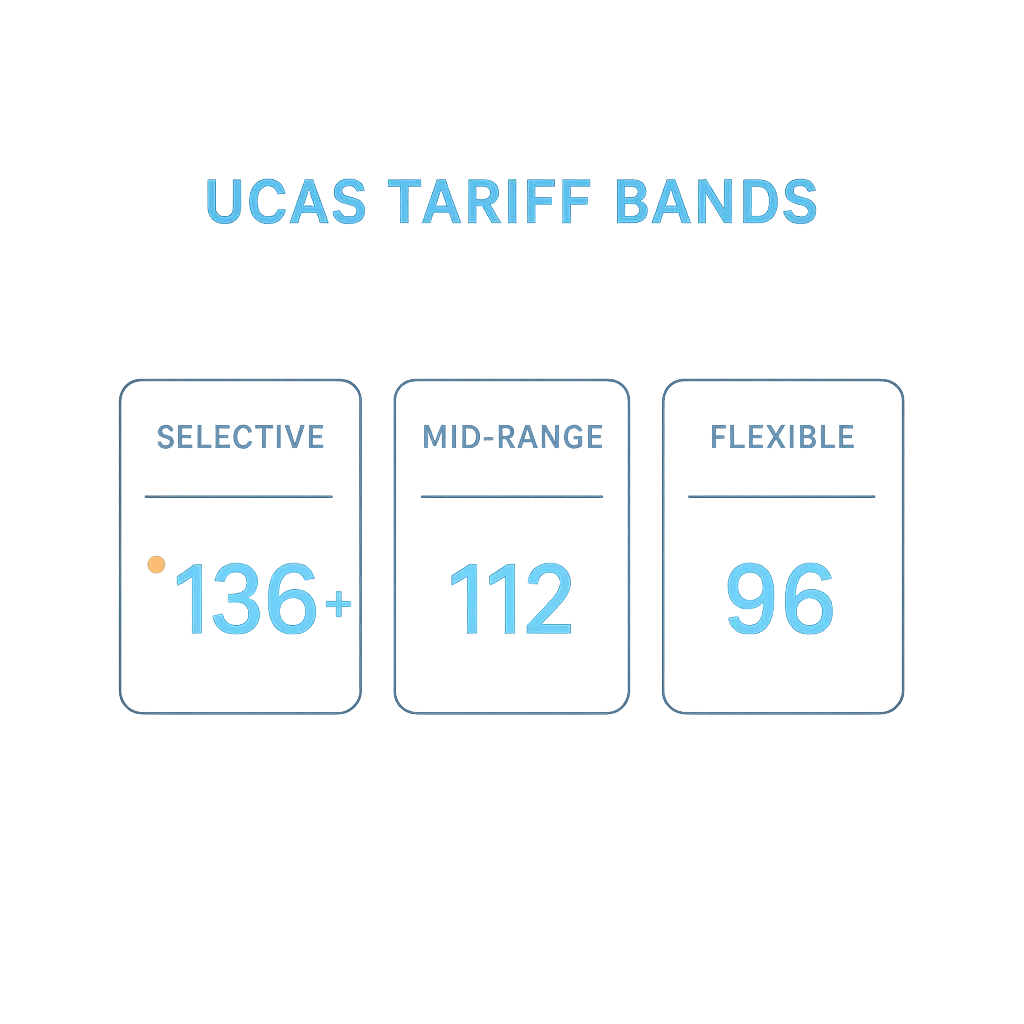
UCAS Tariff points for nursing vary more than most applicants expect. The spread across undergraduate programmes currently runs from around 96 points at the lower end to 136 at the higher end, which means your predicted grades could meaningfully affect which courses are realistic targets.
A rough picture of the range:
| University | Programme | UCAS Tariff |
|---|---|---|
| Buckinghamshire New University | BSc (Hons) Adult Nursing | 112-136 |
| Edge Hill University | MSci Nursing (dual field) | 120-128 |
| University of Bedfordshire | BSc (Hons) Adult Nursing | 112-120 |
| Birmingham City University | BSc (Hons) Adult Nursing | 112 |
| Anglia Ruskin University | MNurs Nursing | 104-120 |
| Bournemouth University | BSc (Hons) Adult Nursing | 104-120 |
| University of Plymouth | BSc (Hons) Adult Health Nursing | 104-128 |
| University of Chester | BN (Hons) Nursing | 104 |
| Bangor University | BN (Hons) Adult Nursing | 96-120 |
Sources: UCAS nursing search, UCAS adult nursing search
Some institutions publish no tariff at all. University of Glasgow, University of Liverpool, and University of Southampton all list 'N/A' on UCAS. That does not mean lower standards. It typically means they assess contextually or weight non-academic criteria heavily. You must check their course pages directly, because no tariff calculator will tell you whether you qualify.
**Three requirements are universal, regardless of tariff band.** Every NMC-approved programme will require a formal interview, an occupational health assessment, and an enhanced DBS (Disclosure and Barring Service) check. These are not optional extras added late in the process. Budget time for all three before you start your application.
IB Diploma applicants are accepted at most universities, but the wording varies. Institutions typically specify a total IB points range alongside Higher Level subject requirements, and a science at HL is a common expectation. Because each course page words this differently, check the individual entry requirements rather than assuming the tariff-point conversion tells the full story.
The non-obvious gotcha: a lower tariff entry point does not guarantee an easier interview. Bangor's 96-120 range and Chester's 104 floor are among the most accessible on paper, but the interview remains the filter that all universities use regardless of where they sit in the points table.
6. University Comparison Table: NMC Approval, Fields, Placements, and Entry Bands
Before using this table, verify NMC approval directly on each university's course page. NMC approval status can change between academic cycles. Note also that Anglia Ruskin University's mental health nursing course is currently under NMC extraordinary review as of July 2026 - prospective applicants should check the NMC's published findings before applying to that specific field at ARU.
Entry bands below use descriptors rather than grade equivalents, because grade-to-points conversions vary by qualification (A-level, SQA Higher, BTEC, T Level) and by offer type.
| University | Fields Offered | Degree Level | Typical UCAS Tariff | Notes on Placement Region |
|---|---|---|---|---|
| University of Exeter | Adult, Mental Health, Child, Learning Disabilities | MSci (4 yr) | N/A - interview-based | South West England |
| University of Glasgow | Adult, Mental Health, Child, Learning Disabilities | BN Hons (4 yr) | N/A - SQA-based entry | Greater Glasgow and West of Scotland |
| University of Liverpool | Adult, Mental Health, Child, Learning Disabilities | BN Hons (3 yr) | N/A - interview-based | Merseyside and Cheshire |
| University of Southampton | Adult, Child (dual-field) | MN (4 yr) | N/A - interview-based | Hampshire and surrounding counties |
| Edge Hill University | Adult + Learning Disabilities; Adult + Mental Health (dual-field) | MSci (4 yr) | Selective / 120-128 | Lancashire and Greater Manchester |
| University of Plymouth | Adult + Child; Adult + Mental Health (dual-field); Adult (single) | MNurs (4 yr) / BSc (3 yr) | Mid-range / 104-128 | Devon, Cornwall, South West |
| Anglia Ruskin University | Adult, Child (MH course under NMC review - see above) | MNurs (4 yr) | Mid-range / 104-120 | Essex, Cambridgeshire, East of England |
| Birmingham City University | Adult | BSc Hons (3 yr) | Mid-range / 112 | West Midlands; Jan 2027 start also available |
| Bournemouth University | Adult | BSc Hons (3 yr) / MSc (2 yr) | Flexible / 104-120 (BSc) | Dorset and surrounding counties |
| University of Chester | Adult (3 campuses) | BN Hons (3 yr) | Flexible / 104 | Cheshire and North Wales border |
| Bangor University | Adult | BN Hons (3 yr) | Flexible / 96-120 | North Wales; Welsh-medium placements available |
One counter-intuitive point worth noting: universities that list "N/A" for UCAS Tariff are not necessarily more selective in practice. Several use contextual admissions or weight interview performance heavily, meaning strong applicants with lower predicted grades are not automatically at a disadvantage. Check each institution's admissions criteria rather than reading "N/A" as a barrier.
7. Best UK Universities for Specific Nursing Fields
Your field choice narrows the university list faster than entry grades do. Here is what the course landscape looks like across each field.
Adult Nursing
The largest field by far: UCAS lists 234 adult nursing courses across UK universities, so competition for students is real and entry requirements vary widely. Undergraduate routes are almost all three years full-time; postgraduate MSc routes (for career changers with a relevant degree) run two years. Universities including Bournemouth, Bedfordshire, and Buckinghamshire New offer both a BSc and a standalone MSc, which matters if you already hold a degree in a life science and want a faster route to registration.
Children's and Paediatric Nursing
Fewer universities offer a dedicated children's field than adult, so the more common route is a dual-field MNurs. Three universities with well-established adult-and-child programmes are:
- University of Plymouth - MNurs Adult and Child, 128 UCAS points
- University of Southampton - MN Nursing Adult and Child, four years full-time
- Anglia Ruskin University - MNurs Nursing Adult and Children, 104-120 points, available across three campuses
The counter-intuitive trade-off with dual-field degrees is workload: you sit two sets of practice competencies and, on graduation, hold two registrations, but placement hours across both fields are compressed into the same four years.
Mental Health Nursing
A genuine caution here. As of July 2026, the NMC is conducting an extraordinary review of Anglia Ruskin's mental health nursing course, following concerns about teaching standards and oversight that were first raised three years earlier. ARU has self-reported the issue to the NMC. Until the review report is published, applicants targeting mental health nursing should treat ARU as uncertain. Edge Hill University's MSci Adult and Mental Health, requiring 120-128 UCAS points, is a well-regarded alternative in the North West.
Learning Disability Nursing
The least commonly offered field in the UK. Edge Hill also runs an MSci Adult and Learning Disabilities, one of only a small number of programmes nationwide that includes this specialism. If this is your intended field, check NMC approval for this specific pathway before applying, as approval is granted per programme, not per institution.
Nursing and Midwifery / MSc Entry Routes
Joint nursing and midwifery programmes exist but are rare, with timetabling and placement complexity meaning most universities keep them separate. For career changers, the two-year postgraduate MSc adult nursing route (available at Bournemouth, Bedfordshire, and others) leads to the same NMC registration as the undergraduate route, without the need for a full three-year commitment.
8. What the Rankings Don't Tell You About Nursing Degrees
Subject league tables are worth a glance, but they measure research output and academic reputation, not what happens to you after graduation.
The KCL ranking quirk worth knowing. King's College London's nursing faculty was ranked second in the world in the QS 2020 subject rankings, which looks impressive on a prospectus. The catch: KCL's UCAS-listed nursing course is a Nursing Studies BSc open only to already-registered nurses, whether UK-qualified or overseas. It is not a route to initial nurse training. If you search "King's nursing" expecting a pre-registration place, you will not find one. That gap between ranking prestige and actual course availability catches applicants out every cycle.
**What actually predicts graduate outcomes.** For anyone choosing among the best UK universities for nursing, three indicators matter more than any league table position:
- NMC inspection history and whether the programme currently holds full approval
- First-attempt pass rates on the NMC registration assessment
- Which NHS trusts provide placements, and how far from campus they typically are
A post-1992 university with strong placement partnerships at a well-run NHS trust can produce better-prepared nurses than a research-intensive institution where clinical links are thin.
**The earn-while-you-train alternative.** The registered nurse degree apprenticeship (standard ST0781) lets you qualify without tuition fees, paid by your employer instead. Universities including Derby, Bedfordshire, and Cumbria were among the institutions that helped develop the standard. Version 2.0 of ST0781 has an earliest start date of 25 March 2026, so availability is expanding.
At open days, ask programmes directly for their NMC inspection outcomes and placement trust list. That conversation will tell you more than any ranking.
9. What to Do Next
Your shortlist comes down to four checks: confirm NMC approval, verify the specific field you want is offered, review where placements are based relative to where you live, and cross-reference entry requirements directly on the course page rather than relying on league table summaries.
One non-obvious gotcha: a university may hold NMC approval for Adult nursing but not yet for Mental Health or Children's, so the field matters as much as the institution. Always check at course level, not provider level.
Do this before the end of the week. Visit the UCAS nursing course search and pull up each shortlisted course individually. Confirm NMC approval status and check whether the exact field you want is listed on that course, not just at that university.
For broader guidance on nursing pathways and related health subjects, visit our nursing and health sciences subject hub.
FAQ
Which universities are best for nursing in the UK?
There is no single best university - the right choice depends on the nursing field you want to study, NMC approval status of the specific course, placement geography, and your entry qualifications; the comparison table above covers the main providers.
Do all UK nursing degrees allow you to register as a nurse after graduating?
Only if the degree is approved by the Nursing and Midwifery Council; approval must be confirmed on the individual course page, not assumed from the university's general reputation.
What are the entry requirements for nursing degrees in the UK?
UCAS Tariff requirements range from around 96 points at the most flexible providers to 136 or above at the most selective, and virtually all courses additionally require an interview, occupational health clearance, and an enhanced DBS check.
Can I study nursing in the UK with an IB Diploma?
Yes - universities accept the IB Diploma and typically specify a total-point range alongside Higher Level subject requirements, often expecting a science at HL, but exact wording varies by institution so each course page should be checked.
What is the NHS Learning Support Fund and do nursing students get it?
The NHS Learning Support Fund provides eligible nursing students in England with a non-repayable training grant; the current figure is published on the official NHS website, and arrangements differ in Scotland, Wales, and Northern Ireland.
Is there a nursing degree apprenticeship route in the UK?
Yes - the registered nurse degree apprenticeship (standard ST0781) lets students train while employed by an NHS trust, with universities including Derby, Bedfordshire, and Cumbria listed as providers under version 2.0 from March 2026.
References
- Anglia Ruskin mental health nursing course under review - BBC News - https://www.bbc.co.uk/news/articles/c20yl45g6npo
- Search | All results | "Adult Nursing" | UCAS - https://www.ucas.com/explore/search/all?query=Adult+Nursing
- Search | All results | "nursing" | UCAS - https://www.ucas.com/explore/search/all?query=nursing
- UK global university ranking Brexit warning - BBC News - https://www.bbc.co.uk/news/business-47346798
- Nursing Studies (for qualified healthcare professionals) BSc | King's College London, University of London | UCAS - https://www.ucas.com/explore/courses/b516d7e8-203e-4387-8411-30b2a5c29335/course
- Registered nurse degree (NMC 2018) / Skills England - https://skillsengland.education.gov.uk/apprenticeships/st0781-v2-0