Do UK Universities Prefer IB or A-Levels?
By Michael Thompson · Former IB Diploma Programme coordinator; 10 years at Bromsgrove School · Published 5 July 2026
Do UK universities prefer IB or A-levels? Neither - universities set parallel offers for both qualifications and do not rank one above the other. Oxford, Cambridge, and other selective institutions publish separate entry requirements for A-level and IB applicants, with the IB offer designed to reflect the same academic standard as its A-level counterpart. What matters is the subject choices you make and the grades you achieve, not which qualification you sit. This guide explains how the equivalence works, where breadth versus depth can tip the balance for specific courses, and how to check your real position without guessing at conversions.
Key Takeaways
- No preference exists at policy level: Oxford states that success rates for IB and A-level applicants are broadly similar, and that the choice of qualification plays no part in its selection criteria.
- Offers are set in parallel: A typical selective university publishes an A-level offer (e.g. A*AA) alongside an IB equivalent (e.g. 39 points with 7,6,6 at Higher Level) for the same course.
- Higher Level subjects stand in for A-level depth: Admissions teams treat IB HL subjects as the direct equivalent of A-levels - so subject choice at HL matters as much as your overall points total.
- Breadth can help or hinder: The IB's six-subject structure suits courses that value wide preparation, but can be a disadvantage where a university wants very deep coverage of one subject (e.g. Further Mathematics for Cambridge Engineering).
- The 'IB is worth more' myth is unfounded: Universities do not award bonus credit for the IB Diploma's breadth; the equivalence mechanism means 39 points maps to A*AA, not to grades above that threshold.
- IB predicted grades work directly in course search: The Course Finder at /course-finder accepts IB predicted grades, so you can see matching UK courses without first converting to A-level equivalents.
In This Article
- What UK universities actually say about IB vs A-levels
- How the equivalence mechanism works: IB points, HL grades, and A-level offers
- Breadth vs depth: where the structural difference matters for specific courses
- Busting the myths: 'IB is worth more' and 'A-levels are safer'
- Oxford and Cambridge IB entry requirements: what the numbers look like
- How to check your IB predicted grades against real UK course offers
- What to do next
1. What UK universities actually say about IB vs A-levels
The short answer to whether do UK universities prefer IB or A-levels is: they don't. UK universities set equivalent offers for both qualifications and assess applicants on individual merit regardless of which route they took.
Oxford's Medical Sciences Division is as direct as any admissions page gets. According to Oxford, success rates for IB applicants and A-level applicants are "broadly similar," the choice of qualification "plays no part" in its selection criteria, and students are advised to pick whichever option "best offers the teaching style from which they would most benefit." That is not a polite hedge. It reflects how Oxford actually processes applications: no preference is recorded, no weighting is applied.
Cambridge similarly lists the International Baccalaureate alongside A-levels as a standard accepted qualification for undergraduate entry, with offers translated between the two systems rather than one being treated as superior.
The non-obvious point here is that the real question was never preference. It is equivalence. How does an IB total point score map to an A-level grade offer? And where do subject choices at Higher Level or Standard Level create problems that grades alone cannot fix? Those are the practical questions that affect whether an offer is made, and they vary significantly by course. The sections below work through exactly that.
2. How the equivalence mechanism works: IB points, HL grades, and A-level offers
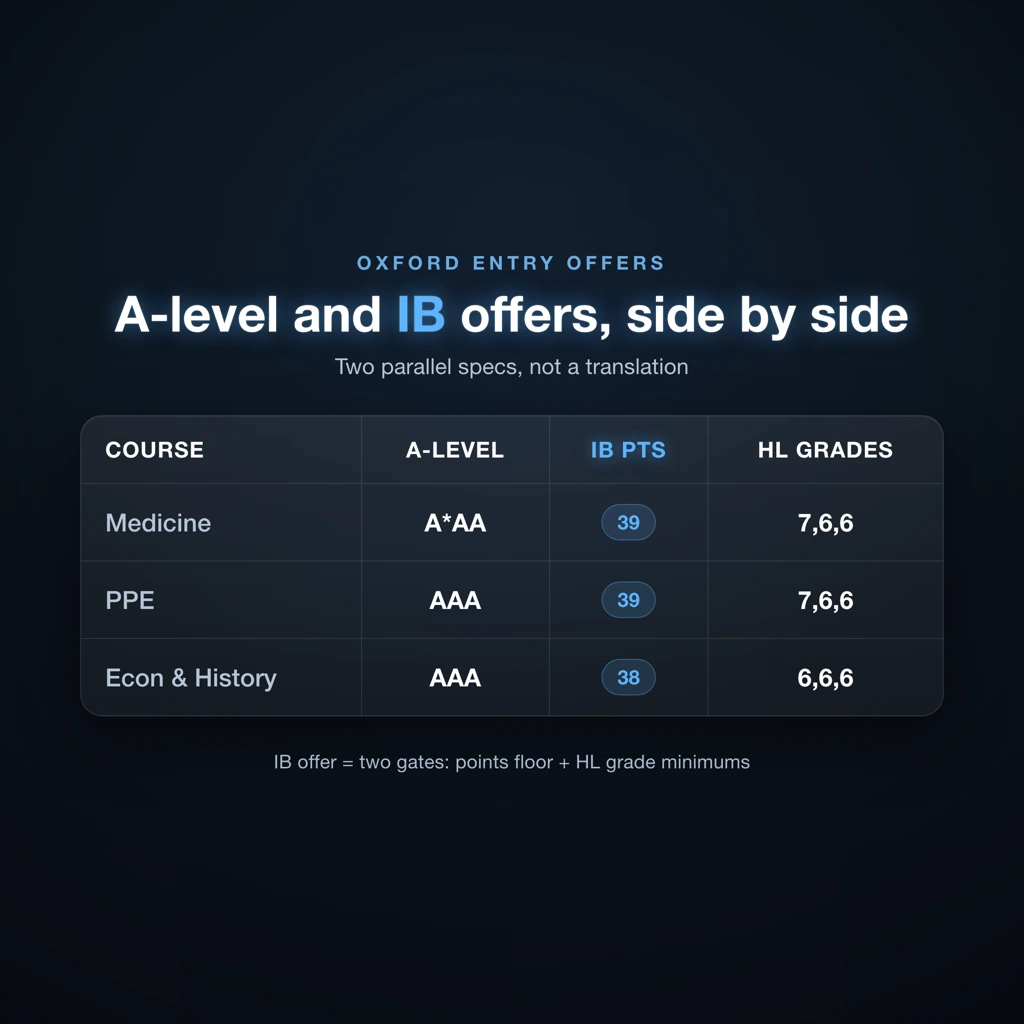
UK universities publish two parallel offers for most courses: an A-level grade string and a separate IB package made up of an overall points total plus specific Higher Level (HL) grade conditions. Neither is a rough translation of the other - they are distinct specifications designed to test equivalent preparation through different structures.
The table below shows how this works in practice at Oxford.
| Course | A-level offer | IB offer (points + HL grades) |
|---|---|---|
| Medicine | A\*AA (Chemistry + one of Biology, Physics, Maths) | 39 points incl. core; 7,6,6 at HL; Chemistry compulsory at HL plus one of Biology, Physics, or Maths at HL |
| PPE | AAA | 39 points incl. core; 7,6,6 at HL |
| Economics & History | AAA | 38 points incl. core; 6,6,6 at HL |
Sources: Oxford Medicine entry requirements, Oxford Economics/PPE admissions criteria.
HL subjects function as the direct depth equivalent of A-levels. Where an A-level offer names a compulsory subject, the IB offer mirrors it at HL. For Oxford Medicine, Chemistry must be taken at HL, not Standard Level, exactly as it must appear in the A-level grade string. An IB student who studied Chemistry only at SL would be ineligible regardless of their overall points score.
The points total itself is out of 45, and up to 3 of those points come from the core components: Theory of Knowledge (TOK) and the Extended Essay. That means the maximum score achievable from six subjects alone is 42. An applicant targeting 39 points needs to account for core points in their planning, not treat them as a bonus. A student with 36 from subjects plus 3 from core meets a 39-point threshold; a student with 39 from subjects but 0 from core also meets it - but the HL grade conditions still apply independently.
Read the IB offer as two separate gates: the overall points floor, and the HL grade requirements. Clearing one gate while failing the other is still a rejection.
3. Breadth vs depth: where the structural difference matters for specific courses
A-levels and the IB Diploma are structurally different by design, and for some courses that difference is more than cosmetic.
A-levels concentrate study into three subjects taken over two years. The IB spreads across six subject groups, plus three core components: Theory of Knowledge (TOK), the Extended Essay, and Creativity, Activity, Service (CAS). An IB student who loves Chemistry studies it alongside five other subjects and a 4,000-word essay. An A-level student can put three slots into Chemistry, Mathematics, and Further Mathematics.
Where IB breadth helps. Courses that reward analytical writing, contextual reasoning, or a second language sit well with the IB's structure. The Extended Essay gives applicants something concrete to discuss at interview, and Language B at Higher Level satisfies modern language requirements that some humanities courses carry.
Where A-level depth has a practical edge. The gap is sharpest in mathematics-heavy STEM courses. Cambridge describes Further Mathematics as "essential" for Mathematics and Computer Science, and "very useful" for Engineering and Natural Sciences (Physics). Strong STEM applicants typically take it as a fourth A-level. An IB student cannot add a seventh Higher Level subject to replicate this, because the IB structure caps HL subjects at three. This is the concrete asymmetry that matters, not a vague claim about depth.
Mixed qualifications. If an IB student wants to address this gap, some schools allow them to sit an A-level alongside the Diploma. Cambridge assesses applicants taking combinations of qualifications, such as IB HL subjects alongside other qualifications, on an individual basis, so a mixed route is not automatically penalised.
Neither structure is inherently superior. The trade-off is real but course-specific: check the subject requirements for each course you are applying to before choosing your qualification pathway.
4. Busting the myths: 'IB is worth more' and 'A-levels are safer'
Two pieces of received wisdom circulate endlessly among students choosing between these qualifications. Both are wrong.
Myth 1: The IB carries a hidden premium. The equivalence tables do not reward breadth with bonus credit. Oxford's offer for Medicine maps an IB score of 39 (including core points) directly to A\*AA at A-level, as stated in its academic entry requirements. There is no tier above A\AA that an IB score unlocks. A student with 40 IB points holds the same nominal standing as one with 39 when the published offer is 39 - the extra point does not convert into something an A\AA candidate cannot also achieve.
Myth 2: A-levels are the safer bet. Oxford's Medical Sciences Division states explicitly that success rates for IB and A-level applicants are broadly similar, and that the choice of qualification plays no part in its selection criteria. A well-constructed A-level set is not inherently lower-risk than a well-chosen IB programme, and the reverse is equally true.
The counter-intuitive detail that matters most: which subjects you take at the appropriate level outweighs which qualification you sit. Oxford Medicine requires Chemistry at IB Higher Level, plus at least one of Biology, Physics, or Mathematics at HL. An IB candidate with Chemistry at Standard Level cannot satisfy the offer regardless of their total score. That subject-level mismatch is a more common reason for an application failing than the choice of IB over A-levels in the first place.
5. Oxford and Cambridge IB entry requirements: what the numbers look like
Both Oxford and Cambridge set IB offers at the highest level of attainment they expect from any qualification. These are equivalent offers, not preferential ones. An IB applicant is not advantaged over an A-level applicant, nor disadvantaged.
**Oxford's course-level requirements** vary more than many applicants expect. The numbers below come directly from Oxford's published admissions criteria.
| Course | IB overall (inc. core) | HL grades required | Subject conditions |
|---|---|---|---|
| Medicine | 39 | 7, 6, 6 | Chemistry compulsory at HL; plus Biology, Physics, or Maths at HL (source) |
| PPE | 39 | 7, 6, 6 | None specified (source) |
| Economics & Management | 39 | 7, 6, 6 | Mathematics at HL, score 6 or 7 (source) |
| Economics & History | 38 | 6, 6, 6 | History and Maths highly recommended (source) |
One non-obvious gotcha on the Medicine requirement: Chemistry must be one of your three HL subjects, and a second science or Maths must also be at HL. A student who takes Chemistry at Standard Level to free up HL slots elsewhere is ruled out entirely, regardless of their overall points score.
Cambridge expects students to be achieving the highest grades in whichever qualification they take, and accepts the IB alongside A-levels and other international credentials. Specific offer levels can differ between Colleges for the same course, so checking at College level is essential rather than relying on a single published number. Cambridge also notes that its requirements are set for 2027 entry and were updated in March 2026, so figures can shift year to year (source).
If your question is whether Oxford or Cambridge prefers the IB over A-levels, the answer from both institutions is the same: they do not.
6. How to check your IB predicted grades against real UK course offers
Most generic advice tells IB students to convert their predicted total into A-level equivalents first, then look up course requirements. That approach introduces rounding error at every step and, more importantly, strips out the HL subject-matching detail that many admissions offers depend on. A university requiring a 7 in HL Chemistry is not asking for "an A* equivalent" - it is asking for a 7 in HL Chemistry. The conversion loses that precision entirely.
The Course Finder on this site solves that problem directly. You enter your IB predicted grades and your HL subjects, and it returns UK courses whose entry requirements you actually meet, stated in IB terms rather than reconstructed from A-level tables.
A few things worth knowing before you use it:
- Use your predicted grades, not conversions. Your IB coordinator's prediction carries direct weight with UK admissions tutors - a translated grade does not.
- HL subject selection matters as much as the total. A 38-point prediction with HL Biology reads very differently to a 38 with HL Theatre Arts, for course-specific requirements.
- Run the check early. Before your school finalises predicted grades, you can model the boundary cases - "what if my Maths HL drops from 7 to 6?" - and identify which offers become out of reach.
That last point is the non-obvious one: early modelling lets you flag subject choice mismatches to your coordinator before predictions are locked, when there is still time to act.
7. What to do next
The question of whether UK universities prefer IB or A-levels matters far less than whether your specific predicted grades and HL subjects match the published requirements for your target courses.
Start there. Search for courses by IB predicted grade using our Course Finder, enter your HL subjects alongside your points total, and check which course profiles your combination actually meets. The non-obvious gotcha: a strong overall score will not rescue you if a course requires a specific HL subject you have not taken. History at UCL, for example, specifies HL subjects, not just a points band.
If you are still choosing HL subjects, do that cross-check now, before your school finalises your registration. Subject fit is harder to fix than a grade shortfall. Open the Course Finder this week and confirm your HL choices against at least three target course entries.
FAQ
Do UK universities prefer IB or A-levels?
UK universities do not prefer one over the other - they publish parallel entry requirements for both qualifications, and Oxford explicitly states that success rates for IB and A-level applicants are broadly similar.
Does Cambridge prefer IB or A-levels?
Cambridge accepts both as standard qualifications and assesses each application on its individual merits; offers are set at the highest level of attainment for both, and taking four A-levels does not give an advantage over three.
Is the IB harder than A-levels?
The IB spreads workload across six subjects plus core components while A-levels go deeper in three, making direct difficulty comparisons unhelpful - the challenge is different in structure rather than straightforwardly greater or lesser.
Is the IB diploma recognised by UK universities?
Yes - all major UK universities, including Oxford and Cambridge, recognise the IB Diploma and publish explicit IB entry requirements for their undergraduate courses alongside their A-level requirements.
What is the IB equivalent of A*AA at A-level?
Oxford's published offers show that A*AA maps to 39 IB points (including core) with 7,6,6 at Higher Level for courses such as Medicine and PPE, though subject-specific HL requirements also apply.
Do A-levels give a better chance of getting into a top UK university than the IB?
No - Oxford states the choice of qualification plays no part in its selection criteria and that A-level and IB applicant success rates are broadly similar; subject choices and grades matter far more than which qualification you sit.
References
- Pre-clinical medicine: Do you prefer A-levels or the IB? - University of Oxford, Medical Sciences Division - https://www.medsci.ox.ac.uk/study/medicine/pre-clinical/faqs/do-you-prefer-a-levels-or-the-ib
- Check which qualifications we accept | Undergraduate Study - https://www.undergraduate.study.cam.ac.uk/apply/before/accepted-qualifications
- Medicine: Academic Entry & Age Requirements - University of Oxford, Medical Sciences Division - https://www.medsci.ox.ac.uk/study/medicine/pre-clinical/requirements/academic
- Undergraduate: Admissions Criteria | Department of Economics - https://www.economics.ox.ac.uk/undergraduate-admissions-criteria
- How to choose A levels or high school subjects | Undergraduate Study - https://www.undergraduate.study.cam.ac.uk/apply/before/choosing-high-school-subjects
- International entry requirements | Undergraduate Study - https://www.undergraduate.study.cam.ac.uk/international-students/international-entry-requirements