Joint Honours Degree: What It Is and How It Works
By Michael Thompson · Education Specialist; 10 years teaching the IB at Bromsgrove School · Published 5 July 2026
A joint honours degree combines two subjects within a single undergraduate qualification, splitting your study roughly equally between both - unlike a major-minor structure where one subject dominates. The terms joint honours, dual honours, and combined honours are often used loosely, but they carry distinct meanings that affect how your timetable, workload, and degree classification work. Choosing between a joint and a single honours degree is one of the less-discussed decisions in a UCAS application, yet it shapes your entire undergraduate experience. This guide explains the terminology, how offers are set, what the workload really looks like, and how to decide whether two subjects suit you better than one.
Key Takeaways
- Joint honours = roughly equal split: A joint honours degree divides study between two subjects at approximately 50/50, whereas 'X with Y' courses signal a major-minor weighting where one subject takes priority.
- Terminology matters: 'Joint' and 'dual' honours typically mean an even two-subject split; 'combined honours' can mean several subjects grouped under one programme, as at Durham and Newcastle.
- Entry requirements combine both departments: The more competitive of the two subjects usually sets the bar, so check both departments' A-level or IB Higher Level requirements before applying.
- IB applicants must check HL requirements twice: A joint honours offer may demand specific Higher Level subjects from each side, and both sets of HL conditions apply simultaneously.
- Timetable clashes are a real risk: Because you belong to two departments, compulsory sessions can overlap - confirm at open day how the university handles this.
- Breadth comes at a cost of depth: You will develop two skill sets and keep more career options open, but you will cover less of each subject than a single honours student would.
In This Article
- What Is a Joint Honours Degree?
- Joint Honours vs Single Honours: A Side-by-Side Comparison
- The Terminology: Joint, Dual, Combined - and 'X with Y'
- Pros and Cons of a Joint Honours Degree
- How Entry Requirements Work for Joint Honours
- IB Students: Checking Higher Level Requirements for Joint Honours
- Universities That Offer Joint Honours Degrees
- What to Do Next
1. What Is a Joint Honours Degree?
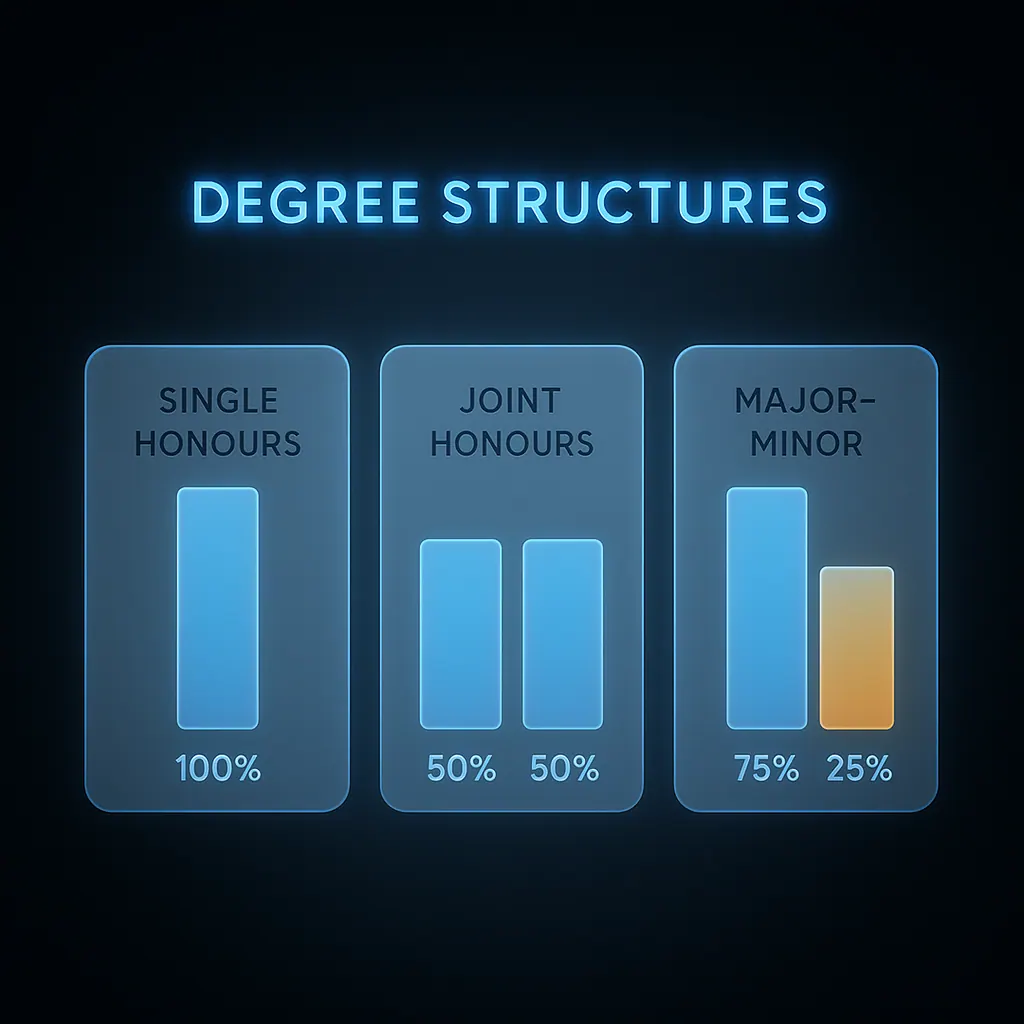
A joint honours degree combines two subjects at roughly equal weighting within a single undergraduate qualification. You graduate with one degree, not two, but your transcript reflects serious study in both disciplines. Per UCAS, joint honours courses (also called dual honours) let students combine two subjects within a single undergraduate degree.
The terminology gets slippery, and the difference matters when searching. UCAS treats "joint honours" and "combined honours" as distinct categories. Combined honours, in UCAS's own definition, allows students to choose several subjects within one degree, not just two. Durham's Combined Honours in Social Sciences, for example, lets students mix Politics, International Relations, Human Geography, Sociology, and French inside one programme. That is a different beast from a standard two-subject joint degree.
There is a third structure worth knowing: the "X with Y" or major-minor format, where one subject takes the larger share of your credit (typically around two-thirds) and the second is a supporting strand. This is not joint honours, even though the degree title can look similar at a glance.
The non-obvious gotcha: because UCAS search results blend these structures, a student searching for a joint law and philosophy degree may land on combined honours listings or major-minor programmes without realising the credit split is uneven. Checking the actual module breakdown in the course specification, not just the title, is the only reliable test.
2. Joint Honours vs Single Honours: A Side-by-Side Comparison
As UCAS notes, UK undergraduate courses are specialised from day one. That applies whether you pick one subject or two, but the implications look quite different in practice.
| Factor | Joint Honours | Single Honours |
|---|---|---|
| Workload | Reading lists and assessments from two departments, running in parallel | Deep reading in one discipline; volume can be equally high but focused |
| Timetable-clash risk | High - two departments set timetables independently, so clashes are common | Low - one department controls your schedule |
| Breadth | Structured coverage of two subjects at degree level | Narrow by design; elective modules add some variety |
| Dissertation | Usually one dissertation, but some programmes require a substantial piece of work in each subject | Single dissertation in your chosen field |
| Study split | Often 50/50, but many programmes weight subjects 60/40 or 70/30 - check the course structure carefully | N/A |
The timetable point is the non-obvious gotcha. Because the two departments in a joint programme rarely coordinate their compulsory module slots, you can find yourself forced to choose between clashing core lectures in Year 2, which effectively narrows what you can study. It is worth asking admissions tutors directly how the programme handles this before you apply.
The dissertation row is worth attention for postgraduate ambitions. A single 10,000-word dissertation drawn from two disciplines can look unfocused to a master's admissions committee unless you frame it carefully.
3. The Terminology: Joint, Dual, Combined - and 'X with Y'
The labels universities use for these degrees are not standardised, so the same structure can appear under several different names. Knowing the pattern helps you read a prospectus accurately.
'X and Y' titles (Politics and Sociology, French and Spanish) typically signal a roughly even split between the two subjects. 'X with Y' titles (History with Film Studies) typically signal a major-minor weighting, where X takes up the larger share of your credits and Y is secondary. That single word swap changes the shape of your degree, so read the programme specification rather than relying on the title alone.
UCAS describes combined honours as a separate category that lets students choose several subjects within a single degree, which takes it beyond the two-subject joint structure. Durham's Combined Honours in Social Sciences illustrates this well: one student ambassador combines Politics, International Relations, Human Geography, Sociology, and French simultaneously within a single BA.
The non-obvious gotcha: BA Joint Honours and BSc Joint Honours follow the same joint structure. The difference is purely in subject mix (arts and humanities versus sciences and social sciences), not in how the two subjects share your time.
Always check the programme specification. Terminology varies enough between universities that "combined honours" at one institution can mean something close to what another calls "joint honours."
4. Pros and Cons of a Joint Honours Degree
A joint honours degree suits some students well and genuinely does not suit others. The case for or against depends heavily on which subjects you are combining and how those subjects interact.
The strongest argument for a joint honours degree is intellectual fit. Some questions sit naturally across two disciplines. Law and Psychology overlap in areas like criminal responsibility and witness reliability. Computer Science and Mathematics share formal logic and proof. Where the pairing is genuinely complementary, the combined study can be richer than either subject alone. Oxford's History and Modern Languages joint school illustrates this concretely: a student can pair the History paper "Enlightenment and Revolutions: 1650-1850" with French "Modern Prescribed Authors I" covering Voltaire and Diderot, reading the primary sources in French while analysing the historical context in the same term. Neither single-honours course would offer quite that alignment. That pairing is described directly by a student on the course.
Other genuine advantages:
- Two distinct skill sets on your transcript, which can widen graduate options.
- Freedom from the coverage requirements of a single-honours course. Oxford joint schoolers, for instance, face no period or geographical requirements across History papers, whereas single-honours History students must cover both British Isles and European and World streams. (source)
- The ability to pursue cross-disciplinary interests that a single-honours route would force you to abandon.
The cons are real and worth taking seriously:
- Timetable clashes. Two departments, two sets of lectures, two sets of seminars. A second-year Oxford Modern Languages and History student described a weekly schedule of history tutorials, literature tutorials, language tutorials, two language classes, and two lectures, all running concurrently. (source) That coordination load is typical, not exceptional.
- Less depth per subject. You cover fewer papers in each discipline than a single-honours student does. If you want to specialise deeply in one field, single honours is the more honest choice.
- Final-year complexity. Dissertations or capstone projects may require sign-off from two supervisors in two departments, with different submission conventions.
The non-obvious trade-off: a first-class joint honours result is achievable. Approximately 50% of Oxford English and Modern Languages students achieve a first-class degree. But reaching that level demands managing two departments' expectations simultaneously rather than focusing all your effort in one direction.
If your interest is depth rather than breadth, single honours will serve you better.
5. How Entry Requirements Work for Joint Honours
Entry requirements for a joint honours degree typically combine the conditions from both contributing departments. If one subject requires AAB and the other ABB, the joint offer will usually sit at AAB or above. The more selective department sets the ceiling, not the average.
The less obvious catch: subject prerequisites stack too. A History and French joint course may require a specific A-level in a modern language from the French side, plus no particular subject from History, but you still need both. Reading only the joint course summary page can miss prerequisites that are only spelled out on an individual department's page.
Oxford illustrates the double-workload clearly. Applicants for English and Modern Languages must submit written work for the English component and a separate piece of written work for the Modern Languages component, including work in the chosen language. They may also need to sit admissions tests in both subjects depending on the combination. That is two sets of written work, potentially two tests, and one application cycle.
Practical step: for every joint course you are considering, open the department pages for both subjects separately and compare their standalone entry requirements. Do not rely on the combined course page alone. Discrepancies between what those pages say and what the joint page summarises are common, and the stricter condition will apply at offer stage.
6. IB Students: Checking Higher Level Requirements for Joint Honours
For IB Diploma students, joint honours offers carry a specific complication that single honours applicants rarely face: both sets of Higher Level subject requirements apply at the same time, not as alternatives.
Consider a joint honours offer in History and French. The university may require History at HL and French at HL simultaneously. That means two of your three HL slots are already spoken for before you choose your third. If your school timetable makes a third HL in, say, Mathematics or a science subject near-impossible alongside those two, you need to know this before IB subject choices are finalised, not after.
The non-obvious gotcha: some competitive joint honours courses phrase their offer as a single points total, for example "38 points including 6,6 at HL in History and French." The HL subject conditions are embedded inside that points figure, not listed separately. Students sometimes read the headline number and miss the subject-specific conditions beneath it.
Practical steps for IB applicants:
- Find both departments' individual admissions pages, not just the combined course page, and check each one for HL subject requirements.
- Note how the points offer is written: look for "including" or "with" clauses that carry hidden HL conditions.
- Treat aggregator sites and comparison tools as a starting point only. University course pages are the authoritative source, and the wording matters.
- If you are still in Year 11 or the equivalent, raise the subject-combination question with your IB coordinator before options are locked in.
7. Universities That Offer Joint Honours Degrees
The joint honours degree is not a niche option. A search for "combined honours" on UCAS returns over 29,000 courses across 834 pages, covering institutions in all four UK nations. The range is wide enough that almost any subject pairing you can think of exists somewhere.
A few universities are worth knowing by name:
- Oxford runs what it calls Joint Schools, pairing Modern Languages with Classics, English, History, Philosophy, or Linguistics. The four-year structure includes a year abroad. One concrete measure of how well the format works: around 50% of English and Modern Languages students achieve first-class degrees, a higher rate than many single-honours courses.
- Durham offers Combined Honours in Social Sciences, which lets students mix subjects as different as Politics, International Relations, Human Geography, Sociology, and French within a single degree.
- Swansea lists three routes for its combined honours: standard three years, with a Year Abroad, and with a Year in Industry, all at 104-128 UCAS Tariff points.
- Oxford Brookes offers multiple Anthropology, Geography, History, Philosophy, and Sociology pairings, most at 120 UCAS Tariff points.
- Newcastle offers a Combined Honours BA allowing a range of study options, with entry requirements listed separately per combination.
Among the most searched combinations are joint honours law degrees (commonly Law with Criminology or Politics) and joint honours arts degrees pairing languages with history or philosophy. These appear consistently in UCAS autocomplete and reflect genuine employer and postgraduate demand.
These universities are examples, not a definitive list. Provision varies significantly by campus and intake year, so run your own search on UCAS with the specific subjects you want to combine.
8. What to Do Next
The most common mistake at this stage is checking only one department's entry requirements. A joint honours law degree, for example, may demand specific A-level subjects from the Law side that the Politics or Criminology side does not mention at all - and the two lists rarely appear on the same page.
This week, open the university's own course pages for both subjects in your intended combination and read each department's requirements separately. Confirm the A-level subjects or IB Diploma Programme Higher Level subjects each side needs, and check whether either department sets a minimum grade for a specific subject rather than just a points threshold.
When you are ready to compare programmes across institutions, search joint and combined honours combinations by subject pair using the Course Finder. To catch programmes a name-search would miss, find joint honours combinations a name-search would miss in the full Course Directory.
FAQ
What is a joint honours degree?
A joint honours degree is a single undergraduate qualification that divides study roughly equally between two subjects, as distinct from a major-minor structure where one subject dominates.
Is a joint honours degree harder than single honours?
Not necessarily harder in academic level, but more demanding to coordinate - you belong to two departments, manage two sets of deadlines, and risk timetable clashes that single honours students don't face.
Is a joint honours degree more work?
The total credit load is the same as a single honours degree, but splitting that load across two departments with different assessment styles and scheduling can make it feel heavier to manage.
What does 'first class joint honours degree' mean?
A first class joint honours degree means you achieved a first (70%+ in the UK grading system) averaged across both subjects, with the exact calculation method varying by university - check your institution's degree classification rules.
Is a joint honours degree good for employment?
It depends on the combination: pairings with clear vocational logic (Law and Criminology, Business and a Language) can strengthen employability, while less coherent combinations may require more explanation at interview.
Is PPE a joint honours degree?
PPE (Philosophy, Politics, and Economics) is technically a combined or multi-honours degree rather than a standard joint honours, since it spans three subjects rather than two - though it is often grouped with joint honours courses in general usage.
References
- How to choose the right undergraduate course for you - https://www.ucas.com/applying/you-apply/what-and-where-study/choosing-course
- Search | All results | "combined honours" | UCAS - https://www.ucas.com/explore/search/all?query=combined+honours
- February | 2022 | Adventures on the Bookshelf - https://bookshelf.mml.ox.ac.uk/2022/02
- Joint Schools | Faculty of English - https://www.english.ox.ac.uk/joint-schools
- Search courses | UCAS - https://www.ucas.com/explore/search/courses-beta?query=combined+honours