Foundation Year Explained: What It Is and Who It Suits
By Michael Thompson · Former IB Diploma Programme coordinator; 10 years at Bromsgrove School · Published 5 July 2026
A foundation year - sometimes called year zero - is an extra preparatory year taken before year one of an undergraduate degree, turning a standard three-year course into a four-year integrated programme. It is designed for students who have the potential to succeed at university but whose current qualifications, subject choices, or circumstances do not yet meet the standard entry requirements for direct entry. The foundation year sits within the same UCAS application as the degree itself, so you apply for the full four-year course rather than the single year in isolation. Understanding exactly how it works - and how it differs from a standalone foundation programme - matters because the two routes carry different funding rules and lead to different outcomes.
Key Takeaways
- A foundation year is year zero: It is a preparatory year embedded at the start of a degree, making an otherwise three-year honours course a four-year integrated programme.
- Lower entry requirements: Foundation-year routes typically accept lower UCAS Tariff points or non-standard qualifications than the direct-entry version of the same degree.
- Student finance covers the extra year: UK-domiciled students can access tuition-fee and maintenance loans for the foundation year, but check current rules on gov.uk as fee caps for classroom-based subjects changed from 2025/26.
- Integrated vs standalone are different things: An integrated foundation year is part of the degree and sits in one UCAS application; a standalone or international foundation programme is a separate qualification with different funding treatment.
- IB students can use this route too: Students who fall short of Higher Level subject requirements or total IB points may qualify for a foundation-year entry with a lower points threshold - check the specific course page.
- Spot it in a course listing by its title and code: Look for 'with Foundation Year' in the course title, a four-year duration, and a distinct UCAS course code ending in F.
In This Article
- What Is a Foundation Year
- Who Foundation Years Are For
- Foundation Year vs Direct Entry: How the Routes Compare
- Funding and Course Length: What an Extra Year Means
- How to Find Foundation Year Courses on UCAS
- Is a Foundation Year Worth It
- What to Do Next
1. What Is a Foundation Year
A foundation year (sometimes called year zero) is an extra preparatory year taken before year one of an undergraduate degree. It turns a standard three-year degree into a four-year integrated course. According to UCAS, foundation years are generally full-time courses delivered at a university or college, and students undertaking one are treated as full-time undergraduate students throughout.
The year is built around the subject-specific knowledge and skills you will need for degree-level study, not general academic catch-up. That distinction matters: a foundation year in Engineering will cover different ground from one in Fine Art or Law, even though both carry the same structural role in the degree pathway.
One counter-intuitive feature: UCAS notes that not all universities and colleges offer foundation years, so the choice of institution is partly shaped by whether a foundation route exists in your subject at all. Most students who complete a foundation year stay at the same university to finish their degree, which means the institution you pick for year zero is, in practice, likely to be the one awarding your honours degree four years later. That is worth weighing before you apply, not after.
2. Who Foundation Years Are For
A foundation year suits several distinct groups. UCAS identifies two core cases: students whose grades fell short of standard entry requirements, and those whose subject combination at school did not match what a degree course expects. Beyond those two, the picture is broader.
The main groups who benefit:
- Students who missed standard grades - either through predicted grades that did not materialise, or a change in course direction after results day.
- Subject-mismatched applicants - for example, a student who wants to study Engineering but took no Physics A-level, or a Social Sciences applicant with no essay-based subjects.
- Mature and returning students - those re-entering education after a gap, whose qualifications may be dated or incomplete.
- **Students with overseas or non-standard qualifications** - where the credential does not map cleanly onto UK university entry requirements.
The IB angle is worth flagging specifically. IB Diploma students who fall short of required Higher Level subjects, or whose total points sit below a course's standard threshold, can find that a foundation year offers a lower entry bar than direct degree entry. Foundation-year entry requirements vary by institution, so check the specific course page rather than assuming a uniform IB threshold applies.
The non-obvious part is how selective some foundation years are at the top end. Oxford's Astrophoria Foundation Year is restricted to students who attended non-selective UK state schools throughout their entire secondary education, with a standard A-level benchmark of grades BBB. Independent school attendance at any point, including on a scholarship, disqualifies an applicant. That is a foundation year designed to widen access, not to catch students who narrowly missed a standard offer.
Cambridge's Foundation Year pilot operates on similar widening-participation principles. Eligibility includes being care-experienced, a young carer, from a low-income household, or from a school with low higher education progression rates. The academic requirement is 120 UCAS Tariff points, equivalent to BBB at A-level, with no specific subject requirements.
Care-experienced students should check widening-participation and contextual-offer policies at any university they consider. These policies can make foundation entry meaningfully more accessible, and some institutions apply contextual adjustments to their foundation-year entry thresholds as well as to standard degree offers.
3. Foundation Year vs Direct Entry: How the Routes Compare
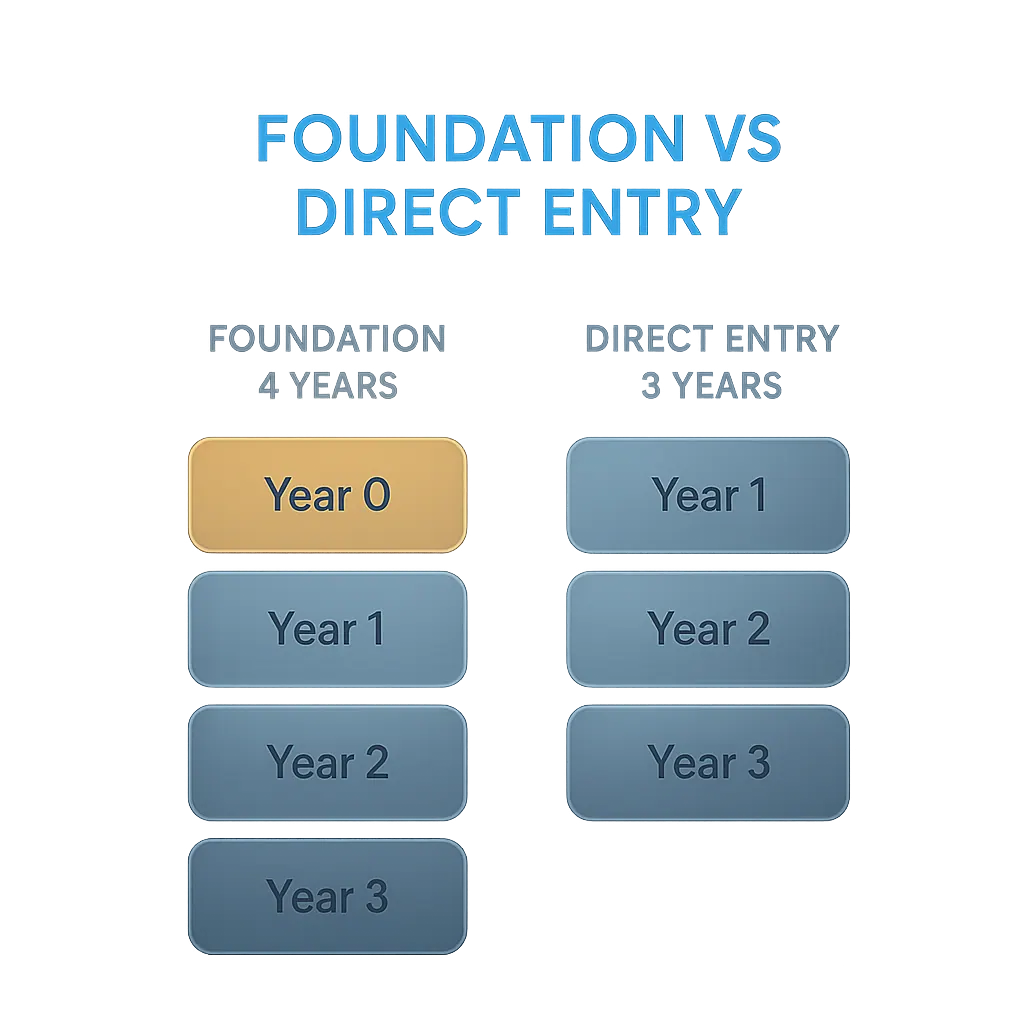
The clearest way to see the difference is side by side.
| **Foundation year route** | Direct entry | |
|---|---|---|
| Entry requirements | Lower: e.g. 48 UCAS Tariff points (DD at A-level) for the University of South Wales History course | Typically BBC-ABB or equivalent at A-level depending on course and institution |
| Total course length | 4 years (foundation year + 3-year degree) | 3 years |
| Tuition and funding | Tuition fees are payable for the foundation year as an additional undergraduate year; maintenance costs apply for the extra year too | Fees and maintenance across 3 years only |
| UCAS application | Integrated foundation years: applied for on the same UCAS application as the degree, using the degree course code | Standard UCAS application to a 3-year degree |
| Who it suits | Students whose grades or subject combinations did not meet direct entry requirements | Students meeting standard entry criteria |
Integrated vs standalone: a distinction that matters for funding
An integrated foundation year is part of the degree itself. You apply once through UCAS, the foundation year sits at year zero of the programme, and Student Finance England treats the whole thing as one undergraduate course. The University of South Wales History Including Foundation Year is this model: four years, one application, one course code (V00F).
A standalone or international foundation programme is a separate qualification. It has its own application process, is often run by a private provider or college, and funding treatment differs. You would then apply again through UCAS for a degree after completing it. This matters practically: if you already hold a degree, Student Finance England will not fund a standalone foundation programme.
The non-obvious gotcha with integrated programmes is progression. UCAS notes that most students who complete a foundation year stay at the same university for the degree, but it is not automatic. Check the progression conditions in the offer letter before you accept, particularly the minimum grade required to move to year one.
4. Funding and Course Length: What an Extra Year Means
An integrated foundation year adds one full year to your degree, so a standard three-year BSc becomes four years. That matters for two reasons: total fees and total living costs both increase, and so does the debt you graduate with.
Student finance does cover the foundation year. UK-domiciled students can apply for a tuition-fee loan and a maintenance loan for the foundation year under the same Student Finance rules that apply to the rest of their degree. Check gov.uk for current loan limits, as figures are updated annually.
One non-obvious wrinkle: the government announced on 17 July 2023 that maximum fee and loan limits for foundation years in classroom-based subjects would be reduced to £5,760, intended to take effect from the 2025/26 academic year, according to the Department for Education's foundation years statistics release. That cap applies specifically to classroom-based subjects, not to non-classroom-based ones such as lab-heavy or studio-based courses. The distinction matters: in 2021/22, 59% of foundation year entrants studied a classroom-based subject, so the majority of students would be affected by the lower limit.
The practical trade-off is straightforward. If your course is classroom-based and falls under the new cap, your foundation year fees will be lower than a standard undergraduate year. But you are still adding 12 months of living costs on top of a full degree. Over four years rather than three, maintenance borrowing accumulates. That is the debt comparison worth running before you commit, not just the tuition figure.
Check whether your specific subject is classified as classroom-based or non-classroom-based before assuming which fee cap applies to you.
5. How to Find Foundation Year Courses on UCAS
The quickest way to filter foundation year options is to type "foundation year" into the keyword field in the UCAS undergraduate search tool. That field is separate from the subject field, so you can combine both to narrow results to, say, history with a foundation year entry point.
Once you have results, look for two signals in the listing itself:
- Course title. Foundation year routes typically end with "with Foundation Year" or "Including Foundation Year", for example BA (Hons) History Including Foundation Year at the University of South Wales.
- Duration. A normally three-year degree becomes four years full-time when a foundation year is attached.
- Course code. The foundation year variant carries its own distinct UCAS code. The University of South Wales History course above uses code V00F, separate from the standard History code, so applying to the wrong code is a real risk worth double-checking.
One non-obvious point: Clearing can surface foundation year vacancies too. If your results arrive in August and fall short, foundation year places are sometimes still available through Clearing when direct-entry spots have gone.
Entry requirements, contextual-offer policies, and any IB-specific thresholds vary by course and institution, so always read the individual course page rather than assuming the pattern from one listing carries over to another. You can find degrees that offer a foundation-year route to compare entry points, tariff thresholds, and course lengths side by side.
6. Is a Foundation Year Worth It
The core trade-off is straightforward: one extra year of fees and time in exchange for access to a degree programme that would otherwise require qualifications you do not yet hold. Whether that exchange makes sense depends on [your alternatives](/guides/degree-apprenticeship-vs-university).
The scale of the route suggests many students find it worthwhile. According to the Department for Education's foundation years statistics, there were 69,325 foundation year entrants at English HE providers in 2021/22, up from 8,470 in 2011/12. Over the same period, the number of courses grew from 678 to 3,717. This is not a niche workaround; it is a well-established part of the undergraduate landscape.
Business and management alone accounted for 51% of all foundation year entrants in 2021/22, compared with 13% of first-year undergraduates in the same year, per the DfE release. The counterintuitive implication: the foundation year is less common in STEM than the course catalogues might suggest, so competition for science-based foundation places can be sharper than students expect.
The route is a weaker fit in two specific situations:
- You can realistically resit A-level units or sit an additional AS-level to meet direct-entry requirements within a year, at lower cost.
- A standalone foundation programme at a different institution offers a broader choice of progression routes than an integrated foundation year tied to one university's degree.
If neither applies, a foundation year is a straightforward path to a degree that would otherwise be out of reach.
7. What to Do Next
This week, go to UCAS and search the course listings using the phrase "foundation year" alongside your subject (for example, "foundation year chemistry" or "foundation year law"). Note the five-digit UCAS course code for each result you like, then open the individual course page and read the foundation-entry requirements carefully. This step catches a non-obvious gotcha: some integrated foundation years list lower entry requirements on the course page than the university's general admissions page shows, so the specific course page is the one that counts.
Cross-check those thresholds against your predicted grades or IB points now, before offers are made.
Browse undergraduate courses including foundation-year routes to compare options side by side, or use our tool to find degrees that offer a foundation-year route. Start with the course code in hand.
FAQ
What is a foundation year at university?
A foundation year (year zero) is a preparatory year embedded at the start of an undergraduate degree, designed to bring students up to the academic level required for year one; it makes a standard three-year degree a four-year integrated course.
Is a foundation year worth it?
For students who cannot meet direct-entry requirements, a foundation year is often the most direct route to the degree they want, though it adds an extra year of tuition fees and living costs - weigh this against the alternative of resitting qualifications or applying to a lower-tariff course.
How much does a foundation year cost in the UK?
Tuition fees vary by university and subject; for classroom-based foundation years the government announced a maximum fee limit of £5,760 intended from 2025/26, and UK-domiciled students can apply for tuition-fee and maintenance loans - check the current rules on gov.uk.
How long is a foundation year?
A foundation year is typically one academic year, full-time, meaning a standard three-year honours degree becomes a four-year integrated programme when taken with a foundation year.
What is the difference between an integrated foundation year and a standalone foundation programme?
An integrated foundation year is part of the degree and applied for in the same UCAS application with a single course code, whereas a standalone or international foundation programme is a separate qualification applied for independently and treated differently for funding purposes.
Can IB students apply for a foundation year?
Yes - IB students who fall short of the Higher Level subject requirements or total points needed for direct entry may be eligible for a foundation-year route, and some universities set lower IB thresholds for foundation entry, so check the individual course page.
References
- How to choose the right undergraduate course for you - https://www.ucas.com/applying/you-apply/what-and-where-study/choosing-course
- Frequently Asked Questions | Astrophoria Foundation Year - https://foundationyear.ox.ac.uk/faqs
- FAQs | Foundation Year - https://www.foundationyear.cam.ac.uk/applying/faqs
- History (Including Foundation Year) | University of South Wales | UCAS - https://www.ucas.com/explore/courses/3b15c072-3820-4059-8670-577ca8cc6a56/course
- Release home - Foundation year participation, provision and outcomes at HE providers - Explore education statistics - GOV.UK - https://explore-education-statistics.service.gov.uk/find-statistics/foundation-years-statistics/2021-22