Russell Group Universities: Full List and Entry Guide
By Michael Thompson · Former IB Diploma Programme coordinator; 10 years at Bromsgrove School · Published 5 July 2026
Russell Group universities are a self-selected association of 24 research-intensive UK institutions - not an official ranking, not a government classification, and not a British equivalent of the Ivy League. The group was formed in 1994, named after a London hotel where university heads met, and has sat at 24 members since Durham, Exeter, Queen Mary University of London, and York joined in 2012. Understanding what the label does and does not mean will help you decide whether a Russell Group university belongs on your UCAS application - and which one is actually the best fit for your subject.
Key Takeaways
- 24 universities, not a ranking: The Russell Group is a membership association of 24 research-intensive universities; it has no official tier list and is not endorsed by any government body.
- Members span all four UK nations: England holds the majority, but Edinburgh and Glasgow represent Scotland, Cardiff represents Wales, and Queen's University Belfast represents Northern Ireland.
- Entry requirements are generally higher: Most Russell Group courses ask for AAA-ABB at A-level or 38-32 IB points, but the range is wide and some members set more accessible offers than others.
- The label is not a proxy for course quality: Non-Russell-Group universities regularly top subject-level league tables in law, nursing, architecture, and other fields - course fit and teaching quality often matter more for your specific degree.
- 82% graduate employment in high-skilled roles: According to the Russell Group, 82% of working graduates from member universities were in highly-skilled jobs 15 months after graduation, though this reflects the research-intensive intake as much as the brand.
- Use the Informed Choices tool before picking subjects: The Russell Group runs Informed Choices, a free tool for students aged 14 and up, to check which A-level or IB subject combinations keep your degree options open.
In This Article
- What Russell Group Universities Are (and Are Not)
- Full List of the 24 Russell Group Universities
- Russell Group Entry Requirements: A-levels and IB
- How Much the Russell Group Label Actually Matters
- Choosing a Russell Group University for Your Subject
- Personal Statement Tips for Russell Group Applications
- What to Do Next
1. What Russell Group Universities Are (and Are Not)
The Russell Group is a self-selected association of 24 research-intensive UK universities, not a government classification or an official ranking. It was founded in 1994 and named after a Russell Hotel in London, where vice-chancellors met to coordinate on research funding and policy. That origin matters: the Russell Group is, at its core, a lobbying and advocacy body, and it exists to represent its members' interests to government and funding bodies.
The comparison to the US Ivy League is common and mostly misleading. The Ivy League is a sports conference that became a shorthand for prestige. The Russell Group is neither a prestige ranking nor a quality kite-mark issued by any independent body. No external assessor decides who is in.
**Membership works by invitation, not annual merit review.** Universities join when invited and stay until they choose to leave. The most recent expansion brought the total to 24 when Durham, Exeter, Queen Mary University of London, and York joined, each recognised for carrying what the Group's chairman described as a "critical mass of research excellence across a wide range of disciplines." Those four universities left the rival 1994 Group to join.
The practical consequence: two universities with similar league-table positions can sit on opposite sides of the Russell Group line simply because one was invited and one was not.
2. Full List of the 24 Russell Group Universities
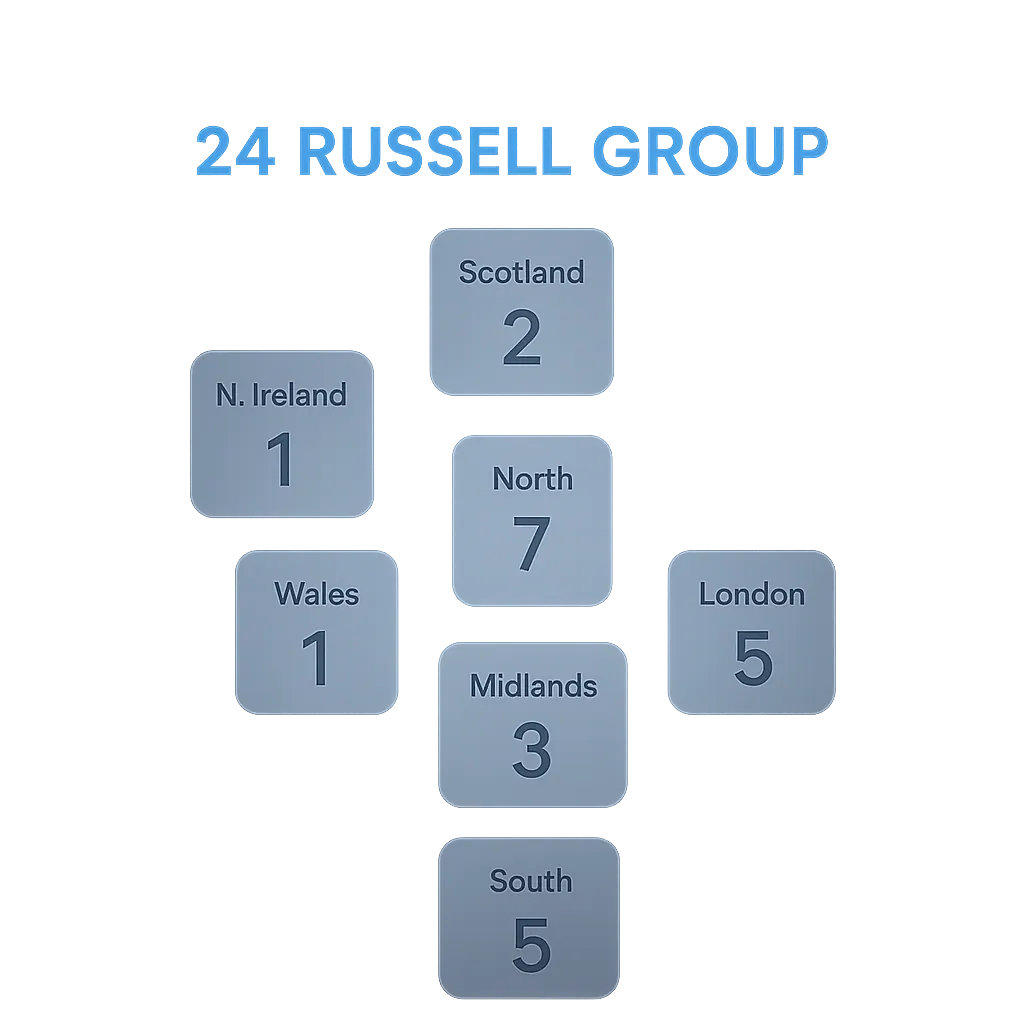
The membership of russell group universities has stood at 24 since 2012, when Durham, Exeter, Queen Mary University of London, and York joined, bringing the group to its current size. The list has not changed since.
Here are all 24 members in alphabetical order, with national annotations:
- University of Birmingham
- University of Bristol
- University of Cambridge
- Cardiff University (sole Welsh member)
- Durham University
- University of Edinburgh (Scotland)
- University of Exeter
- University of Glasgow (Scotland)
- Imperial College London (London)
- King's College London (London)
- University of Leeds
- University of Liverpool
- London School of Economics and Political Science (London)
- University of Manchester
- Newcastle University
- University of Nottingham
- University of Oxford
- Queen Mary University of London (London)
- Queen's University Belfast (sole Northern Irish member)
- University of Sheffield
- University of Southampton
- University College London (London)
- University of Warwick
- University of York
*Source: Russell Group, Our Universities*
Five of the 24 are based in London, which matters more than it might appear: London universities compete directly with each other for applicants, and some, notably LSE, are highly specialist rather than broad research universities. Two members sit in Scotland (Edinburgh and Glasgow), where the undergraduate degree structure is four years rather than three, a practical difference worth factoring in when choosing a Russell Group university in the UK.
3. Russell Group Entry Requirements: A-levels and IB
There is no single Russell Group entry requirement. Each of the 24 universities sets its own offers, and each course within a university sets its own bar. Treating the group as a monolith here will lead you astray.
The realistic A-level range runs from roughly AAA at the most competitive end down to ABB or even BBB at the lower end of the group. Medicine, law, and engineering at the most selective members typically sit at AAA or above. Less competitive courses, or universities at the lower-threshold end of the group, may make offers at ABB to BBB. The spread is wide enough that "Russell Group entry requirements" is a question you need to answer university by university, not once for the whole group.
For IB Diploma Programme students, the picture has an extra layer. Most Russell Group offers pair a **total points threshold** with specific Higher Level grade conditions, and both must be met. A typical competitive-course offer might read: 38 points overall, with HL grades of 6, 6, 6. A more accessible course at the same or a different university might ask for 32 to 34 points with HL grades of 6, 6, 5 or 6, 5, 5. The non-obvious gotcha: a student who hits the points total but misses one HL grade condition will still have the offer rejected. Check both numbers on every UCAS entry.
One practical check worth knowing: the Russell Group's Informed Choices tool, aimed at students aged 14 and up, maps A-level subject choices to degree pathways and flags which subjects are considered "facilitating" by member universities. Subject choice can affect the range of offers available to you before predicted grades are even part of the conversation.
4. How Much the Russell Group Label Actually Matters
The label carries real weight in certain contexts, but it is not a reliable proxy for course quality on its own.
Where it genuinely counts. Graduate recruiters in finance, law, and management consulting do use Russell Group membership as an initial filter on high-volume application rounds. That is a documented practice, not a myth. The group's aggregate numbers are also substantial: member universities generate £37.6 billion for the UK economy each year and 82% of working graduates were in highly-skilled roles 15 months after graduation. Those figures matter, but read them carefully. They reflect the research intensity of the institutions and the academic profile of the students they admit. The brand is not the cause in isolation.
Where it misleads. Membership tells you nothing about which university is strongest for your specific subject. A non-Russell-Group institution can, and often does, outrank a member in a particular field. Subject-level tables compiled from graduate outcome data, teaching quality assessments, and National Student Survey scores regularly produce results that cut across the Russell Group boundary. The counter-intuitive gotcha here: some Russell Group universities have weaker undergraduate teaching scores in certain departments precisely because research output is rewarded more heavily in their internal incentive structures.
What to look at instead.
- Subject-level rankings for your exact course, not overall university rankings.
- Graduate outcome data broken down by subject, not institution-wide averages.
- Teaching Excellence Framework ratings, which assess undergraduate experience directly.
- Entry requirements relative to your predicted grades, since a realistic offer beats a prestige rejection.
Membership is a useful starting signal. It should not be the last word.
5. Choosing a Russell Group University for Your Subject
The right Russell Group choice depends heavily on what you want to study. Picking by reputation alone, without checking subject-level strength, is one of the most common shortlisting mistakes.
Medicine and dentistry sit at one end of the spectrum. According to the Russell Group, 3 in 4 UK doctors and dentists train at Russell Group universities, reflecting how concentrated clinical school provision is within the group. Not every member has a medical school, though, so your longlist is shorter than it first appears. Russell Group medicine entry requirements typically include Chemistry plus one or two further sciences at A-level, and most schools require a UCAT or BMAT score on top of grades.
Law looks more uniform but isn't. Russell Group law entry requirements vary enough that an AAA offer at one member sits alongside an A*AA offer at another, and some schools weight the LNAT heavily while others do not use it at all.
Vet schools within the group are a genuinely limited set. Only a handful of Russell Group members offer veterinary medicine, so if that is your route, the shortlist largely makes itself.
For any subject, cross-reference Russell Group membership with subject-level league tables and UCAS entry profiles before you finalise your choices. The group's free Informed Choices tool, aimed at students aged 14 and up, is a practical starting point: it maps A-level and IB subject combinations to degree routes, which is especially useful if you are still picking your post-16 options.
The non-obvious gotcha: some facilitating subjects listed in Informed Choices are soft requirements rather than hard ones, but admissions tutors in competitive courses notice when they are missing.
6. Personal Statement Tips for Russell Group Applications
Admissions tutors at research-intensive universities read thousands of statements each cycle. The ones that stand out are specific, not enthusiastic. A sentence like "I have always been passionate about economics" is invisible. A sentence like "Reading Ha-Joon Chang's 23 Things They Don't Tell You About Capitalism made me question the assumptions in my A-level Edexcel textbook" gives a tutor something to work with.
The counter-intuitive point most applicants miss: Russell Group tutors are often active researchers in the field you are applying to. Generic enthusiasm reads as thin to someone who has spent twenty years publishing in that discipline. Concrete engagement, a named author, a seminar you attended, a project you completed, a paper you tried to read and found difficult, all of these signal that you understand what the subject actually involves.
Practical steps that make a difference:
- Draft by October of your application year. UCAS deadlines for Oxford and Cambridge are 15 October; all other Russell Group courses share the 25 January deadline. Starting late compresses feedback cycles.
- Name your sources. "wider reading" is a hollow phrase. Cite the book, the podcast series, the journal article. If you cannot name it, it does not belong in the statement.
- Get your subject teacher to read it, not just a form tutor. A history teacher will spot a vague claim about historiography faster than a generalist.
- One strong concrete example beats three vague ones. Cut ruthlessly.
The personal statement sits alongside predicted grades, your reference, and, for courses like medicine, law, and veterinary science, admissions tests and interviews. A strong statement cannot compensate for grades that fall below a conditional offer. Treat it as supporting evidence for a case your grades are already making.
7. What to Do Next
The most useful thing you can do this week is open the Informed Choices tool and check whether your current A-level or IB subject combination keeps your preferred degree routes open. The non-obvious gotcha: [dropping a facilitating subject](/guides/required-a-level-subjects-for-university) like Maths or a science at AS level can close off degree pathways at multiple Russell Group universities simultaneously, even if your predicted grades are strong. That is worth knowing before your options are locked in at sixth form.
Once you have confirmed your subject choices are working for you, browse our UK universities directory to compare specific entry requirements, course structures, and campus details across all 24 members.
Check the Informed Choices tool now, and use the directory to build your UCAS shortlist before any open day deadlines pass.
FAQ
Are Russell Group universities hard to get into?
Entry requirements vary by university and course - competitive courses like medicine or law at Oxford and Cambridge require very high grades, but some Russell Group members make offers at ABB or equivalent IB scores, so difficulty depends heavily on your chosen subject.
Are Russell Group universities worth it?
The label carries real weight for research funding and recognition from some graduate employers, but subject-level course quality and graduate outcomes for your specific degree often matter more than membership status alone.
Is King's College London a Russell Group university?
Yes - King's College London is one of the five Russell Group universities based in London, alongside Imperial College London, LSE, Queen Mary University of London, and UCL.
How many Russell Group universities can you apply to on UCAS?
You can apply to as many of the 24 Russell Group universities as you like within UCAS's standard five-choice limit, though Oxford and Cambridge require a separate decision as you cannot apply to both in the same cycle.
Do Russell Group universities accept BTECs?
Some Russell Group universities do accept BTECs, either alone or alongside A-levels, but policies vary significantly by institution and course - check each university's entry requirements on their admissions pages directly.
What are Russell Group universities known for?
Russell Group universities are known for research intensity, generating the majority of UK university research output, training large numbers of doctors and dentists, and producing spin-out companies that contribute significantly to the UK economy.
References
- Our universities | Russell Group - https://www.russellgroup.ac.uk/our-universities
- Four universities join elite Russell Group - BBC News - https://www.bbc.co.uk/news/education-17341478
- For students | Russell Group - https://www.russellgroup.ac.uk/our-universities/for-students